
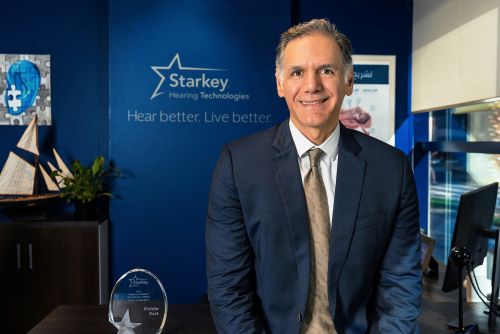
Starkey reiterated the regional availability of the world’s first hearing aids with a balance assessment feature embedded directly in the device. Starkey’s Edge AI platform which was launched in January 2025 in Dubai highlights the well-established link between untreated hearing loss and elevated fall risk, and demonstrates how advanced hearing technology can support proactive, whole-person care.
The balance assessment feature is based on the Centers for Disease Control and Prevention’s STEADI (Stopping Elderly Accidents, Deaths & Injuries) initiative. It includes a 12-question screening and functional assessments of gait, strength, and balance, all administered through the hearing aid. This innovation comes alongside Starkey’s industry-leading fall detection technology, pioneered to help address one of the most pressing health risks facing older adults today.
“In Middle East and Africa, we see an aging curve that’s accelerating faster than many expect, and falls remain a major cause of injury in older adults. By embedding motion sensors and AI into our hearing aids, we’re turning them into health and safety companions—screening balance, detecting falls, and giving clinicians actionable insights alongside premium sound,” said Giscard Bechara, Regional Director, Starkey Middle East & Africa. “This is about protecting independence as much as hearing—helping families and caregivers act before a fall becomes an emergency, we see many patients with hearing loss and balance issues and honestly it’s a lot of stress on the patient and their family”.
In the Middle East, the case for integrated hearing–balance solutions is compelling. Across the WHO Eastern Mediterranean Region, more than 22 million people already live with disabling hearing loss—a figure expected to exceed 52 million by 2050. At the same time, the Arab world is aging rapidly: people aged 60 and above are projected to comprise roughly 15% of the population by 2050, with the GCC approaching one in five residents in this age group by mid-century. In the UAE specifically, studies identify falls as a leading cause of trauma among older adults, highlighting the need for systematic screening and prevention.
Globally, falls are the second leading cause of unintentional injury deaths, with older adults bearing the greatest burden. Multiple studies also show that older adults with hearing loss face significantly higher odds of falling—further underscoring the importance of hearing technology that supports balance assessment and fall prevention.
“Using on-board motion sensors and AI, Starkey hearing aids guide users through a validated balance screening and functional checks for instance timed measures and stance tasks. Results, combined with the device’s fall detection, equip hearing care professionals to flag risk, coordinate referrals, and tailor counseling—without additional wearables or clinic hardware,” added Giscard.
The balance assessment and fall detection features are available through Starkey MEA’s network of partner clinics. Market availability, device compatibility, and feature sets may vary by country and require fitting by a licensed hearing care professional. Patients and caregivers can contact Starkey MEA’s authorized partners to book a combined hearing and balance screening.