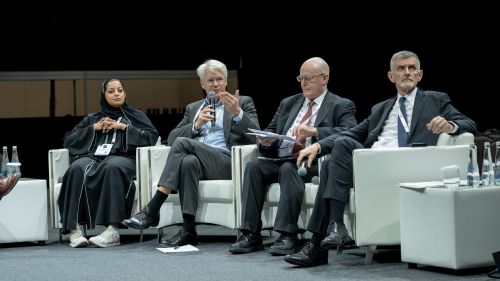
Day Four of the IUCN World Conservation Congress 2025 placed the spotlight on scaling ocean solutions, transforming global food systems, and mobilising finance for biodiversity, underscoring the Congress’s role as the world’s leading platform for turning conservation ambition into action.
Hosted by the United Arab Emirates and co-hosted by the Ministry of Climate Change and Environment (MOCCAE) and the Environment Agency – Abu Dhabi (EAD), the Congress, which runs from 9-15 October, continued to foster dialogue and discussions for actionable plans towards the Kunming–Montreal Global Biodiversity Framework and the 2030 climate and nature targets.
The morning opened with the 100% Alliance: Scaling Ocean Solutions for Global Impact, bringing governments, philanthropies, and science institutions together to fast-track marine protection and sustainable blue economy pathways. In parallel, the Members’ Assembly Global Meeting of all IUCN Member Committees set the stage for coordinated regional positions ahead of key motions.
Announcements on Day Four included the launch of the Nature-based Education Facility, supported by a $10 million in-kind contribution from Esri, and the release of a new IUCN Flagship Report exploring how to feed the world while restoring nature. Exhibitions and pavilions showcased innovations ranging from geospatial AI for conservation and scaling action on invasive species, to nature-positive urban frameworks and youth-led conservation research.
The most significant announcement of the day, however, was the unveiling of the venue for the IUCN World Protected and Conserved Areas Congress, the world’s leading forum on protected areas. Panama has been selected to host this landmark event, which influences global conservation priorities, marking an important milestone for biodiversity and sustainability efforts worldwide.
The UAE Pavilion hosted the Joint Biodiversity Forum, organised by ADNOC in collaboration with MOCCAE and EAD, under the theme ‘Learning from Nature, Acting for Nature’, convening leading voices to address urgent environmental challenges. The ‘From space to Sustainability’ panel, organised by the UAE University, explored how satellite technology and space-based data applications are transforming global environmental protection, drawing on real-world missions such as Arab Satellite 813 and next-generation hyperspectral systems like HyperX. The session highlighted the UAE’s lead in fostering international collaboration in environmental monitoring, where data sharing, joint missions, and scientific exchange transcend borders.
At the Forum, high-level dialogues underscored the urgency of system change. ‘Transformational change from Rio and beyond: An all-out push for the 2030 goals’ examined the need for coordinated global leadership to close the gap on biodiversity commitments, while ‘The Balancing Act: Feeding People, Sustaining the Planet’ advanced solutions for aligning food security with ecosystem restoration. Finance and innovation were central themes, with sessions on unlocking private finance for 30×30, powering blue finance in the Caribbean, and launching the GEF Small Grants Program CSO Challenge.
With Members’ Assembly debates intensifying and final motions approaching, Day Four outcomes are expected to drive enforceable agreements on food, oceans, and finance that will guide conservation action through 2030 and beyond.