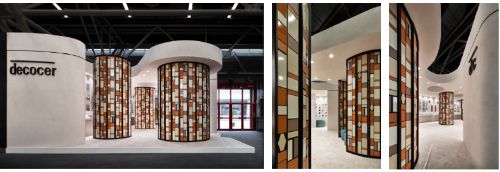
| The Decocer Pavilion – Echoes of the Earth, designed by Héctor Ruiz Velázquez for Cersaie 2025, is conceived as an architectural installation that celebrates the origin and essence of ceramics.It emerges from a large ceramic mass that opens at the corner with an organic, human gesture—a symbolic invitation to delve into the heart of the material. This initial movement defines the entire concept: clay, in its purest state, is transformed into living, plastic, natural, and tactile architecture.In just 65 m², the pavilion demonstrates how ceramics can transcend its traditional role as a surface material to become structure, space, and narrative. Its compact scale contrasts with the sculptural strength of the whole, creating a balance between craftsmanship and architecture.An architectural ecosystem inspired by natureThe space is conceived as a living architectural ecosystem, where materiality, form, and light interact in harmony. Three monumental ceramic cylinders, built entirely from custom small-format pieces by Decocer, rise within the interior as inhabitable sculptures that evoke tree trunks and define the spatial experience.The spatial journey is organized into three areas that establish different rhythms of perception:Entrance and transition hall, a threshold that awakens curiosity and leads inward.Pause area, a serene refuge nestled among the ceramic cylinders.Exhibition and conversation zone, where product, research, and dialogue converge.Every element of the pavilion is crafted from clay and ceramics: floors, walls, furniture, and sculptural pieces. Everything is architecture; everything is ceramic. A mirrored wall visually multiplies the depth and creates a powerful scenographic effect, while dramatic lighting accentuates textures and reliefs, projecting movement and transforming the perception of space as visitors move through it.Presentation of the new Decocer collectionsThe pavilion hosts the presentation of Decocer’s new collections, seamlessly integrated into the architecture of the space. The ceramic cylinders function as living display windows, where visitors can walk, touch, and inhabit the surfaces, establishing a direct connection with the material.More than an exhibition space, the pavilion becomes a sensory and emotional experience, where ceramics is understood as a material that builds, envelops, and communicates.This staging reinforces Decocer’s commitment to innovation, sustainability, and customization—values that define its small-format production model and its artisanal, contemporary approach.The Decocer Pavilion – Echoes of the Earth is structured around four pillars of innovation. First, ceramics becomes structure, transcending its traditional role as a surface material to define the architectural space. The modular and sustainable design allows for disassembly, transport, and reuse of the installation, ensuring its viability for future setups.Tactile immersion invites visitors to experience ceramics through the body—walking, touching, inhabiting—enhancing its sensory dimension. Finally, the architectural storytelling transforms the material into a living language, capable of expressing emotion, identity, and spatial narrative.A space that expresses Decocer’s identityThe Decocer Pavilion – Echoes of the Earth embodies the brand’s philosophy: tradition and contemporaneity, beauty and functionality, sustainability and emotion. In this intimate yet monumentally inspired space, ceramics stands as an immersive architectural experience that invites a rediscovery of its expressive power. More than a stand, it is a statement of principles—a material manifesto that conveys Decocer’s vision of ceramics as a medium to build, inspire, and inhabit. |
Echoes of the Earth, a design by Héctor Ruiz Velázquez for Decocer