Photo Credit: RTA
Dubai has taken a decisive step towards fully autonomous mobility with the launch of Baidu Apollo Go’s Autonomous Vehicles Operations and Control Centre, the first such facility established by the Chinese technology company outside China.
The 2,000-square-metre centre, located at Dubai Science Park, was inaugurated on Thursday by Mattar Al Tayer, Director General and Chairman of the Board of Executive Directors of Dubai Roads and Transport Authority, alongside Yunpeng Wang, Corporate Vice President of Baidu and President of Baidu’s Intelligent Driving Group.
Commercial autonomous ride-hailing services are scheduled to begin in the first quarter of 2026, with plans to gradually scale the fleet to around 1,000 vehicles.
Central hub for autonomous operations
Mattar Al Tayer, Director General and Chairman of the Board of Executive Directors of Dubai’s Roads and Transport Authority, and Yunpeng Wang, Corporate VP of Baidu and President of Baidu’s Intelligent Driving Group, inaugurate Baidu Apollo Go’s Autonomous Vehicles Operations and… pic.twitter.com/ye8RPMAe5L
— Dubai Media Office (@DXBMediaOffice) January 8, 2026
The new facility functions as a comprehensive command hub for managing driverless vehicles. It brings together command-and-control operations, simulation and training rooms, as well as operations and maintenance capabilities. The centre is designed to oversee safety testing, software updates, charging, maintenance, and real-time responses to operational requirements.
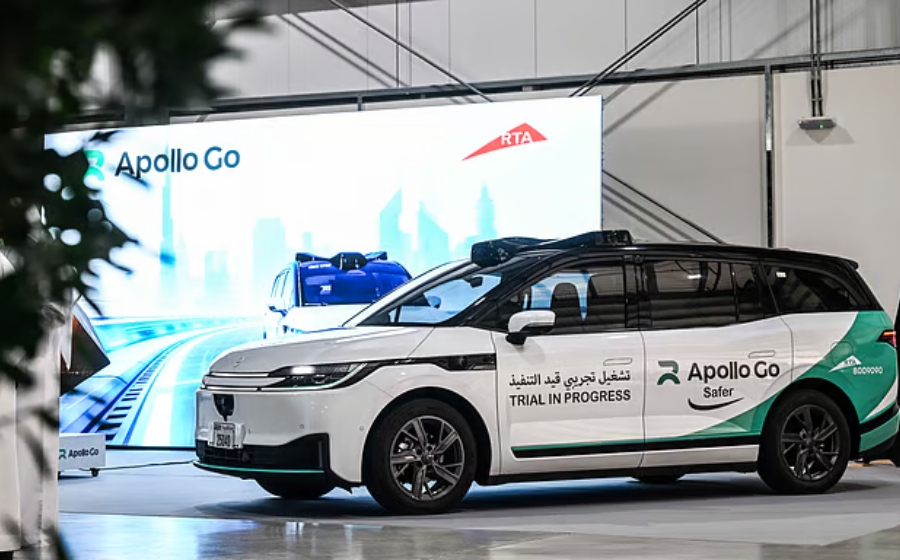
As part of the launch, RTA granted Baidu Apollo Go Dubai’s first permit authorising trials of fully autonomous vehicles on designated public roads without a safety driver behind the wheel.
Advancing autonomous mobility
During a tour of the centre, Al Tayer was briefed on its advanced systems, including intelligent road infrastructure integration, charging solutions, fleet inspections, component maintenance, and large-scale operational management. The facility also supports safety drivers through training, readiness checks, and operational support during testing phases.
The opening follows a Memorandum of Understanding signed between RTA and Baidu Apollo Go in March 2025 to enable large-scale autonomous taxi services in Dubai. This was followed by the issuance of the emirate’s first autonomous driving trial permit in July 2025 and the launch of pilot trials involving 50 RT6 autonomous vehicles on selected roads a month later.
Strategic milestone for Dubai
Al Tayer described the centre’s launch as a major milestone in Dubai’s smart mobility journey. He said the establishment of Apollo Go’s first overseas operations centre reflects global confidence in Dubai’s regulatory framework and the readiness of its smart infrastructure to support advanced autonomous vehicle technologies.
He added that issuing the first permit for fully driverless trials without a safety driver represents a qualitative leap, reinforcing Dubai’s commitment to flexible, forward-looking legislation that keeps pace with rapid technological change while maintaining the highest safety standards.
According to Al Tayer, the partnership with Baidu Apollo Go supports RTA’s wider vision to expand future mobility solutions, enhance road safety, reduce carbon emissions, and improve the overall efficiency of the emirate’s transport network.
Expansion beyond China
Baidu executives said Dubai’s supportive regulatory environment and advanced infrastructure were key factors in Apollo Go’s international expansion. Yunpeng Wang said the permit and the opening of the first overseas Apollo Go Park mark a significant milestone in the company’s long-term commitment to the UAE.
Liang Zhang, Managing Director for Europe, the Middle East and Africa at Baidu Apollo, said receiving Dubai’s first driverless vehicle trial permit demonstrates the maturity and safety of the company’s technology, adding that the new centre provides a strong foundation to localise operations and deliver sustainable autonomous mobility solutions for residents.
Proven global track record
Apollo Go’s entry into the UAE is backed by extensive global experience. The platform has logged more than 240 million kilometres of autonomous driving, including over 140 million kilometres in fully driverless mode. Operating across 22 cities worldwide, Apollo Go’s weekly ride volumes exceed 250,000 trips, with more than 17 million completed rides recorded as of October 31, 2025.