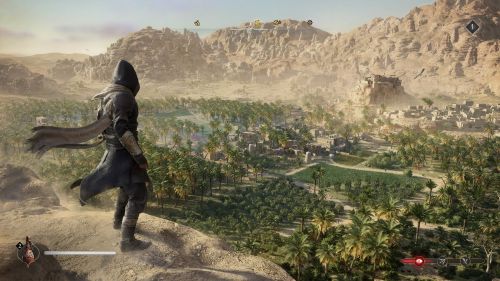
AlUla’s timeless landscapes and ancient archaeological wonders are prominently featured in Ubisoft’s latest release ‘Assassin’s Creed Mirage: Valley of Memory’.
The new ‘Valley of Memory’ expansion draws directly from AlUla’s stunning desert landscapes, life-giving oasis and monumental tombs of Hegra, Saudi’s first UNESCO World Heritage Site, weaving history into game design and narrative to create an experience that is richly researched and profoundly human. In this chapter, the lead character Basim Ibn Ishaq journeys with his friend Dervis to AlUla after learning of a painting by his estranged father, Is’haq Ibn Khalid.
Throughout development, developers and experts worked together to include key historical and architectural elements to recreate 9th century AlUla, while balancing gameplay needs. Ubisoft worked closely with leading scholars including Dr. Abdulrahman Alsuhaibani, Vice President of Culture at the Royal Commission for AlUla; Dr. Rebecca Foote, Director of Archaeology and Cultural Heritage Research at The Royal Commission for AlUla; and Dr. Ingrid Périssé-Valéro, Director of Archaeology, Heritage and Research, AFALULA.
Their guidance informed detailed architectural decisions: the shape and size of the tombs that still exist in modern-day AlUla, Saudi Arabia, the carvings that adorn them, stone selection and thickness, and how religious architecture may have looked thousands of years ago. In some cases, designers and experts agreed to add walls or climbable elements purely for level design, but without compromising the identity of the sites.
Additionally, educational content inside the game draws on images and artefacts from AlUla’s collections and international museums, grounding a fictional story in a rigorously researched backdrop. ‘Valley of Memory’ also integrates updated names of landmarks in AlUla, including the correct reading of the Tomb of Hayyan, Son of Kuza, reflecting the ancient language used in local inscriptions. The result is a careful, collaborative “dance” between scholarship and playability, where AlUla’s real topography and heritage shape the player’s journey.
AlUla’s landmarks that players can explore:
Lion’s Tomb: Based on the famed lion reliefs at Dadan, which visitors can still witness today, the in-game Lion’s Tomb is accurately recreated to showcase its intricate design, hand carved into the rock face. The seated lion sculptures symbolised power and protection and stand guard at what some believe is the burial place of an elite member of society.
AlUla Oasis: The lush oasis anchors the ‘Valley of Memory’ world visually and emotionally. Its greenery and richness reflect the oasis’ status as a vital stop on the ancient Incense Road, while Basim’s connection to the oasis underscores themes of lineage and belonging.
AlUla Fort in AlUla Old Town: The hilltop citadel overlooking AlUla Old Town is recreated with great attention to detail. In-game, it serves as a pivotal prison fortress, transforming authentic fortification elements into tense gameplay.
Elephant Rock: This natural sandstone monolith appears with its distinctive profile in the game.
Jabal Ikmah: Known as AlUla’s ‘open-air library’, Jabal Ikmah’s inscription-rich corridors are reproduced in the game, allowing players to witness pieces of history that are still preserved to this day.
Tomb of Hayyan, Son of Kuza: The game uses the correct, updated reading of the tomb’s name and emphasises the monument’s commanding height and refined Nabataean facade.
Jabal Ithlib: This ancient site within Hegra is known for its natural, narrow passage between the rocks, along with altars created for deities and a large carved a banquet hall – making it the perfect location in the ‘Valley of Memory’ gameplay.
Visit experiencealula.com to learn more.