Photo credit: HKSAR Government
Dubai, UAE — April 2026 — Two major technology exhibitions that concluded on Thursday have successfully cemented Hong Kong’s role as a bridge between Chinese Mainland innovation and global markets, drawing more than 88,000 buyers from 155 countries and regions.
The growing global focus on artificial intelligence and robotics is strongly reflected in the UAE, which has emerged as a regional pioneer in embedding these technologies into both government and industry.
As part of its strategy, the country has deployed AI across sectors including healthcare, transportation, and smart city infrastructure. Dubai, in particular, has integrated robotics into police operations, logistics, and customer service, while Abu Dhabi has invested heavily in AI-driven healthcare diagnostics and autonomous mobility solutions.
InnoEX, jointly organised by the Innovation, Technology and Industry Bureau of the Hong Kong SAR Government and the Hong Kong Trade Development Council, along with the HKTDC’s Hong Kong Electronics Fair, brought together industry elites over four days, with overseas buyers, according to a press release.
Jenny Koo, deputy executive director of the HKTDC, said the concurrent fairs leverage Hong Kong’s unique advantage in connecting the Chinese Mainland with the world, assisting mainland enterprises in expanding overseas while offering global companies a springboard into Asian and Chinese mainland markets.
She noted that the events promote Hong Kong’s development as an international innovation and technology hub, fostering cross-industry exchanges and application transformation.
Both exhibitions align with China’s 15th Five-Year Plan and the innovation and technology policies outlined in the Hong Kong Government’s latest Budget, with a strong emphasis on cutting-edge technologies and AI-driven market applications.
A major highlight was the newly launched RoboPark, which featured more than 100 robots across diverse application scenarios and brought together tech companies from Hong Kong, the Chinese Mainland and overseas.
UBTECH, the world’s first listed humanoid robot company and one of the top five global humanoid robot vendors by sales, engaged with potential buyers from the Chinese Mainland, the United States, Europe and Southeast Asia, reporting results that far exceeded expectations and underscoring the fair’s strong international reach.
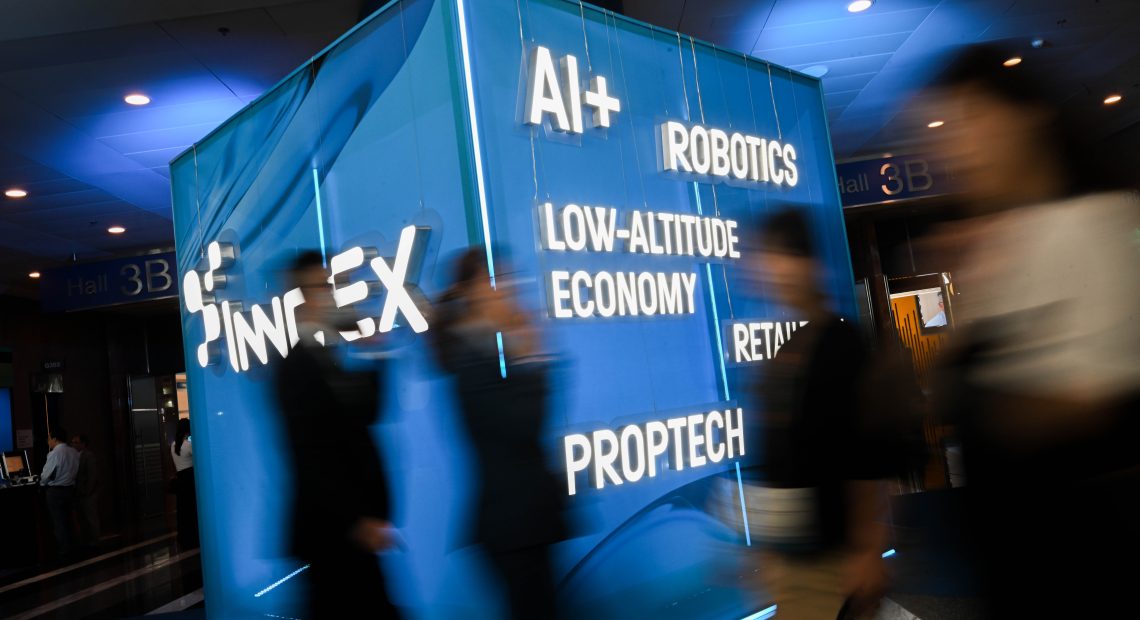
InnoEX focused on five key areas including AI+, Robotics, the Low-altitude Economy, Property Technology and Retail Technology, showcasing innovations from 21 countries and regions.
The UK Pavilion and Macao Pavilion both saw strong buyer turnout, with Macao exhibitors alone holding more than 280 business meetings during the first three days.
Major technology enterprises such as Huawei, China Mobile Hong Kong, HKT and Lenovo participated, with Huawei concurrently organising Huawei Hong Kong Tech Week 2026, featuring 12 themed events that generated strong synergy with InnoEX.
The Chinese Mainland pavilions comprised 17 provinces and municipalities, including the Zhongguancun Beijing Hong Kong-Macao Youth Innovation Center, which reported that its 10 high-quality tech enterprises attracted strong interest on the first day from Brazil, Germany, India, Japan, Malaysia, South Korea and the Middle East.
The Hong Kong Electronics Fair showcased three major areas of smart home solutions, health tech and gadgets, and pet intelligence, with approximately 60 products making their debut.
HelloBaby, a local company specialising in baby monitor products, participates annually and noted that its buyers come mainly from Japan, Korea, Singapore and other Asian markets.
Australian automotive electronics manufacturer Carmate Electronics Pty Ltd successfully connected with high-quality buyers from Brazil, Mexico, Belgium and Indonesia, recording potential transactions of around $200,000 on the first day and expecting follow-up orders to reach $400,000 to $500,000.
Michael Lin, the company’s general manager, said that amid heightened China-US tensions, Hong Kong’s unique role as an international platform has positioned the city as an important bridge generating valuable business opportunities, confirming his company’s participation again next year.
Beyond sourcing, buyers gained valuable industry insights. Pari Jazz, a buyer from Germany-based P.J Global Way Management Ltd, said the exhibition enabled her to place orders while staying abreast of latest market trends, arranging around 12 business meetings and identifying two to three promising potential partners.
The fairs featured more than 100 events with over 260 speakers decoding industry trends. In the AI+ area, the Hong Kong Computer Society co-organised a session on enhancing workplace performance with representatives from HKT Limited, Lenovo and CLP.
InnoEX also co-organised the first Low-altitude Economy Development Conference with the Working Group on Developing Low-altitude Economy and the Greater Bay Area Low-altitude Economy Alliance, featuring distinguished guests including Michael Wong, deputy financial secretary of the HKSAR, and Bakhtiyar Mukhametkaliyev, vice minister of Artificial Intelligence and Digital Development of Kazakhstan.
Another thematic seminar, “Embodied AI in Robotics: The Dawn of Autonomy,” explored how AI-driven robotics are transforming industries such as education, entertainment and services.
According to surveys conducted by an independent institution interviewing 347 InnoEX participants and 648 Electronics Fair participants, 81 percent of respondents expressed interest in expanding into emerging markets including Europe, ASEAN, the Chinese Mainland and Latin America, while 78 percent indicated their companies have already explored or adopted generative AI technologies.
Among generative AI applications, 42 percent of InnoEX respondents said they have applied or plan to apply it to sales and customer communications, 40 percent to data analysis and reporting, and 39 percent to product design and research and development.
At the Electronics Fair, 59 percent of respondents expect overall sales revenue to increase in the next one to two years, and 33 percent believe consumers are willing to pay a premium of 11 to 20 percent for products supporting smart home or artificial intelligence applications compared with traditional electronics.