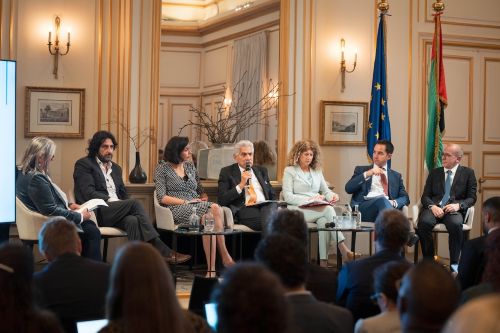
The UAE Embassy in Brussels alongside Dubai Humanitarian and the European Commission’s Directorate-General for European Civil Protection and Humanitarian Aid Operations (DG ECHO), co-hosted a panel discussion on Humanitarian Supply Chain Resilience in a Volatile Geopolitical Landscape, amid escalating global tensions affecting supply chains.
Held in Brussels and bringing together more than 80 senior representatives, from the European Union, the UAE, UN agencies, NGOs, humanitarian logistics experts, and private sector stakeholders, the high-level dialogue addressed mounting pressures on global humanitarian supply chains and explored collaborative approaches to ensure operational continuity and sustained humanitarian access during crises.
In the opening remarks, H.E. Mohammed Ismail Al Sahlawi, UAE Ambassador to the Kingdom of Belgium, the Grand Duchy of Luxembourg, and the European Union, said: “Millions of people around the world depend on food, fuel and medicine delivered through the Strait. This latest crisis in the Hormuz is not the first time we are seeing supply chains disrupted. Since the shockwaves caused by COVID, the UAE has been working with our European partners to ensure we are better prepared for emergencies and that humanitarian deliveries are more resilient. Our event today allowed us to take stock of lessons and to identify new opportunities to future-proof our systems.”
Maciej Popowski, Director-General, Directorate-General for European Civil Protection and Humanitarian Aid Operations (DG ECHO), said: “Resilience is built through collaboration. The experience of recent months has confirmed the importance of working together to address humanitarian challenges. We need to move from siloed and often disconnected supply chains towards a coordinated and integrated network – a system that enhances preparedness, adaptability and efficiency of humanitarian action. This is key to withstanding future shocks and ensure that life-saving assistance reaches those who need it most. In a volatile geopolitical environment, the EU remains a reliable, principled, leading humanitarian actor – committed to strengthening partnerships. Today’s discussion organised jointly with the UAE and Dubai Humanitarian is intended to catalyse broader engagement and help strengthen the collective resilience of our humanitarian system.”
Commenting on the timely event, Guiseppe Saba, CEO of Dubai Humanitarian, said: “Humanitarian action depends today more than ever on our ability to adapt and collaborate across borders and systems. In an era defined by volatility and constrained access, the strength of our response lies in the resilience of our partnerships, the preparedness of the humanitarian ecosystem and the efficiency of our logistics networks. This dialogue with our European counterparts reinforces the shared responsibility we carry to protect humanitarian supply chains. It also reflects the mission of Dubai Humanitarian to support the international humanitarian action through a global safety net, ensuring aid delivery remains uninterrupted, predictable, and focused on those most in need.”
Addressing Growing Pressures on Global Humanitarian Supply Chains
The dialogue examined the increasing impact of conflicts, maritime insecurity, airspace restrictions, and broader supply chain disruptions on humanitarian operations worldwide.
Participants explored how strengthened international collaboration, more resilient logistics infrastructure, and adaptive humanitarian corridor mechanisms can help safeguard the timely and reliable delivery of life-saving assistance to vulnerable populations.
Strengthening UAE–EU Humanitarian Cooperation
The event reflected the growing strategic cooperation between the UAE and the European Union in the humanitarian field, building on the 2025 Administrative Arrangement between DG ECHO and Dubai Humanitarian.
Since then, both entities have been advancing closer coordination across humanitarian operations, including the use of shared humanitarian hubs, the development of a global humanitarian safety net, the exchange of information and best practices, support to local community preparedness, and mutual operational support among humanitarian hubs worldwide.
Showcasing Dubai Humanitarian’s Operational Continuity Model
The discussion drew on operational insights from the Dubai Humanitarian community, which has played a critical role in sustaining aid flows to crisis-affected regions including Gaza, Lebanon, and Afghanistan, and many other countries despite escalating regional instability.
Through its integrated logistics ecosystem, pre-positioned stockpiles, and coordinated partner network, Dubai Humanitarian demonstrated how resilient humanitarian hub models can ensure continuity of operations even when traditional supply routes are disrupted.
Rethinking the Future of Humanitarian Response Systems
The panel underscored the growing importance of international cooperation, humanitarian emergency preparedness, and humanitarian diplomacy at a time when needs are rising faster than the capacity of traditional response systems. Moderated by Sarah Muscroft, Chief of the Response Support Branch, UN OCHA, the panel included: Giuseppe Saba, CEO & Board Member, Dubai Humanitarian, Michela Matuella, Director, Emergency Response Coordination Centre, DG ECHO, Christian Lungarotti, First Counsellor, the Permanent Representation of Italy to the EU, Walid Ibrahim, Network Coordinator, UN Humanitarian Response Depot (WFP/UNHRD), Cecile Terraz, Global Director of Humanitarian Services & Supply Chain Management, IFRC, and Jean‑Baptiste Lamarche, Co‑Founder & CEO, Hulo.
Building on the humanitarian expertise, policy leadership and operational agility and logistics capabilities of both the EU and the UAE, the panel highlighted opportunities to reshape humanitarian delivery by enabling faster response times, more reliable aid corridors, and stronger preparedness for future crises.
The panel further examined key pillars required to future-proof humanitarian logistics systems, including resilience, preparedness, adaptability, digitalisation, localisation, and multi-stakeholder coordination. It also provided a platform to identify operational gaps and explore opportunities for deeper engagement between European humanitarian actors and Dubai Humanitarian’s capabilities.
Held under Chatham House Rules to encourage open and constructive dialogue, the exchange supported more coordinated and systemic approaches to humanitarian supply chain continuity in complex and evolving emergencies.
The event concluded with a shared recognition of the need to strengthen collaborative frameworks that ensure humanitarian assistance remains uninterrupted, efficient, and responsive to urgent global needs.