
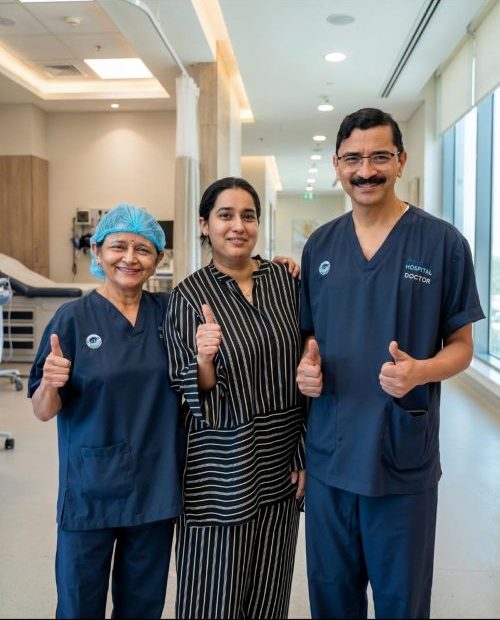
Aster Hospital, Al Qusais, has successfully managed a highly complex and rare cardiac case on a 32-year-old patient, Mahpara Ashraf, a Pakistani national who underwent an emergency redo coronary artery bypass grafting (CABG) procedure just six months after her initial surgery, which was performed elsewhere.
This case highlights the hospital’s expertise in handling high-risk and complex cardiac surgeries through specialized surgical expertise, careful planning, and coordinated care. It also demonstrates the strength of a multidisciplinary approach, where cardiac surgeons, cardiologists, anesthesiologists, and critical care teams worked together to achieve the best outcome.
The case reinforces an important message for patients and families: even highly complex second heart surgeries can be successfully treated with timely intervention, experience and the expertise of treating team. This is especially relevant for patients with advanced cardiac disease and those seeking specialized cardiac care.
Mahpara, a Dubai resident, had multiple co-morbid conditions including diabetes, high blood pressure, high cholesterol, and severe coronary artery disease. In May 2025, she underwent a stent procedure (PTCA) to one of the heart arteries, followed by bypass surgery (CABG) in June 2025 in Pakistan. However, while in Dubai, she began experiencing severe chest pain again and was referred to Aster Hospital, Al Qusais for further evaluation.
Repeat coronary angiography (CAG) revealed several blockages in her native coronary arteries, as well as critical blockages in the previous bypass grafts. However, only one of her bypass grafts remained functional. She was admitted with unstable angina, a condition that can lead to a massive heart attack if not treated urgently. Her multiple comorbidities, along with ongoing chest pain, further increased her surgical risk.
The hospital’s expert cardiac surgical team performed an emergency redo CABG on a beating heart. Another challenge was finding suitable blood vessels to create new bypasses, as vessels used in the first surgery were no longer available.
Redo bypass surgeries are rare, accounting for only about 2% of such procedures globally.1 Performing a repeat surgery within just six months, particularly in a young female patient, makes this case exceptionally uncommon. The complexity was further increased as the patient required emergency surgery and was on blood-thinning medication.
Coronary artery bypass grafting (CABG) is predominantly performed in men, with males accounting for approximately 70% to 80% of all procedures globally, while women comprise only 20% to 30% of the CABG patient population. The lower prevalence in women has historically been attributed to the cardiovascular protective effects of estrogen before menopause. Despite representing a smaller proportion of CABG patients, women consistently experience higher postoperative mortality rates and poorer clinical outcomes compared to men, often presenting at an older age and with more advanced cardiovascular disease and multiple pre-existing health conditions.[1] The fact that this patient was a 32-year-old and a woman requiring an emergency redo CABG within six months of her initial surgery makes the case particularly rare and clinically significant.
Dr. Sandeep Shrivastava, Consultant Cardiothoracic Surgeon at Aster Hospital, Al Qusais, said: “This was a highly challenging and rare case. Performing a redo bypass surgery within such a short time frame, and that too on a beating heart, requires a high level of experience & surgical expertise. The second time surgery, presence of prior grafts, and the patient’s unstable condition added to the complexity. Our team carefully planned every step, and complete revascularization with four grafts is expected to provide a long-term durable outcome.”
Her post-operative recovery was uneventful.
Dr Shipra Srivastava, Consultant Cardiothoracic Surgeon at Aster Hospital, Al Qusais, said “This case is rare for multiple reasons. Our patient was only 32 years old and female, with multiple pre-existing medical conditions. Within just six months, all except one of her grafts were completely blocked. Globally, the prevalence of CABG in females accounts for only 20–30% of cases.”
Dr. Abdul Rauoof Malik, Specialist Cardiology at Aster Hospital, Al Qusais, added: “This case reflects a growing trend where younger patients are developing serious heart disease due to conditions like diabetes, hypertension, and high cholesterol. It also highlights the importance of timely follow-up after previous heart procedures. With proper evaluation and a team-based approach, even high-risk redo surgeries can be performed successfully at Aster Hospital, Al Qusais.
Expressing her gratitude, Ms. Mahpara Ashraf said: “I am truly grateful to the doctors and staff at Aster Hospital, Al Qusais for saving my life. I was very worried when my chest pain came back so soon after my first surgery, but the cardiac surgical team handled my case with great care and confidence. Their support throughout my treatment and recovery means everything to me.”
This successful case demonstrates Aster Hospital, Al Qusais’ exemplary cardiac surgery facility and its proficient team in delivering excellent short- and long-term outcomes even in complex and challenging cases.