Photo Credit : AFP
Dubai’s ambitious expansion of Al Maktoum International Airport is progressing on schedule, with the first phase of the mega project set to become operational in 2032, according to Sheikh Hamdan bin Mohammed bin Rashid Al Maktoum, Crown Prince of Dubai, Deputy Prime Minister and Minister of Defence, and Chairman of The Executive Council of Dubai.
In a post on X, Sheikh Hamdan said contracts valued at Dh13 billion are currently under execution, while construction teams have completed more than 10 million work hours during the past 15 months. He added that additional strategic contracts worth over Dh55 billion are expected to be awarded in the coming months, advancing Dubai’s vision for what is expected to become the world’s largest airport by passenger capacity.
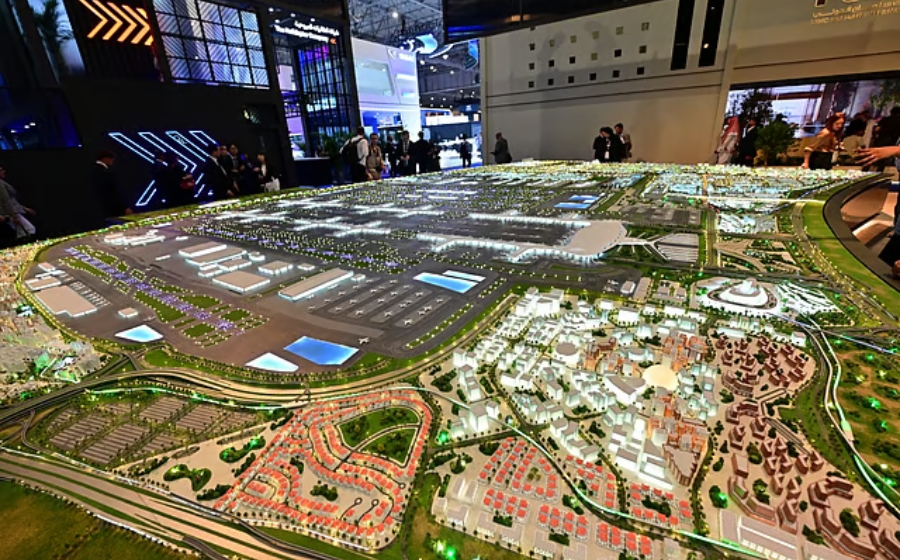
Designed to accommodate more than 260 million passengers annually upon full completion, Al Maktoum International Airport will play a key role in supporting Dubai’s long-term economic growth and strengthening its position as a leading global aviation hub.
The airport, located in Dubai South, forms a central part of the emirate’s future transport strategy. As passenger numbers continue to grow, Dubai plans a gradual transition of major passenger operations from Dubai International Airport (DXB) to Al Maktoum International Airport. DXB is projected to reach its maximum capacity of around 115 million passengers by 2031, while the new airport is expected to handle approximately 124 million passengers during its initial major operating phase.
Spanning around 70 square kilometres, the development will feature five parallel runways and 400 aircraft gates, providing significant capacity for airlines, cargo operators and logistics companies. The site is approximately five times larger than Dubai International Airport and is being developed as a major aviation, logistics and commercial hub.
The project is also expected to accelerate growth across Dubai South, with residential communities, commercial districts and logistics facilities planned around the airport. Future Dubai Metro connectivity is set to further strengthen the area’s role as a major economic corridor.
As Dubai prepares for the next phase of aviation growth, airlines are expected to gradually shift operations to the new facility. Flydubai is anticipated to be among the first carriers to relocate, while Emirates continues to operate an average of 1,500 weekly passenger departures from DXB alongside around 70 weekly freighter services from Al Maktoum International Airport.
The expansion is aimed at ensuring Dubai remains prepared for rising global travel demand while enhancing passenger experience, cargo capacity and long-term economic competitiveness.