Between 2020 and 2024
According to new data released by the Stockholm International Peace Research Institute (Sipri), Ukraine emerged as the world’s largest importer of major arms between 2020 and 2024, with its imports increasing nearly 100-fold compared to the 2015–2019 period.
The surge in Ukraine’s arms imports is primarily attributed to the ongoing conflict with Russia, which escalated with Russia’s full-scale invasion in February 2022. In this new global arms landscape, European arms imports have also experienced a significant rise, increasing by 155 per cent over the same timeframe, reflecting broader regional insecurity and the shifting dynamics of international military alliances.
This dramatic growth in arms imports comes amidst a series of global geopolitical shifts, particularly in response to Russia’s aggression and the uncertainty surrounding the future direction of US foreign policy.
Sipri’s analysis indicates that the volume of global arms transfers remained relatively stable between 2015 and 2024, compared to previous years, with significant growth in some regions offset by decreases in others. European nations, mainly NATO members, have sharply increased their reliance on arms imports, particularly from the United States. This comes as the US boosted its share of global arms exports to 43 per cent, while Russia’s exports experienced a substantial decline, falling by 64 per cent.
Ukraine’s arms imports in the 2020–24 period accounted for 8.8 per cent of global arms imports, with the vast majority of these supplies coming from the US (45 per cent), followed by Germany (12 per cent) and Poland (11 per cent).
US dominates
The United States remains the dominant global supplier, having significantly expanded its arms exports by 21 per cent from 2015–19 to 2020–24. US arms exports were directed to 107 countries in this period. Europe now receives the largest share of American arms (35 per cent), surpassing the traditional recipient region, the Middle East, which received 33 per cent.
Despite the US securing its place as the world’s leading arms exporter, Russia’s falling exports have highlighted its diminishing influence on the global arms market. Russia, which once accounted for a significant portion of global arms exports, sharply decreased its market share.
The decline began before Russia invaded Ukraine, as Russian arms exports had already been on a downward trajectory during 2020 and 2021. The impact of international sanctions and increasing demand for weapons to fuel the war effort has made it more difficult for Russia to sustain its weapons trade.
While Russia’s arms exports to its traditional clients, such as India, China, and Kazakhstan, have continued, the sharp drop in overall sales signals a broader reorientation of global arms trade.
In recent years, India, which has long been a major importer of Russian arms, has increasingly turned to other suppliers, notably the United States and France. China, similarly, has reduced its reliance on Russian arms, choosing to boost its own growing arms industry.
For its part, France has seen an increase in arms exports, becoming the world’s second-largest arms exporter between 2020 and 2024. France’s exports surged by 187 per cent to other European countries, mainly driven by arms supplies to Greece, Croatia, and Ukraine. India remains the largest recipient of French arms, with nearly 30 percent of its arms exports going to the South Asian nation, underscoring the strategic importance of arms trade in maintaining alliances.
In Asia, the shifting landscape is particularly pronounced. Arms imports to the Asia-Oceania region dropped by 21 per cent between 2015–19 and 2020–24. This decline was primarily driven by China’s drastic reduction in imports, which fell by 64 per cent, as the country increasingly turned to indigenous weapons production.
India role
Despite this drop, countries like India, Pakistan, Japan, and Australia remain major arms importers, with India as the second-largest global arms importer. This shift is primarily driven by regional security concerns, particularly the perceived threat from China.
Arms imports to the Middle East have also seen notable trends. The region experienced a decline of 20 per cent in arms imports between 2015–19 and 2020–24, despite the presence of major importers such as Qatar, Saudi Arabia, and Egypt.
Qatar, in particular, emerged as the third-largest arms importer globally, while Saudi Arabia saw a significant drop in its imports, which fell by 41 per cent. A substantial portion of the arms supplies to the Middle East still comes from the US, accounting for more than half of the region’s imports, underscoring the enduring influence of the US arms industry.
At the same time, Africa’s arms imports have experienced significant declines, particularly in North Africa, where imports from Algeria and Morocco fell sharply. However, the security situation in West Africa has led to increased arms imports, with countries such as Nigeria, Mali, and Senegal seeking to boost their defences amid escalating regional instability.
Sipri noted that while the volume of arms imports to West Africa remains small, the geopolitical implications of these rising imports are profound, particularly as new arms suppliers like Turkey and China continue to increase their presence in the region.
The global arms trade is undergoing a significant transformation, with shifting alliances, security concerns, and geopolitical rivalries reshaping the landscape of international arms transfers. As Ukraine imports vast arms to support its defence efforts, the global arms market remains a key battleground for influence and power among the world’s leading military powers.
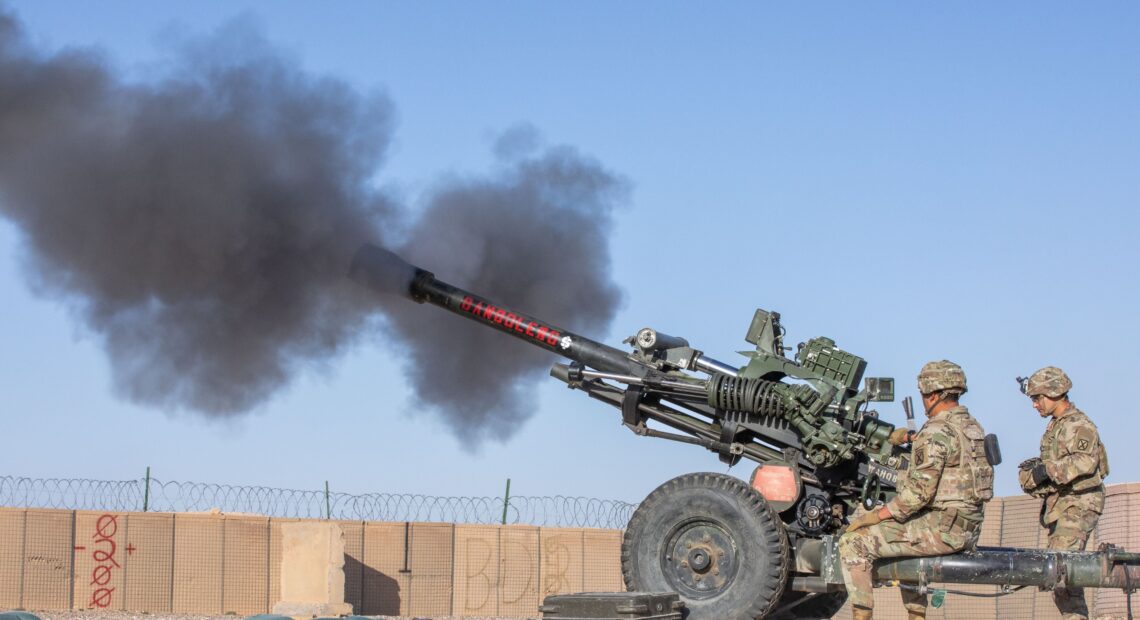
Image: US Army soldiers with the 10th Mountain Division fire an M119 Howitzer during a live fire exercise in the US Central Command area of responsibility. Credit: USCentcom