In a well-curated push
In an exclusive interview, Anthony Behan, Global Managing Director for Communications, Media & Entertainment at Cloudera, shares insights on how the company is enabling telecom and media firms—especially across the Middle East—to transition into digital-first enterprises.
Speaking about hybrid data platforms, AI deployment, and region-specific challenges, Behan reflects on Cloudera’s role in helping the sector unlock new value through data-driven innovation.
Excerpts from the interview, which have been edited for clarity and brevity:
What does your current role at Cloudera entail?
I lead the telecom, media, and entertainment business at Cloudera, our second-largest industry cluster after banking.
How does Cloudera’s hybrid data platform enable telecom providers to modernise legacy billing and network systems effectively?
‘Modernisation’ can mean many things, such as operating on virtualised infrastructure, both public and private; operating at scale in terms of volume, velocity, and variety of data; and being well-governed, secure, and compliant with increasingly onerous regulations.
Most of all, ‘modernised’ means being ready for the opportunities presented by AI and automation. Cloudera achieves this by providing an open, scalable, and proven platform that the world’s largest enterprises and governments rely on.
How is Cloudera ensuring ethical and responsible AI deployment in customer-facing applications?
Cloudera places an enormous emphasis on governance and what we refer to as a trusted data platform. This means it is secure, robust, and scalable, so it can be relied upon to serve the business’s needs, no matter how intense they become.
It also means there is auditability, support for explainability, and traceability, so when the data is used to automate decision making, Cloudera customers can easily identify how those decisions were arrived at.
What innovative approach does Cloudera take to data monetisation for telecom operators—what sets it apart?
There are two forms of data monetisation – internal and external. For internal data monetisation, we have clients worldwide quantifying the returns on data investments by demonstrating how costs were saved in areas such as network operations and customer retention, which is extremely important.
For external data monetisation, it is all about ecosystems and collaborating with third parties to make the valuable data of the telco available in the right ways. Our Shared Data Experience layer enables Cloudera customers to implement features such as ‘masking’ and ‘tokenisation’ to protect privacy and ensure that data is shared securely and appropriately.
Similarly, Cloudera customers utilise the environment to develop value-added services, such as SLA support for enterprise customers and dashboards for IoT customers.

How does Cloudera help CSPs (Communication Service Providers) use data for improving customer experience and reducing churn?
Cloudera is a hybrid data cloud platform that operates on multiple levels within the telco industry. As a result, a single Cloudera environment can support customer data in one domain, such as a public cloud, and network data on-premises. That is a typical scenario. Combining the two provides a holistic view of customer experience.
This consists of ‘passive’ customer experience data, which refers to the experience when consuming the service, and ‘active’ customer experience data, such as when a customer attempts to manage the service, including topping up a prepaid phone, paying a bill, or reporting a fault.
Once this understanding has been modelled, it can be used to automate customer retention strategies around campaigns, communications and offers.
What are some use cases where Cloudera’s data solutions have directly enhanced marketing automation or digital advertising for clients?
MTN is an excellent example of a Cloudera customer, operating across 24 countries in Africa and the Middle East, who saw campaign adoption increase by 186% after implementing the solution.
For a cable customer, Cloudera deployed data processing agents into the set-top boxes to measure audiences for digital advertising market management. Lastly, in one of the world’s largest streaming companies, Cloudera forms the platform for all customer recommendations and offers.
How is Cloudera supporting 5G-related analytics, especially in areas like network performance and edge intelligence?
LG UPlus in South Korea rolled out one of the world’s first commercial 5G networks in 2019, and it was all based on Cloudera to manage service assurance data.
One of the key benefits of the hybrid data cloud architecture was that they were able to combine 4G, 3G, and wireline service assurance data with the new 5G service data, dramatically reducing their cost of operations, but also – crucially – having one environment where they could design the rollout of the new network, and the decommissioning of the old 3G network.
What role does Cloudera play in enabling AI-powered service assurance across telco networks?
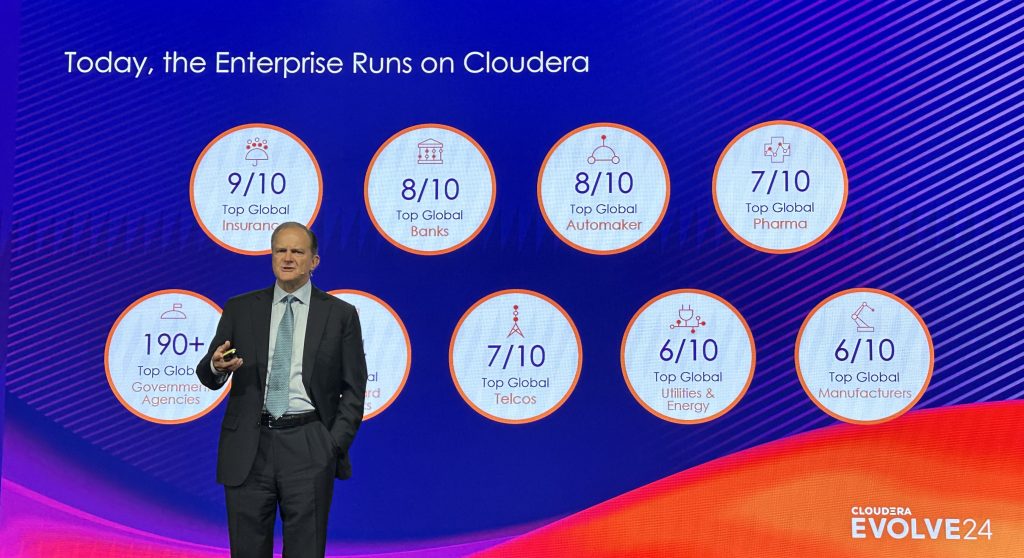
Cloudera operates with most of the world’s largest telecommunications companies, including 85 of the top 100, and in many of these, it serves as a core workload for network analytics.
Historically, this was used for root cause analysis, network planning, and other assurance functions. Increasingly, however, our customers are looking at this environment to drive network automation.
One of our customers is now exploring AI agents in the network to automatically detect anomalies in core network behaviour, classify them automatically based on those classifications, and pass the anomalies to event management agents that can automate the network operations required, such as configuration changes. This dramatically reduces the mean time to repair (MTTR) and delivers real value to the business.
How is Cloudera helping telcos integrate emerging technologies at scale?
Everything begins with data, and the platform, as an open environment with scale by design, is synonymous with innovation. Without data, there is no AI, and Cloudera AI is enabling innovation in telecommunications companies worldwide.
How is Cloudera helping media organisations manage and analyse massive content libraries for improved discoverability and engagement?
Understanding consumer behaviour around content is critical to realising its actual value and potential, not just as library objects in and of themselves, but also about other library elements and as part of clusters within a demographic.
Not all demographics have the same clusters of interests, and while (for example) a Latino group may have an interest in a murder-mystery movie starring Antonio Banderas, they may not have an interest in a murder-mystery starring Bryan Cranston.
Similarly, clustering and associations are ephemeral and changing, so having a dynamic, constantly refreshing, and learning understanding of how content relates to other content in the context of different consumers is essential to an intimate knowledge of consumer preferences.
What advice do you offer to telecom and media leaders looking to kick-start their AI journeys using Cloudera’s ecosystem?
Experiment as much as possible in the public cloud, as it is fast and easy. However, plan your enterprise production deployments by starting with data and governance.
Consider delivering value through data first by making data assets available to the organisation in a well-governed manner, and encourage them to experiment as well. Many AI projects fail to transition to production because the necessary data is not available or the required governance is not in place, even if the model appears to work perfectly well.
Cloudera is known for its open-source foundation. How important is this to your clients in regulated or high-compliance industries?
Hugely important. Cloudera’s support for the Apache Software Foundation and its projects dates back over 20 years. Today, we have several dozen open-source projects that form the core of the Cloudera platform.
Our open philosophy extends beyond open source; our open APIs and other components facilitate open integration and enterprise solutions. It means that for regulated and highly compliant industries, it is easier to build solutions that comply and are endorsed by peers.
What role do you see for data platforms like Cloudera in helping telcos transform into digital-first enterprises?
There are different names for it – digital-first is one, AI-native is another, and telco to techco is yet another. But they all begin with data.
If you do not have a well-governed data platform at the core of your business, this transition will not even get started. You may have silos of vertically integrated solutions, such as a digital contact centre or a digital billing system. Still, when it comes to integrated support, provisioning, or acquired-company integrations, things fall apart very quickly.
So, from the ground up, begin with data, and everything will be so much easier!
How is Cloudera tackling real-time data processing needs for communications and media use cases?
Cloudera Data Flow, powered by NiFi, Flink, and Kafka, is the industry standard for real-time, high-performance data processing. The volumes and speeds of data we are seeing now mean that it is often the case that if you do not process the data in real-time, then you do not process it at all.
For example, one customer processes 3PB of data a day, primarily in structured data records. Think about how much data that is! It is hundreds of billions of records every single day. Flink in particular is a secret weapon here.
That project enables clients to stream data extremely quickly, and with Cloudera’s SQL Stream Builder (SSB), you can insert programmatic control into the stream. This means that before the data is written to disk, you can perform simple tasks, such as field truncation, which dramatically reduces the amount of data being processed. It also means that you can do things like in-stream AI, but that is another story!
What are the top technology trends you believe will reshape the communications and media industries in the next five years, and how is Cloudera preparing for them?
Is AI too short an answer? It is obvious, but it is also a big kahuna. AI as a set of applications, AI as a tool for doing data work, and AI as a demand driver for ever more quantities of data – that is what drives everything data-related now.
The other will be regulation. Governments and regulators now understand the centrality of data in tomorrow’s economies and are increasingly asserting more control over how data is managed and governed. This will lead to increased demands for security, sovereign data control, and stricter compliance requirements.
How different or similar is the Middle East African market compared to the rest of the world in terms of communications, media, and entertainment?
The Middle East and Africa comprise numerous distinct markets, ranging from mature markets such as the UAE and Saudi Arabia to emerging markets in Central Africa. Wireless technology dominates, although a few legacy twisted-pair and copper networks remain in use.
Fibre is also beginning to find niche points of value. The market for wireless prepaid services is distributor-led, which is somewhat different from the more direct markets in Europe, for example. Security regulations often mean that data jurisdiction is a crucial consideration as well.
What are the typical pain points of Cloudera’s customers in the Middle East region?
Much the same as the rest of the world, customer acquisition and retention, ARPU growth, and cost control are the typical pain points.
Thankfully, Cloudera has a core offering that drives each of these metrics in a positive direction, allowing our customers to remain loyal and enabling us to grow rapidly in the region.

What unique challenges and opportunities do you see for telcos and media companies in the Middle East and Africa, and how is Cloudera addressing them?
Understanding how to leverage virtualisation and public cloud will unlock significant value for MEA telcos. The supply times for hardware and the overhead of managing fixed-cost data centres are challenging, though; if any industry in the world should be able to optimise this kind of work, it should be the telco industry.
Tapping into the agility of public cloud could be a game-changer.
How does Cloudera view the Middle East region in terms of AI integration at the enterprise level?
The opportunity is phenomenal. Not only can AI help telcos operate more efficiently than ever before, but telcos can also help other industries leverage the benefits of AI, given their pivotal role in the regional ecosystems and economies.
Being an innovator in the SaaS vertical, what led you to join Cloudera?
It was the people. It is always the people. It is what led me to the telecommunications industry as well. People make AI successful, people make telco successful, and working with good people makes each of us simply better!
Hero image: Anthony Behan, Global Managing Director for Communications, Media & Entertainment at Cloudera. Credit: Cloudera