Image Credit : RTA
The future of mobility in Dubai is accelerating and fast. From underground hyperloops to flying taxis, smart roads, and next-generation metros, the emirate is reimagining urban transport for a faster, cleaner, and more connected future.
With national and local projects worth hundreds of billions of dirhams underway, Dubai’s transport infrastructure is on the brink of a historic transformation that promises to ease congestion, reduce travel times, and make everyday commuting remarkably efficient.
Here’s a look at the nine key projects shaping the future of travel in Dubai.
1. Dh170 Billion National Road Network Upgrade
While part of a federal initiative, Dubai motorists will see a major difference on the roads.
The UAE Ministry of Energy and Infrastructure has launched a Dh170 billion programme to upgrade the national transport and road network by 2030 boosting connectivity and cutting congestion across the Emirates.
Highlights include:
- Emirates Road: Expanded to 10 lanes, increasing capacity by 65% and cutting travel time by 45%.
- Sheikh Mohammed bin Zayed Road: Widened to 10 lanes, enhancing capacity by 45%.
- Etihad Road: Six new lanes (three each way), bringing total capacity up by 60%.
These upgrades will streamline inter-emirate travel and improve traffic flow for commuters heading in and out of Dubai.
2. Dubai Loop: Elon Musk’s Underground Transport Revolution
Dubai is set to welcome The Dubai Loop, an underground, high-speed transport system by Elon Musk’s The Boring Company, slated to launch in Q2 2026.
Described by Musk as “wormhole-like travel,” the system will connect key districts through weatherproof, congestion-free tunnels beneath the city — promising safe, swift, and futuristic journeys.
“One of the safest places to be in an earthquake is a tunnel,” Musk has said. “It’s like being in a submarine during a storm.”
3. Flying Taxis To Take Off By 2026
Dubai could become the first city in the world to roll out a fully operational commercial air taxi service by 2026.
Developed by Joby Aviation in partnership with the Roads and Transport Authority (RTA), each electric vertical take-off and landing (eVTOL) aircraft will carry four passengers and a pilot, reaching speeds of over 300 km/h and covering 200 km on a single charge.
The first vertiport is already under construction near Dubai International Airport, with more to follow across the city enabling sub-30-minute journeys between Dubai and other emirates.
4. Etihad Rail: Passenger Services Coming by 2026
The Etihad Rail passenger service is set to transform inter-emirate travel when it launches in 2026.
Each train will accommodate up to 400 passengers, offering high-speed, eco-friendly transport across the UAE.
Projected travel times:
- Abu Dhabi – Dubai: 57 minutes
- Abu Dhabi – Fujairah: 105 minutes
- Abu Dhabi – Ruwais: 70 minutes
Plans for a 350 km/h high-speed link between Abu Dhabi and Dubai could further reduce the journey to just 30 minutes.
5. Dubai Metro Blue Line: A Dh56 Billion Expansion
Dubai’s Metro Blue Line will add 30 km of new track, extending the network to 131 km and 78 stations by September 9, 2029 exactly 20 years after the Red Line’s debut.
Key details:
- Route 1: 21 km from Al Khor to Academic City (10 stations)
- Route 2: 9 km from Centrepoint to International City (4 stations)
The project aims to serve one million people, reduce congestion by 20%, and connect seamlessly to the Red and Green Lines, as well as Dubai International Airport.
By 2030, it will carry 200,000 passengers daily, growing to 320,000 by 2040.
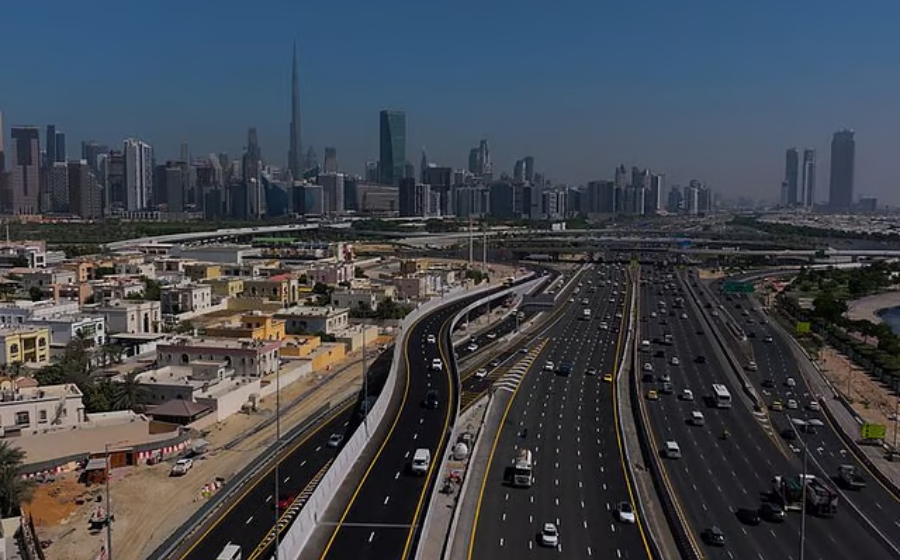
6. Major Road Upgrades Underway Across Dubai
Several major road developments are currently reshaping Dubai’s traffic landscape:
- Trade Centre Roundabout: Travel time cut from 6 minutes to 1 minute.
- Al Mustaqbal Street: Down from 13 minutes to 6 minutes.
- Al Qudra Street: Reduced from 9.4 minutes to 2.8 minutes; capacity tripled.
- Oud Metha & Al Asayel Streets: Travel time cut from 20 minutes to 5 minutes.
- Umm Suqeim Street: Journey time down by 61%; capacity up to 16,000 vehicles/hour.
These enhancements are part of RTA’s long-term plan to streamline inner-city mobility and reduce congestion hotspots.
7. Smart Traffic System: Cars That Talk To Traffic Lights
Dubai’s V2X Smart Traffic System will introduce real-time communication between vehicles and traffic signals using AI and digital twin technology.
Launching between 2027 and 2028, it will analyse live data to optimise signal timings, reduce congestion, and improve safety bringing Dubai closer to a fully connected “smart road” ecosystem.
8. Dubai’s Trackless Tram: The Future of Urban Transit
In another world-first, the RTA will introduce a trackless tram guided by GPS, LiDAR, and AI rather than fixed rails.
Key specs:
- Capacity: 300 passengers
- Top speed: 70 km/h
- Range: 100 km per charge
This eco-friendly innovation complements the existing Dubai Metro and Dubai Tram, offering a flexible, zero-emission transit solution for the city’s growing population.
9. Dubai’s “20-Minute City” Vision
By 2040, Dubai aims to become a 20-Minute City — where 80% of residents’ daily needs can be reached within 20 minutes by walking, cycling, or public transport.
This long-term initiative supports the Dubai 2040 Urban Master Plan, built on two decades of RTA investments in transport infrastructure.
A recent McKinsey & Company study highlights its economic impact:
- Dh150 billion in direct transport revenues
- Dh319 billion saved in fuel and time
- Dh156 billion added to Dubai’s GDP
- 16% increase in property values (Dh158 billion)
The Road Ahead
From hyper-speed tunnels to AI-powered roads, Dubai’s transport strategy is redefining the concept of urban mobility setting a global benchmark for innovation, sustainability, and smart city design.