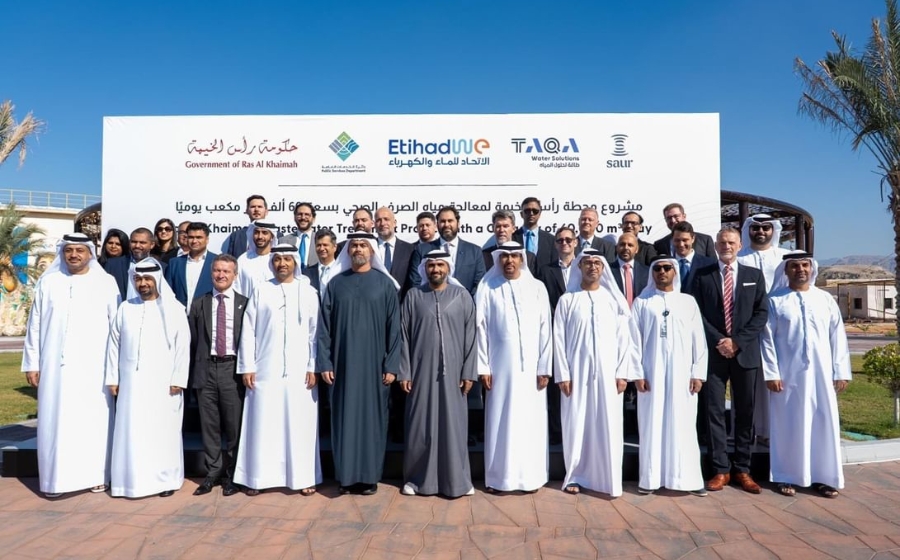
Image Credit : WAM
Ras Al Khaimah has taken a major step in strengthening its environmental infrastructure with the signing of a long-term sewage treatment agreement to develop the emirate’s largest wastewater project to date.
The Government of Ras Al Khaimah, represented by the Public Services Department, has entered into a Sewage Treatment Agreement with a consortium comprising Etihad Water and Electricity, TAQA Water Solutions, and Saur International.
The agreement covers the development of the Ras Al Khaimah Wastewater Treatment Plant, designed with a treatment capacity of 60,000 cubic metres per day. Once operational, the facility will be capable of serving a population of up to 300,000 residents.
The project will be delivered as a public-private partnership, marking Ras Al Khaimah’s first venture under a PPP framework. Officials said the initiative represents a milestone in the emirate’s approach to infrastructure delivery and sets a benchmark for future collaboration with the private sector in essential services.
The partnership aims to upgrade and expand wastewater infrastructure across the emirate, supporting sustainable urban growth, environmental protection and improved quality of public services. The strong market response to the project reflects investor confidence in Ras Al Khaimah’s governance framework and its ability to attract long-term investment in sustainable assets.
Sheikh Ahmed bin Saud Al Qasimi, Chairman of the Public Services Department, said the agreement reflects the emirate’s commitment to delivering projects that directly enhance quality of life, in line with the vision of Sheikh Saud bin Saqr Al Qasimi to position Ras Al Khaimah as a centre of economic and social prosperity.
He added that adopting advanced operating models and leveraging private sector expertise will help accelerate project delivery, improve efficiency and ensure the long-term sustainability of infrastructure and services.
The agreement was signed at the EtihadWE Museum within the Saud bin Saqr Energy and Innovation Complex in Al Barirat. The ceremony was attended by senior officials including Jasim Hussain Thabet, Group CEO and Managing Director of TAQA Group; Eng. Khalid Fadl Al Ali, Director-General of the Public Services Department; Eng. Yousef Ahmed Al Ali, CEO of Etihad Water and Electricity; Eng. Ahmed Al Shamsi, CEO of TAQA Water Solutions; and Christophe Tanguy, CEO of Saur Middle East.
Khalid Al Ali said the project will enhance treatment efficiency, strengthen operational reliability and improve readiness to meet the demands of urban expansion, while protecting the environment and raising service standards for residents.
Yousef Al Ali noted that the agreement supports long-term water security by combining public sector leadership with private sector expertise in project development and operations.
Ahmed Al Shamsi said the project marks TAQA Water Solutions’ first major initiative in recycled water distribution. Under the project scope, the company will manage the full wastewater cycle, from collection and treatment to distribution, enabling the reuse of 100 per cent of treated water for purposes such as irrigation and cooling. Wastewater will be conveyed through a 6.3-kilometre gravity pipeline, with recycled water distributed through a network extending up to 26 kilometres.
The project aligns with national sustainability objectives, including the UAE Vision 2030, the UAE Net Zero 2050 Strategy and the United Nations Sustainable Development Goals related to sustainable cities and communities.
Christophe Tanguy said the development will include a state-of-the-art wastewater treatment plant and associated transmission infrastructure, using advanced technologies to ensure efficiency and resilience.
The project will be implemented under a Build–Own–Operate–Transfer model, with the consortium responsible for design, financing, construction, operation and maintenance throughout the project term. At the end of the agreement, ownership of all assets will be transferred to the Public Services Department in line with international PPP best practices.
Officials said the initiative is expected to support sustainable urban development, strengthen environmental infrastructure and deliver long-term value for the community.