
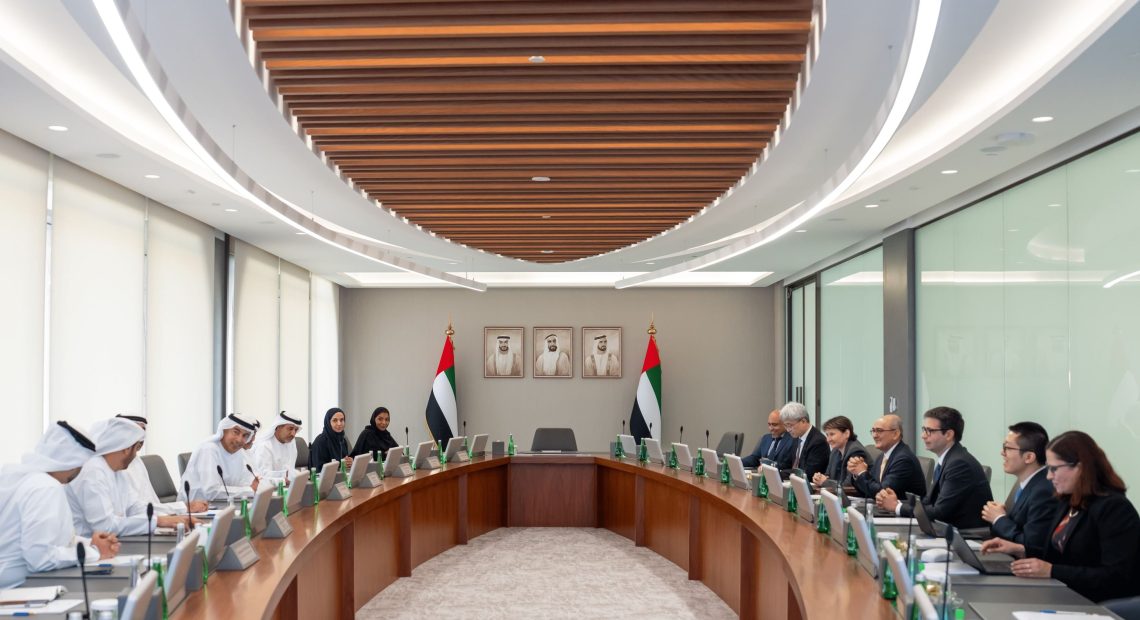
The International Monetary Fund (IMF) has praised the resilience of the UAE economy and the strength of its banking and financial system following the conclusion of its 2026 Article IV Mission, held from November 3 to 17.
The mission, coordinated by the Central Bank of the UAE (CBUAE) in collaboration with federal and local government authorities and private sector representatives, reviewed the country’s economic performance, financial stability and growth prospects amid evolving regional and global challenges.
Discussions covered monetary and supervisory policies, banking sector resilience, financial infrastructure development and ongoing improvements to the UAE’s Dirham Monetary Framework.
UAE Banking Assets Exceed AED5.815 Trillion
Khaled Mohamed Balama, Governor of the CBUAE and Governor for the UAE at the IMF, chaired the mission’s concluding meeting at the Central Bank’s headquarters in Abu Dhabi.
Balama attributed the country’s economic resilience to forward-looking government policies and its ability to respond effectively to global economic developments.
He highlighted the continued strength of the UAE’s financial sector, supported by rising credit and deposits, improved asset quality and effective regulatory oversight.
According to the CBUAE, total banking assets exceeded AED5.815 trillion by the end of the third quarter of 2026, demonstrating the banking system’s capacity to support economic activity and sustainable development.
Balama reiterated the Central Bank’s commitment to strengthening monetary and supervisory frameworks in line with international standards while developing financial infrastructure to enhance the UAE’s global competitiveness.
IMF Projects UAE GDP Growth of 7.3% in 2027
Said Bakhache, IMF Mission Chief for the UAE Article IV Mission, acknowledged the economy’s ability to withstand regional disruptions, citing effective government intervention, substantial fiscal reserves, modern infrastructure and a well-capitalised banking sector.
“The UAE economy has demonstrated resilience and strength in facing regional disruptions, supported by agile and targeted government policy responses, fiscal buffers, robust infrastructure, and a well-capitalised banking system,” Bakhache said.
The IMF expects economic activity to gain momentum across several major industries, particularly oil, trade, aviation and tourism.
Real GDP growth is projected to accelerate to 7.3% in 2027, supported by a 5.4% expansion in the non-oil economy. Inflation is also expected to moderate and stabilise at approximately 2% over the medium term.
The Fund expects the UAE’s public finances and external financial position to remain strong, supported by substantial international reserves.
Strong Financial Buffers Support Economic Stability
The IMF mission highlighted the soundness of the UAE’s financial system, noting that substantial capital and liquidity buffers, alongside improvements in banking asset quality, continue to strengthen financial stability.
Bakhache also recognised the CBUAE’s proactive measures to safeguard financial institutions and maintain confidence in the banking sector.
He described the comprehensive support package introduced in 2026, together with broader government initiatives, as an appropriate response to supply chain disruptions and regional economic challenges.
The IMF noted that the UAE’s substantial fiscal buffers provide additional flexibility to manage external risks while supporting economic growth.
Trade Agreements Strengthen Supply Chain Resilience
The IMF welcomed the UAE’s efforts to diversify international trade relationships through the expansion of Comprehensive Economic Partnership Agreements (CEPAs).
The development of alternative trade corridors was also recognised as an important step towards improving supply chain resilience and reducing exposure to regional disruptions.
These initiatives are expected to strengthen the UAE’s position as an international trade and logistics hub while supporting economic diversification.
IMF Recognises Improvements in UAE Economic Data
The mission acknowledged progress by UAE authorities in strengthening the quality, accuracy and availability of economic and financial statistics.
Particular improvements were identified in the compilation of balance of payments and gross domestic product data, along with continued enhancements to Government Finance Statistics.
The IMF also commended the cooperation demonstrated by UAE government entities throughout the assessment process.
As the national coordinator of the 2026 Article IV Mission, the CBUAE organised technical discussions involving federal and local authorities, private sector stakeholders and IMF representatives.
These meetings examined economic developments, macroeconomic policy effectiveness and regulatory and legislative measures designed to reinforce financial stability and improve the UAE economy’s long-term competitiveness.