
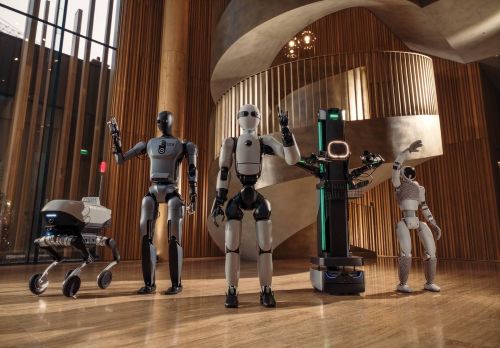
At the international AI Journey conference, Sber unveiled a new lineup of robots: the anthropomorphic robot Green 2.0, Yuni the athletic robot, and a delivery robot. All three platforms are based off Sber’s proprietary neural network model, GreenVLA 2.0, and showcase different facets of physical artificial intelligence: performing complex object manipulation, controlling body movement, and executing practical tasks in urban environments.
The key announcement is the next generation of the versatile anthropomorphic robot, Green 2.0, designed for tasks that require both navigating through space and interacting with objects. Through the coordinated control of its arms, legs, and torso, the robot is capable of executing complex sequences of actions. Compared to its predecessor, Green 2.0 features an increased number of degrees of freedom, a higher payload capacity for its arms, and greater overall flexibility. This more agile design allows the robot to be trained in complex movements and new physical skills, broadening the range of tasks it can perform — and, in the future, potentially enabling it to take on entirely new roles. The development of this platform is accompanied by the expansion of in-house component manufacturing at Sber’s Robotics Center.
Yuni is an athletic robot capable of performing complex dynamic movements, including choreographic and acrobatic sequences. Sber engineers use this platform to develop Physical AI skills — such as precise body control, movement coordination, and balance — which are essential for robots operating in complex physical environments, including those shared with humans.
A last-mile delivery robot is currently undergoing pilot testing in one of Moscow’s districts. Its specialized wheeled-legged platform allows it to successfully navigate curbs, stairs, and other urban obstacles. The design is built to operate in both rain and snow. In the future, such robots could deliver orders directly to a customer’s door, overcoming obstacles that would be impassable for conventional wheeled robots.
The common intellectual foundation for Sber’s family of robots is its proprietary GreenVLA 2.0 model. This serves as a form of physical artificial intelligence for both general-purpose anthropomorphic platforms and specialized robotic embodiments with various form factors tailored to specific business tasks. Through this model, the robots continuously accumulate experience interacting with the physical world, while the technologies used to control them evolve at an accelerated pace.
Herman Gref, CEO and chairman of the Executive Board, Sberbank:
“A year ago, we announced the creation of a group of robots capable of performing highly complex movements and adapting more effectively to their environment. Today, we are unveiling three new robotic platforms, all powered by a shared AI model. Our goal is for these robots to independently carry out tasks that are useful to humans. We are currently actively testing our technologies in the retail and delivery sectors, while our experiments in art, ballet, and sports are pushing the boundaries of what is considered possible. Furthermore, we are developing our own engineering infrastructure and manufacturing components right here in Russia. All of this lays the groundwork for the advancement of robotics in Russia and the country’s economy.”
Green 2.0, Yuni, and the delivery robot have joined Sber’s existing lineup of robots, which already includes Green and Worker.
AI Journey is an annual international conference that brings together leading professionals in the field of artificial intelligence, held with the support of AI Alliance Russia. The event focuses on cutting-edge AI designs and their impact on science, the economy, and society, while also promoting innovation among young people. Last year, the conference featured over 300 speakers from countries including Russia, India, China, and the United States.