Along with advanced Nvidia AI chips
In a groundbreaking agreement finalised during US President Donald Trump’s recent visit to Saudi Arabia, Qatar, and the United Arab Emirates, the UAE and the US have signed a deal to establish the largest artificial intelligence campus outside the continental US.
The AI mega-project, set to be built in Abu Dhabi, is a strategic victory for the UAE. The oil-rich nation has long pursued a position as a global AI powerhouse, yet its close commercial ties to China previously limited access to cutting-edge US semiconductor technology. That appears to be changing under the current Trump administration, which has shown a renewed willingness to deepen technology partnerships with trusted allies in the Arabian Gulf region.
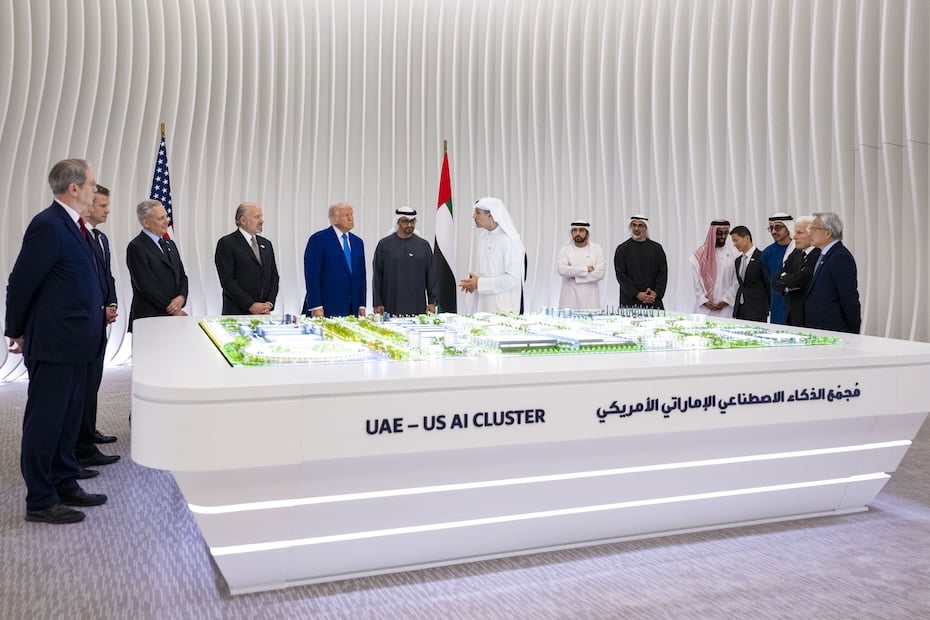
Central to the agreement is a 25.9 sq km AI campus powered by five gigawatts of energy—enough to support over two million of Nvidia’s top-of-the-line B200 chips, according to experts. Abu Dhabi-backed company G42 will lead the development, while American firms will operate the data centres and provide US-managed cloud services across the region.
US Commerce Secretary Howard Lutnik stated, “In the UAE, American companies will operate the data centres and offer American-managed cloud services throughout the region.”
The Biden-era export restrictions, which aimed to prevent sensitive US chips from reaching China via third countries, had stalled the UAE’s ambitions to be a global AI power. However, the new framework—described by the White House as a “historic commitment”—marks a significant shift in US policy, with both countries agreeing to tighten national security regulations and protect against technology diversion.
Sources suggest the UAE will be allowed to import up to 500,000 of Nvidia’s advanced AI chips annually beginning this year itself, a major upgrade that signals Washington’s confidence in new safeguards.
Though specifics around chip types remain undisclosed, the deal is expected to dramatically improve the UAE’s access to AI hardware previously restricted due to fears of Chinese infiltration.
The broader agreement includes the UAE pledging to fund or build US-based data centres comparable in scale to those planned in Abu Dhabi, strengthening bilateral tech integration. It also lays the groundwork for deeper collaboration with firms such as Qualcomm and Amazon Web Services, which will partner with local players on cloud infrastructure and cybersecurity.
Despite its continued Chinese commercial presence in the UAE—including firms like Huawei and Alibaba Cloud—the UAE has been realigning its tech strategy. G42 has divested Chinese-linked assets and forged strong ties with US firms like Openai and Microsoft. Trump’s AI adviser, David Sacks, confirmed earlier in the week that the goal is to protect technology while preserving alliances.
The deal allows the UAE to navigate a complex geopolitical landscape. It maintains critical trade with China while formally aligning with US AI, cloud computing, and chip security standards.
As global competition over AI intensifies, the UAE’s agreement with the US may mark a turning point for regional technology development and Washington’s evolving strategy in the Middle East and beyond.
Image: The 25.9 sq km AI campus will be powered by five gigawatts of energy. Credit: WAM