To boost European defence autonomy
Airbus Defence and Space and Germany-based Quantum Systems signed a memorandum of understanding at the 2025 Paris Air Show aimed at strengthening their strategic collaboration on military drone and reconnaissance technologies.
The agreement focuses on developing systems to support European defence autonomy in the face of evolving geopolitical threats and rapid technological change.
The two companies intend to jointly design and integrate aerial reconnaissance systems that are interoperable with modern command and control infrastructure. The partnership aims to produce solutions that are operationally ready in the short to medium term, prioritising resilience, adaptability, and transparency in system architecture.
The collaboration emphasises the importance of user control over critical technologies, including data ownership and future system upgrades. Unlike closed systems from other global defence suppliers, the Airbus-Quantum approach is based on open interfaces and modularity. Executives say this approach allows for faster integration across platforms and aligns with European efforts to reduce dependency on non-European military technology.
The joint initiative is shaped in part by operational lessons from the conflict in Ukraine, where drone usage and information dominance have become key factors in battlefield performance. Quantum Systems, which maintains a production and R&D presence in Ukraine, brings direct experience from that theatre into the development process. The systems in development will incorporate artificial intelligence, autonomous operations, and simulation-based environments that reflect emerging warfare dynamics.
As part of the agreement, Quantum Systems’ MOSAIC architecture will be integrated beneath Airbus’ CombatCloud platform, creating a layered surveillance capability from high-altitude sensors to frontline drones.
The goal is to establish a comprehensive and adaptable reconnaissance network that supports both crewed and uncrewed teaming and mission flexibility. According to the companies, the system is being designed to function across various theatres of operation, including urban, desert, and maritime environments.
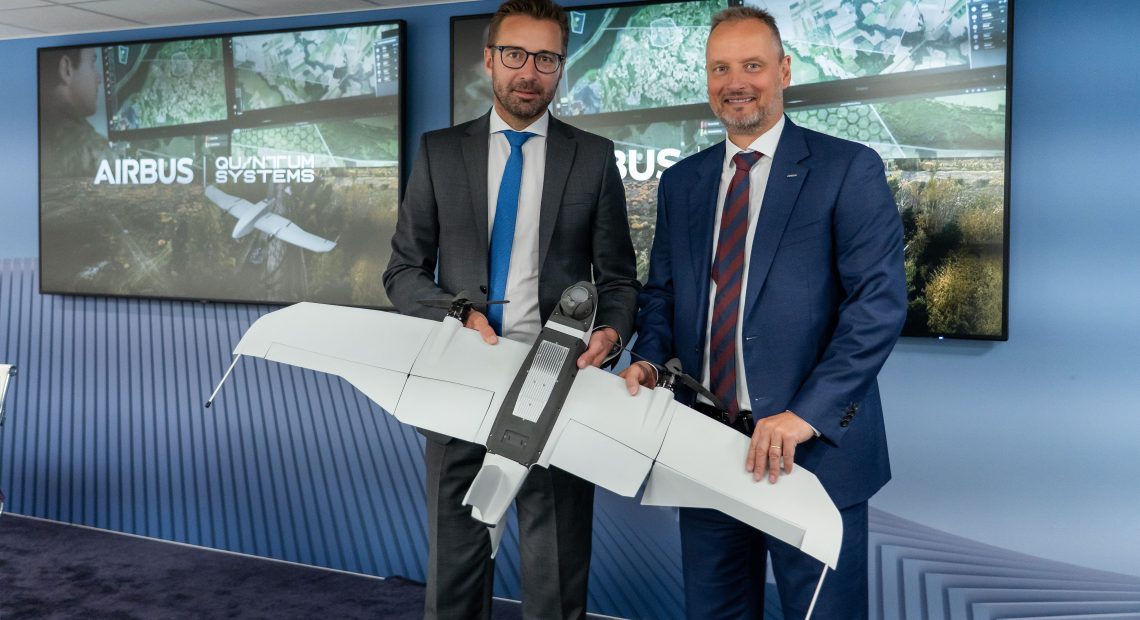
Florian Seibel, CEO of Quantum Systems, stated that the partnership aimed to establish a sovereign ecosystem for unmanned aerial systems. He added that interoperability and openness would be central to the system’s design, ensuring it can adapt to different partners and mission profiles.
Mike Schoellhorn, CEO of Airbus Defence and Space, stated that the agreement supports Airbus’ broader strategy of building a European military aviation ecosystem. He said the companies were focusing on a “software-first” approach to ensure that systems could be updated and adapted quickly in response to new threats or mission requirements.
The partnership comes at a time of increasing pressure on European states to invest in defence innovation and supply chain independence. Since the start of the Ukraine war and the continued instability in parts of the Middle East and North Africa, European nations have been seeking ways to reduce their reliance on external defence suppliers, particularly those from the United States and Asia.
The move may also have implications for Gulf countries such as the United Arab Emirates and Saudi Arabia, both of which have been investing in modernising their armed forces and expanding local defence manufacturing.
The UAE has already demonstrated interest in unmanned aerial systems and AI-based reconnaissance platforms. If successful, the Airbus-Quantum Systems collaboration could offer a model for exportable, modular defence technologies that meet the operational needs of countries in the Middle East while maintaining European control over sensitive components and data.
Neither company disclosed financial details or projected delivery dates for the systems under development. However, both signalled that the work would advance quickly, reflecting the urgent demand across Nato and allied states for flexible and locally controlled military technologies.
Image: (L-R) Florian Seibel, CEO of Quantum Systems, and Mike Schoellhorn, CEO of Airbus Defence and Space. Credit: Airbus