
For 2029 Moon missions
Tokyo-based lunar exploration company iSpace has signed an agreement with Bridgestone Corporation to collaborate on the development and testing of tyre technology for small to medium-sized lunar rovers.
The move signals an expansion of private sector involvement in space exploration, with plans to validate the technology on Earth ahead of potential use on the Moon by 2029.
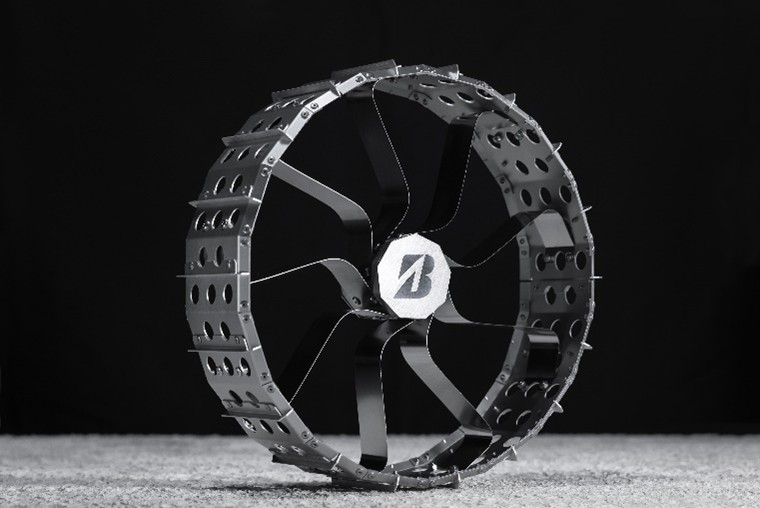
Under the agreement, Bridgestone will supply specially designed tyres to be installed on iSpace’s lunar rover prototypes. These rovers, which are among the smallest in the world, are being developed for future lunar surface missions, including water resource exploration. Bridgestone’s tyre concept, which uses a soft, spoke-based structure made of thin metal, is intended to absorb shocks and maintain traction across uneven lunar terrain.
The collaboration marks a step toward the practical application of surface mobility technology on the Moon. Both companies will conduct ground-based tests to assess the technical feasibility and commercial viability of using such tyres for future missions. The outcome of these trials could determine whether Bridgestone’s tyres are deployed in lunar operations as early as 2029.
Bridgestone began its lunar tyre research in 2019. In April 2025, the company presented its latest concept for lightweight lunar rover tyres, designed specifically for smaller vehicle platforms. The tyres are engineered to deform flexibly under pressure while maintaining durability in extreme lunar conditions, including sharp temperature fluctuations and rocky terrain.
iSpace, which is publicly traded on the Tokyo Stock Exchange under the symbol 9348, has been leading private-sector efforts in Japan to establish a sustained presence on the Moon. The company’s long-term strategy includes building infrastructure to support future lunar economies, including transport and resource extraction. It aims to provide services such as high-resolution imaging and environmental data collection from its rovers.
The partnership with Bridgestone reflects a growing trend of cross-industry collaboration in the global space sector. By pooling technological expertise, the two companies are seeking to support Japan’s national space ambitions. Their efforts may be bolstered by the Japan Aerospace Exploration Agency’s Space Strategy Fund, which backs private innovation in space technologies.
According to data from the Space Foundation, the global space economy reached $546 billion in 2023 and is projected to grow steadily through the end of the decade. Surface mobility, including lunar rovers and support systems such as tyres, is considered a critical component of future space infrastructure.
Takeshi Hakamada, Founder and CEO of iSpace, said the Moon will require contributions from various industries to enable a sustainable economy. He said iSpace is developing micro rovers to support long-term lunar activity, and that the collaboration with Bridgestone will help validate essential technologies for missions in extreme lunar environments.
Masaki Ota, Director of OE Business Strategy and New Mobility at Bridgestone, said the company is working to expand its network within the space sector. He said Bridgestone aims to demonstrate the reliability and performance of its tyres under lunar conditions while supporting Japan’s broader space development efforts.
The ground tests will take place over the next several years, with field evaluations designed to simulate the challenges of navigating the lunar surface. The companies have not yet disclosed the cost of the project or detailed plans for deployment beyond 2029.
As space agencies and private firms worldwide prepare for the next wave of lunar missions, mobility technologies such as those being developed by iSpace and Bridgestone will play a vital role in enabling operations on the Moon’s surface.
From a regional perspective, the Middle East—particularly the UAE—has shown increasing interest in lunar and interplanetary exploration. The UAE’s space agency has prioritised lunar missions under the “Rashid” programme, with ongoing efforts to establish knowledge partnerships with international players.
The Emirates Lunar Mission, launched in 2022, highlighted the region’s capacity to collaborate on advanced space technologies. Developments like the Bridgestone-iSpace agreement could offer insights and future cooperation opportunities for GCC states investing in lunar infrastructure and mobility systems.
Hero image: (L-R) Masaki Ota, Director, OE Business Strategy & Planning/New Mobility Business Division, Bridgestone Corporation, and Takeshi Hakamada, CEO & Founder, iSpace, at a signing ceremony confirming the agreement. Credit: iSpace