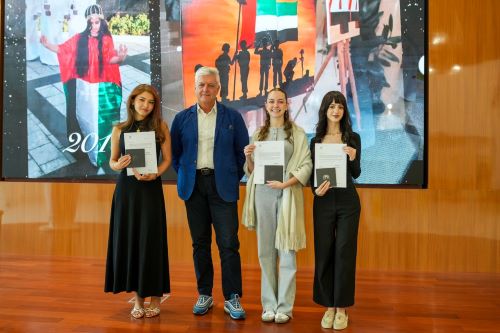
Architecture students from Canadian University Dubai (CUD) have unveiled a series of innovative, sustainability-focused design projects developed in response to the unique environmental and climatic conditions of Dubai. Set within Ghaf Woods, a forest-integrated community that is redefining urban living in the city, each project features a low-rise, multi-use recreation centre that embodies ecological harmony and climate-responsive innovation. The standout designs included a canopy rooted in biomimicry and sustainability, a recharge facility that converts environmental extremes into performance assets, and a pavilion that is embedded harmoniously into the natural landscape.
Anchored in the university’s core pillars of sustainability and innovation, the CUD architecture students were placed in the heart of the living laboratory of Ghaf Woods to nurture their creative mindset and to promote sustainability literacy. Under the mentorship of faculty lead Christine Yogiaman, the designers explored adaptive architecture focused on passive strategies, such as shading, natural ventilation, and thermal mass, to minimise energy consumption in Dubai’s hot climate. The students combined creative exploration with practical environmental strategies, producing designs that not only minimise ecological impact but also enhance the user experience through harmony with the natural world.
Inspired by the native Ghaf tree, Danica Ferreira’s design, ‘The Canopy’, proposes a sanctuary that moderates Dubai’s harsh climate through layered shading, water vapour integration, and passive cooling strategies. Danica explained, “The design acts as a self-regulating microclimate, using innovative materials like datecrete, cross-laminated timber, and photovoltaic components to create a welcoming environment for families and visitors. Light and shadow interplay through multiple canopy layers, transforming the space into a serene retreat, a place for reflection, and a reconnection with nature. The aim is to redefine architecture not just as shelter, but as a regenerative system in harmony with its surroundings.”
Designed by Maya Alhajali, ‘Respire’ is a project that challenges the conventional perception of heat as an obstacle in desert design. The 100 sqm structure functions as both a café and a recharge station, located within a forest park setting. Inspired by the lotus flower’s self-regulating abilities, the design turns environmental stress into performance assets. A PVDF-coated aluminium mesh façade, a ventilated double-skin buffer, and a misting system reduce interior temperatures by 5–10°C. A solar chimney harnesses thermal pressure differentials to power natural ventilation, allowing the building to become more efficient as temperatures rise. Speaking about her thinking behind the concept, Maya said, “I wanted to prove that sustainability isn’t a layer to add, it’s a logic to design from.”
Centered around two native trees, Camelia Yaghi’s design ‘Al-Dara’ is a circular pavilion that listens to and lives with the landscape. The structure features a retractable, breathable roof that responds to seasonal cycles, providing both shade and air circulation. A lightweight steel framework minimises ground impact, while elevated wooden flooring supports the health of the soil. Conceived to be more than just a shelter, Camelia said, “Visitors are invited into a sensory conversation described by rustling leaves, filtered light, sounds of the forest and scent of materials. It is a living enclosure that is not just seen or touched but also felt.”
Speaking about the projects, Dean of the School of Architecture and Interior Design, Mr. Massimo Imparato, said, “The vision and creativity that students have brought forward on this live brief reflect CUD’s commitment to practice-based, research-driven learning.
They are redefining the future of architecture with ideas that are human-centred and climate-responsive, and through projects like this,
They will graduate with the skills and experience to drive the future of regenerative design and create resilient urban landscapes.”
The climate-responsive design projects are part of CUD’s broader approach to support the transition towards sustainable innovation and growth in the region. The university has recently launched a Master of Science in Design Innovation for Circular Economy, focusing on restorative and regenerative design to create urban environments that restore ecological balance, promote biodiversity, and enhance social well-being.