Photo Credit : WAM
Dubai Electricity and Water Authority (DEWA) is advancing major clean energy projects while strengthening environmental protection, resource efficiency and biodiversity conservation across its operations.
The authority said sustainability measures are integrated into every stage of its infrastructure projects, from planning and design to construction and operation. This approach is intended to reduce carbon emissions, conserve natural resources and support Dubai’s position as a leading smart and sustainable city.
Saeed Mohammed Al Tayer, MD and CEO of DEWA, said the authority’s projects support the Dubai Clean Energy Strategy 2050 and the Dubai Net Zero Carbon Emissions Strategy 2050.
He added that DEWA aims to help Dubai generate 100% of its power production capacity from clean energy sources by 2050 while maintaining high standards of efficiency, reliability and environmental responsibility.
Solar and Hydroelectric Projects Expand Clean Energy Capacity
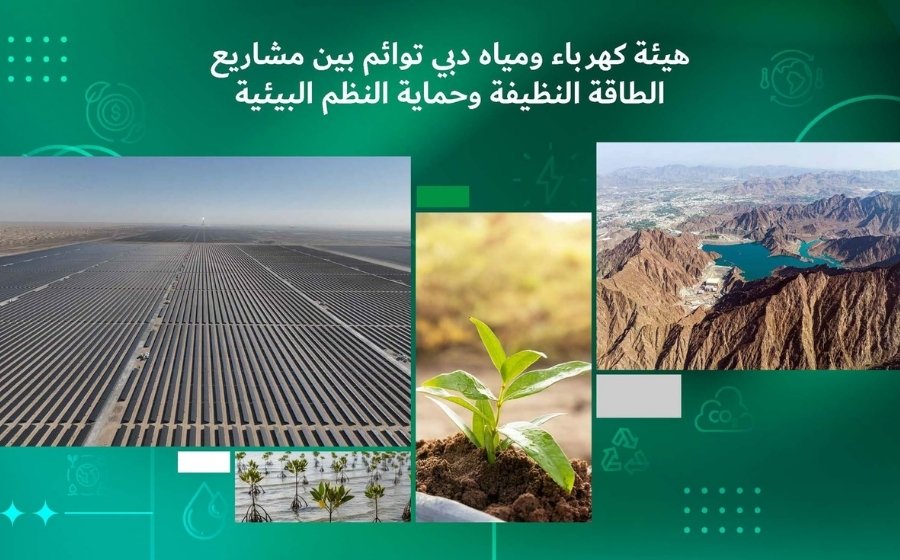
The Mohammed bin Rashid Al Maktoum Solar Park remains one of DEWA’s most important clean energy developments. It is the world’s largest single-site solar park being developed under the independent power producer model.
The solar park currently has a production capacity of 3,860 megawatts and is expected to exceed 8,000MW by 2030, well above its original target of 5,000MW.
Once completed, the expansion is projected to increase clean energy’s share of Dubai’s energy mix to 36%, compared with the original target of 25%.
DEWA is also developing the Hatta pumped-storage hydroelectric power plant, the first project of its kind in the GCC. The facility will have a production capacity of 250MW, storage capacity of 1,500 megawatt-hours and an operational lifespan of up to 80 years.
Together, the solar park and Hatta facility are expected to strengthen Dubai’s energy security, improve storage capabilities and support its transition towards a low-carbon economy.
Environmental Assessments Guide Project Development
DEWA conducts Environmental Impact Assessments to identify possible risks, meet regulatory requirements and incorporate sustainability measures from the early stages of each project.
The findings are included in environmental management plans, while ongoing monitoring programmes assess air, water and soil quality as well as noise levels. The results allow the authority to introduce corrective measures when required.
DEWA also follows circular economy principles across its projects by reducing resource consumption, limiting waste and encouraging the reuse, recycling and recovery of materials.
Environmental inspections, audits, performance indicators and reporting systems are used to monitor compliance and support continuous improvement. Employee awareness programmes also form part of the authority’s wider environmental framework.
Hatta Development Balances Energy and Conservation
Projects in areas with distinctive natural landscapes require additional environmental safeguards. DEWA said the Hatta hydroelectric plant demonstrates how clean energy infrastructure can be developed while protecting the surrounding environment.
Along with supporting Dubai’s clean energy goals, the project is expected to strengthen energy storage and contribute to sustainable economic development in the Hatta region.
Mangrove Planting and Beach Clean-Ups Support Biodiversity
DEWA’s environmental activities also include community programmes focused on protecting terrestrial and marine habitats.
Mangrove conservation is a major part of these efforts because the trees help protect coastlines, improve marine ecosystems, provide habitats for wildlife and absorb carbon emissions.
In 2026, DEWA organised mangrove-planting and beach-cleaning campaigns at the Jebel Ali Marine Sanctuary. A total of 254 volunteers planted 700 mangrove trees and contributed 508 volunteer hours.
Between 2023 and 2026, the authority planted 14,650 mangrove trees at the sanctuary. During the same period, beach-cleaning campaigns involving 2,154 volunteers removed 3,546 kilograms of waste, most of which consisted of plastic materials.
DEWA has also incorporated climate change, emissions, energy, water, waste, circular economy and biodiversity priorities into its corporate governance framework.
The authority said this integrated approach connects clean energy development with environmental stewardship while supporting the UAE’s and Dubai’s net-zero ambitions.