The Federal Authority for Government Human Resources has entered into a strategic partnership with PwC to roll out a knowledge transfer programme across the federal government, aimed at accelerating national talent development and strengthening future readiness.
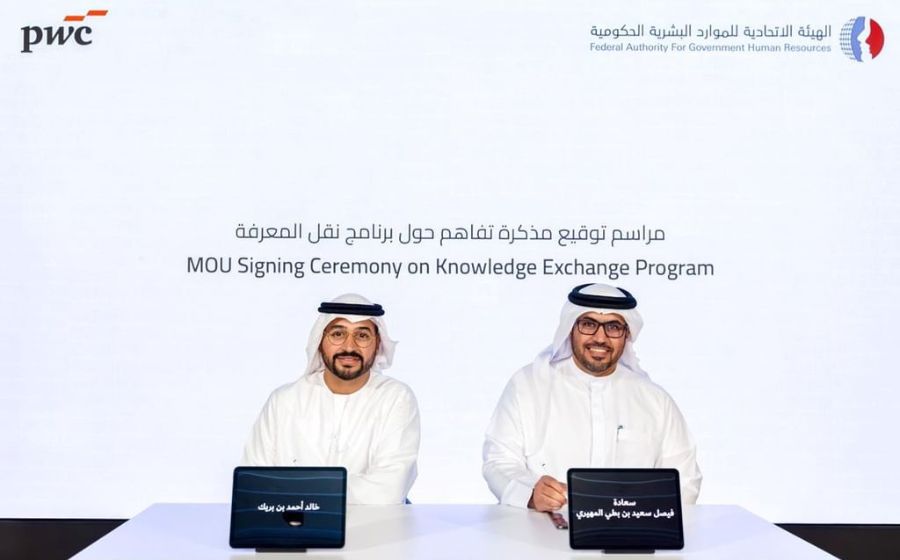
The collaboration was formalised through a Memorandum of Cooperation signed by Faisal bin Butti Al Mheiri, Director-General of FAHR, and Khalid Ahmed bin Breik, Consulting Partner and Head of the Emiratisation Programme at PwC Middle East.
Under the initiative, federal government employees will be able to undertake full- or part-time, hands-on training placements within PwC for periods ranging from three to six months. The programme is designed to transfer practical expertise and enable participants to apply newly acquired skills within their respective government roles, supporting continuous improvement across the public sector.
Al Mheiri said the partnership reflects FAHR’s commitment to the UAE government’s vision of human empowerment, which places people at the centre of sustainable growth and innovation. He noted that the programme will help strengthen institutional capabilities, enhance government performance, and embed a culture of continuous learning among Emirati talent.
He added that the initiative provides a strong platform for public-private knowledge exchange, offering meaningful opportunities to build future skills and empower Emiratis to lead development and innovation initiatives within the federal government.
Bin Breik said the collaboration reinforces PwC’s ongoing support for the UAE’s development agenda by building capabilities and enabling national talent. He added that the programme will create new pathways for learning and knowledge exchange, while enhancing the readiness of government entities to deliver long-term, sustainable impact.
The knowledge transfer programme aligns with FAHR’s recently launched training and development framework and follows a global capacity-building model. It is structured around 70 percent hands-on experience in international work environments, 20 percent interactive learning through mentorship and collaboration with global experts, and 10 percent formal theoretical training.
By linking training outcomes directly to workplace needs, the programme aims to build high-impact capabilities in leadership, innovation, and future skills, strengthening national talent readiness and delivering lasting institutional value across the federal government.