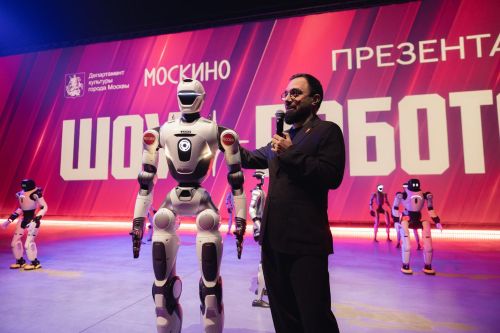
With plans for a phygital arena and new uses for robotics in filmmaking, Moskino Film Factory is expanding the role of its production infrastructure. Its “Robot Show,” presented in Moscow on October 7, demonstrated how the same technologies can support screen production and live entertainment.
Phygital formats already have an international audience. Moskino is developing its own phygital offering. Alongside robot battles, the wider format includes phygital sports, esports and drone racing. At the Film Factory, these activities are being integrated into a technological ecosystem connected to filmmaking.
A phygital arena forms part of the site’s development plan. It will support events that combine real-world action, digital content and direct audience interaction. Together with a music venue, retail spaces and public areas, the arena is intended to become one of Moscow’s key event destinations.
The October presentation showed what this approach could look like in practice. In a retrofuturistic performance space, physical movements triggered immediate responses on screen, while robots and people shared the stage.
One of the presentation’s featured machines was the EngineAI T800, which was brought to Russia specifically for the show and made its debut at the Film Factory. Moskino’s team plans to train the humanoid for future use in film production.
The T800 is the first model designed for heavy-duty applications by EngineAI, a Chinese company headquartered in Shenzhen. A full-size humanoid, it stands 173 cm tall and weighs up to 85 kg. Its body uses aerospace-grade aluminium and titanium to withstand impacts. It appeared alongside other humanoids, including the Unitree G1, in a programme featuring nine humanoids and two combat robots overall.
The show explored three ways of connecting physical and digital action. Its opening robot battle paired an arena contest with a video game presentation. Two machines, controlled by operators, fought as digital characters—including Russian bogatyrs, or epic warriors, and a boxer—mirrored the action on a large screen. Character and location selection, a countdown and game effects completed the fighting-game format.
“Digital Battle,” the second scene, demonstrated the role of human performance in creating virtual action. Two stunt performers in sensor-equipped suits staged a fight, with digital robots matching their movements in real time. The robots then continued fighting independently in a virtual arena above Moscow.
The scene illustrated motion capture, a technology that records the movements of people or animals and transfers them to digital characters or physical robots. It gave the audience a direct view of how performers’ movements can animate characters for the screen.
The programme concluded with “Steel Instincts,” a choreographed training session involving nine performers and nine humanoids. Each person worked with a robot partner, demonstrating combat techniques and movements for the machine to reproduce.
Together, the three scenes presented robotics and motion capture as tools for both filmmaking and live events, giving a practical demonstration of the phygital experiences Moskino is building its infrastructure to support.