New SIPRI study report
Nuclear-armed states are continuing to expand and modernise their arsenals, reversing decades of gradual disarmament and signalling the return of a global arms race, according to the newly released Stockholm International Peace Research Institute Yearbook 2025 – an annual assessment of the state of armaments, disarmament and international security.
Key findings of the SIPRI Yearbook 2025 are that a dangerous new nuclear arms race is emerging at a time when arms control regimes are severely weakened.
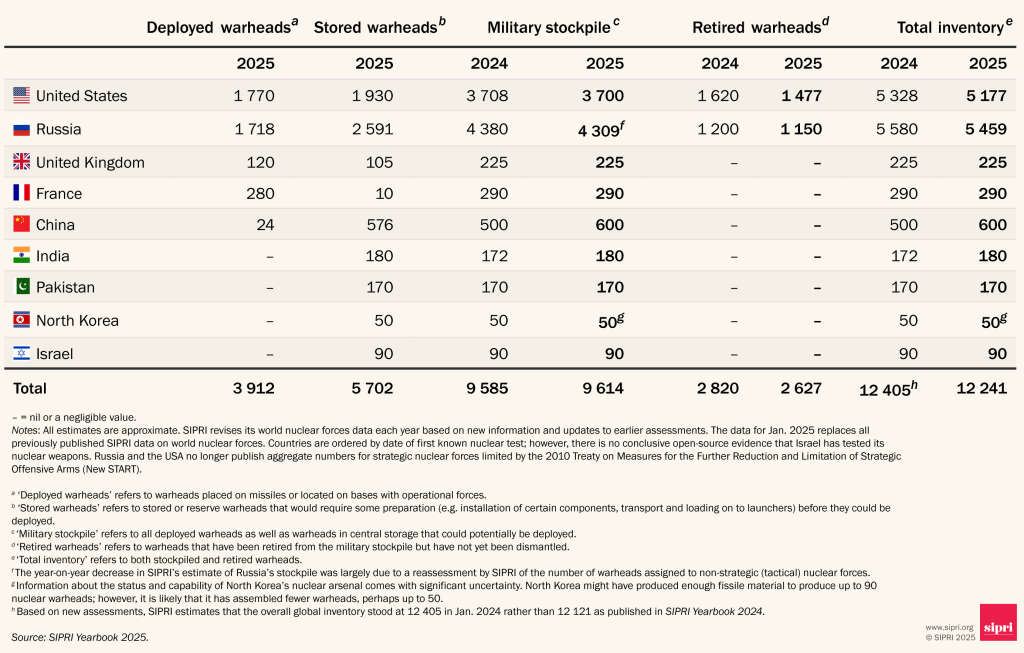
As of January 2025, nine nuclear-armed countries held a combined total of approximately 12,241 warheads, with over 9,600 ready for military use. Around 3,900 were actively deployed, with many on high operational alert, predominantly by Russia and the United States.
This shift marks the likely end of a long-standing trend, dating back to the Cold War, in which nuclear stockpiles have steadily declined through dismantlement and arms control. According to the SIPRI, this reduction is slowing, while deployment of new warheads is accelerating. Analysts say this reflects not only technological upgrades but also deteriorating trust among global powers.
Russia and the US
Russia and the US continue to dominate global nuclear holdings, together accounting for nearly 90 per cent of the world’s nuclear weapons. Their military stockpiles remained stable in 2024, yet both nations pursued broad modernisation plans. These efforts risk increasing their deployed arsenals, particularly after the New START treaty expires in February 2026. No successor treaty is under negotiation.
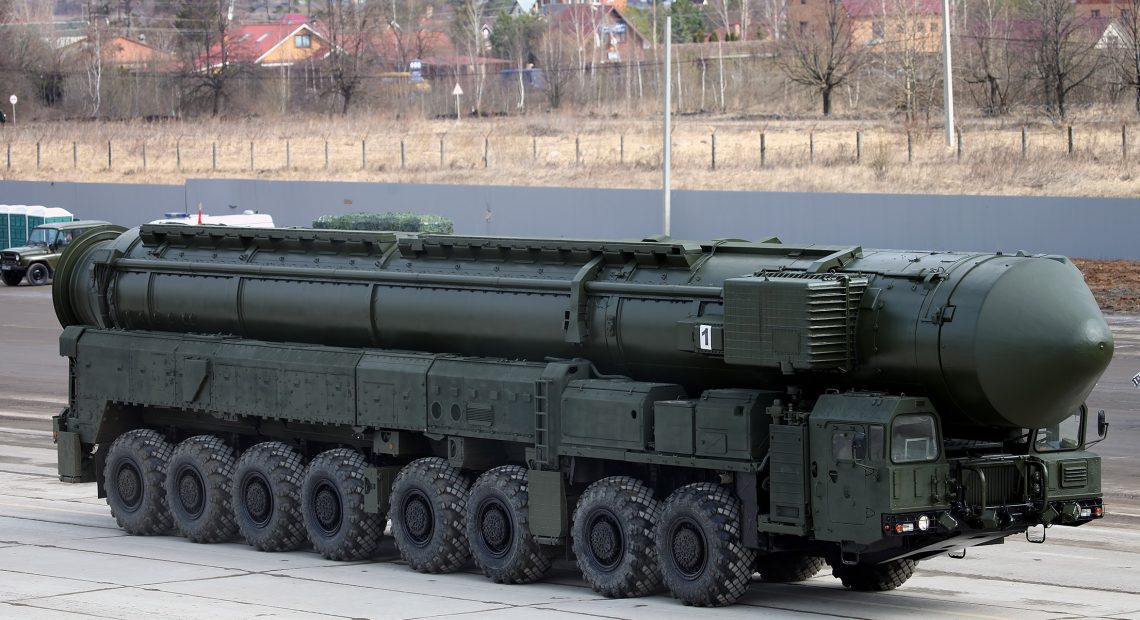
The US programme, though comprehensive, faces funding constraints and delays. The inclusion of new non-strategic nuclear weapons may further strain the system. Russia’s modernisation also encountered obstacles in 2024, including delays to the Sarmat intercontinental ballistic missile (ICBM) and stalled upgrades to other systems.
Despite this, both nations are likely to increase deployment levels. Moscow may reload older missile silos and enhance the capacity of its strategic warheads. Washington could reactivate launchers and add non-strategic weapons, particularly in response to China’s expanding arsenal.
China has increased its nuclear stockpile faster than any other country. By early 2025, it was estimated to have at least 600 warheads and had built or nearly completed 350 ICBM silos. If the current trajectory continues, China could reach 1,500 warheads by 2035. Although this remains below Russia and the US, it signals Beijing’s ambition to close the strategic gap.
Other nations
Other nuclear-armed states are also reinforcing their capabilities. The UK, though not expanding its arsenal in 2024, remains committed to increasing its warhead ceiling. The Labour government, elected in July 2024, pledged to continue building new nuclear submarines and upgrade all parts of the arsenal. However, the plan faces both financial and logistical challenges.
France advanced the development of a new air-launched cruise missile and a third-generation ballistic missile submarine. It also continued work on a new warhead and ballistic missile system.
In South Asia, India and Pakistan both expanded their nuclear capabilities in 2024. India advanced work on canisterised missiles that could carry nuclear warheads during peacetime and possibly host multiple warheads per missile. Pakistan continued to build up its stockpiles of fissile material and develop new delivery systems. The year also saw a brief flare-up in armed conflict between the two neighbours, raising fears of escalation. SIPRI researchers noted that military strikes and disinformation could have pushed the conflict dangerously close to a nuclear crisis.
North Korea accelerated its nuclear programme in 2024, assembling an estimated 50 warheads and continuing production of fissile material. In July, South Korean officials reported the North was close to completing a tactical nuclear weapon. By November, leader Kim Jong-un had called for the unlimited expansion of the programme.
Middle East
Israel, which has never officially acknowledged possessing nuclear weapons, conducted a missile propulsion test in 2024, believed to be linked to its Jericho ballistic missile series. Satellite imagery also indicated upgrades at the Dimona nuclear facility.
Iran, which has repeatedly stated that its nuclear ambitions are for peaceful use only, has been censured by the global atomic agency for clandestinely processing uranium to levels suitable for nuclear weapons, prompting Israel to launch unprecedented widespread ground and airstrikes on its nuclear facilities recently.
Arms control agreements have come under growing pressure. SIPRI’s Director, Dan Smith, said that bilateral US-Russian control mechanisms are near collapse. With New START due to expire in 2026 and no talks underway for a follow-up, arms control appears increasingly sidelined. US calls for China to join any future pact have further complicated the situation.
Smith warned of a new arms race driven not only by the number of warheads but also by emerging technologies. He highlighted advances in artificial intelligence, quantum computing, missile defence and cyber capabilities as factors reshaping deterrence and raising the risk of instability. Faster decision-making in high-stakes scenarios increases the risk of unintended nuclear conflict, especially in a climate of misinformation.
Beyond the current nuclear states, more countries are reportedly reconsidering their stance. In East Asia, Europe, and the Middle East, debates over nuclear sharing have gained momentum. Russia and Belarus reiterated claims in 2024 that Moscow has stationed atomic weapons on Belarusian soil. Several NATO countries indicated readiness to host US weapons, and French President Emmanuel Macron again stated that France’s nuclear forces should serve a broader European role.
Some analysts warn that the expansion of nuclear arsenals may heighten insecurity rather than prevent conflict. SIPRI researcher Matt Korda cited the India-Pakistan crisis as evidence that nuclear weapons may exacerbate tensions rather than deter them. He noted the rising potential for catastrophic misjudgment amid disinformation and heightened military readiness.
In the Middle East, regional dynamics could shift if more countries reassess their nuclear strategies. While no state has officially pursued new programmes, ongoing conflicts between Israel and Iran and shifting alliances may prompt future policy changes.
Image: Russia’s modernisation programme of its nuclear arms encountered obstacles in 2024. Credit: Vitaly V. Kuzmin/SIPRI