

ChatGPT is making inroads
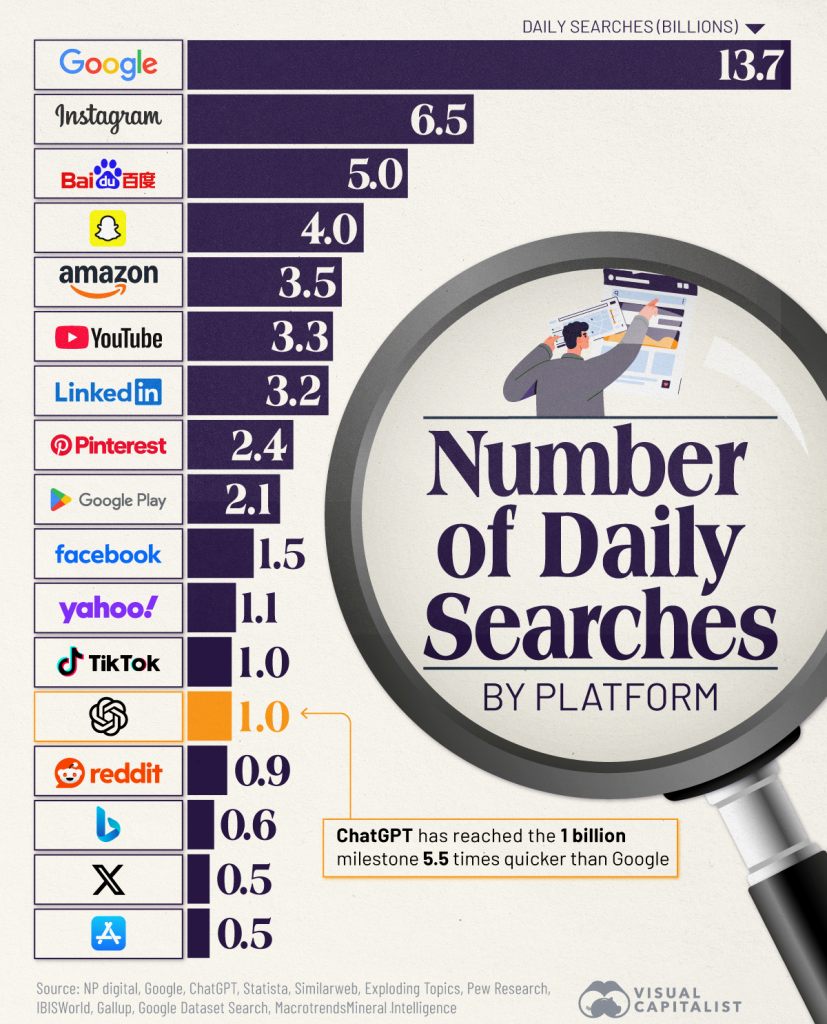
Google continues to dominate the global search landscape, recording an average of 13.7 billion searches per day in 2025, according to new data from NP Digital presented at the Web Summit in Vancouver. The figure more than doubles that of its nearest competitor, Instagram, which logs 6.5 billion daily searches.
The data underscores Google’s entrenched position at the top of the search ecosystem, with usage volumes far exceeding those of even the world’s most popular social and video platforms. With Instagram in the second position with 6.5 billion daily searches, Baidu came in third with 5 billion, followed by Snap at 4 billion and Amazon at 3.5 billion. YouTube, a Google-owned platform, saw 3.3 billion searches each day, underscoring the company’s reach across both traditional and multimedia-based search environments.
The statistics illustrate how far ahead Google remains in the race for user attention, even as alternative platforms evolve their capabilities in discovery and engagement. Despite the surge in popularity of apps like TikTok, which recorded 1 billion daily searches, and Reddit at 0.9 billion, the gap between Google and its competitors remains substantial.
The top 10 platforms by daily search volume also included LinkedIn (3.2 billion), Pinterest (2.4 billion), the Google Play Store (2.1 billion), and Facebook (1.5 billion). Legacy platforms, such as Yahoo, still maintain a foothold with 1.1 billion searches per day, while Bing trails with just 0.6 billion.
Artificial intelligence is beginning to make inroads into this space. ChatGPT, the AI-powered conversational tool developed by OpenAI, currently sees 1 billion daily searches, matching TikTok and exceeding Reddit and Bing. The milestone reflects the growing reliance on AI for information retrieval, summarisation, and explanation, particularly in professional and educational settings.
Despite its rise, ChatGPT remains far behind Google in overall search volume. Experts point out that for any platform to surpass Google, a significant transformation in user behaviour would be required. This would likely involve the seamless integration of alternative tools into browsers, operating systems, and devices, alongside a comparable ability to crawl and index the open web.
Nevertheless, ChatGPT’s impact is more pronounced in specific areas. Users are increasingly turning to AI platforms for complex reasoning, content generation, and understanding long-form information. In tasks where users seek explanations or synthesis, rather than traditional search results, ChatGPT is gaining traction.
Speaking at the Web Summit, analysts suggested the future may be less about competition and more about convergence. Google has already integrated generative AI into its ecosystem via its Gemini model. Meanwhile, ChatGPT can access live web data through its partnership with Bing, signalling a hybrid model where traditional search and AI-powered tools coexist.
While daily search volume remains a key metric of user engagement, industry observers are now also looking at context and utility. Google is still the first stop for fact-checking, directions, and transactional queries. But when it comes to creative tasks or understanding complex ideas, users are increasingly splitting their time between traditional search engines and generative AI models.
This dual approach is likely to shape digital habits over the next few years. As AI tools become more embedded into everyday applications and interfaces, the lines between web search, conversation, and task-solving are expected to blur. For now, most users are still navigating a middle ground—turning to Google for speed and breadth, and to AI assistants for clarity and depth.
For platforms like ChatGPT to close the gap, they must not only scale infrastructure but also shift the mindset of users accustomed to decades of traditional search habits. While change may be likely to unfold gradually rather than in a sudden leap.
Still, one billion searches per day is no small feat. It signals that conversational AI is no longer a novelty—it’s becoming a core part of how people seek and interact with information online.
With innovation accelerating on both sides, the real winner may not be one platform over another, but rather the user, who benefits from having a range of tools tailored to different needs.
Image: Google remains in the race for user attention, even as alternative platforms evolve their capabilities in discovery and engagement. Credit: Sarah Blocksidge