Focus shifts to Dubai air taxi ops
Joby Aviation (NYSE: JOBY), the California-based company developing electric vertical take-off and landing (eVTOL) aircraft for commercial air taxi operations globally, has achieved a significant breakthrough in its aircraft testing programme.
The company has completed manned flights featuring full transitions from vertical take-off to windborne cruise flight and back again—a key design milestone on the path to commercial air taxi service.
The achievement positions Joby as the first eVTOL company in the world to routinely conduct piloted transition flights. Switching from vertical to horizontal flight is crucial to Joby’s unique aircraft design, enabling it to combine the point-to-point convenience of a helicopter with the speed and efficiency of a fixed-wing aircraft.
This milestone highlights Joby’s technical leadership in the eVTOL sector and signals a shift from conceptual development to tangible, operational readiness. The age of electric air taxis, long talked about as a vision of future transport, is now entering its most exciting and promising chapter.
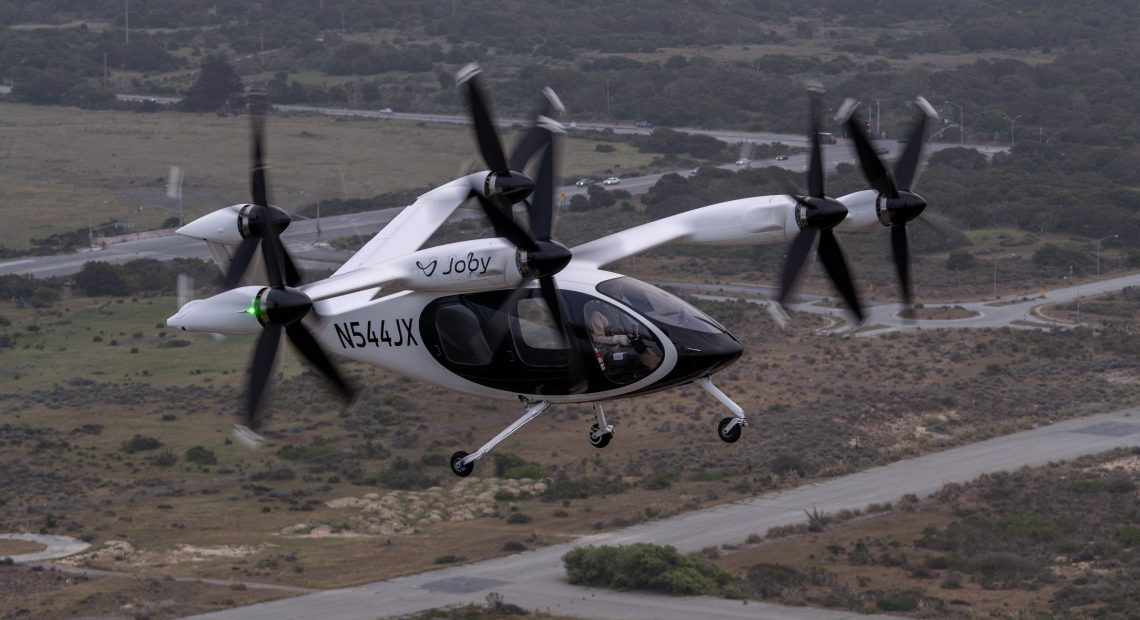
The inaugural piloted transition flight was carried out on April 22, 2025, by Chief Test Pilot James “Buddy” Denham at Joby’s test site in Marina, California. Flying the aircraft designated N544JX—fresh from the company’s production line—Denham lifted off vertically, climbed to altitude, and transitioned smoothly into wingborne flight before returning for a precision vertical landing.
Watch the video here:
Joby has completed multiple transition flights with three different pilots at the controls. This marks a significant escalation in testing maturity as the company prepares for type inspection authorisation (TIA) flight testing with Federal Aviation Administration (FAA) pilots onboard, a critical step toward commercial certification.
Dubai rendezvous
Having accomplished its latest pilot-onboard transition flight with an eVTOL aircraft, Joby says it will deliver its first eVTOL aircraft for air taxi operations in Dubai emirate in the United Arab Emirates (UAE) by mid-2025.
Once flight testing, including local regulatory approval, is completed in Dubai, the affluent city is expected to host Joby’s inaugural eVTOL passenger services, bringing a futuristic transport solution to one of the world’s fastest-growing cities.
Venture-backed Joby has applied to become the UAE’s first certified air taxi operator. To attain an Air Operator Certificate from the UAE’s General Civil Aviation Authority, Joby will demonstrate the readiness of its aircraft and its training, maintenance, operations, and safety programmes for commercial air transport in the UAE.
Joby’s planned service in Dubai is part of an agreement with Dubai’s Roads and Transport Authority, granting Joby the exclusive right to operate air taxis in Dubai for six years. Skyports, Joby’s launch infrastructure partner in Dubai, has begun construction of the first vertiport in Joby’s planned Dubai air taxi network, located at Dubai International Airport.
In Abu Dhabi, Joby has signed a multilateral agreement with the Department of Municipalities and Transport, the Abu Dhabi Department of Economic Development, and the Department of Culture and Tourism. This agreement lays the groundwork for Joby to establish and scale air taxi services in the emirate and unlock the potential for inter-emirate services.
In late 2024, Joby and Jetex entered a collaboration to focus initially on Jetex locations across the Middle East. There, Joby plans to install its Global Electric Aviation Charging System to support Joby operations and connect Jetex passengers to a network of vertiports, offering efficient and sustainable travel across the region and between the seven emirates that constitute the UAE.
Significant milestone
“Achieving this milestone is hugely significant for Joby,” said Didier Papadopolous, President of Aircraft OEM at Joby. “It not only demonstrates the high level of confidence we have in the aircraft’s performance as we prepare for commercial service in Dubai, but it also paves the way to starting TIA flight testing with FAA pilots onboard.”
Joby has taken a deliberate and data-driven approach to reaching this moment. The company initially began flight testing in 2017 with remotely piloted full-scale prototypes. Since then, Joby aircraft have completed over 40,000 miles in the air, including hundreds of uncrewed transitions and over one hundred piloted hover and low-speed flights.
Denham, a retired US Navy test pilot with experience in over 60 aircraft types, praised the N544JX aircraft’s responsiveness and control. “Designing and flying an aircraft that can seamlessly transition between vertical and cruise flight has long been considered one of the most challenging technological feats in aerospace,” he said.
“Our team has developed an aircraft that makes it feel like an everyday task. The aircraft flew exactly as expected, with excellent handling qualities and low pilot workload.”
Extensive ground-based testing in Joby’s Integrated Test Lab was vital in preparing for the piloted transition. The lab mimics the systems found in the aircraft, allowing engineers to test propulsion units, flight controls, actuators, and software in a safe and controlled environment.
Complementing the ground tests, Joby has also run critical redundancy and failure recovery scenarios during Edwards Air Force Base test flights. Using remote pilots, the team simulated scenarios like motor-out and battery-out conditions, confirming that the aircraft can maintain safe flight even when relying on just four of its six propellers. These exercises reinforced confidence in the aircraft’s robust safety architecture and prepared the way for inhabited flight transitions.
Joby currently operates five test aircraft. Two of these are stationed at Edwards in collaboration with the US Department of Defence, while others are flying missions in California and abroad. The company has previously conducted successful demonstration flights in New York City, Japan, and South Korea, showcasing its global ambitions.
Joby’s electric air taxi is built for fast, quiet, and emission-free urban transport. It has a top speed of 200mph (321km/h) and can carry a pilot and four passengers. The aircraft produces a fraction of the noise of helicopters, making it particularly well-suited to operations in densely populated areas.
Over the past few years, Joby has been developing eVTOL technology. It intends to operate eVTOLs as air taxis in cities worldwide as part of a fast, quiet, and convenient service. In this regard, Joby faces intense competition from other eVTOL startups based in China, Europe, and the US.
Image: Joby test pilot James “Buddy” Denham flying a fully transitioned Joby eVTOL aircraft (N544JX) above the company’s facilities in Marina, California, on April 22, 2025. Photo: Joby Aviation