
And the most energy efficient
The European Union has launched its most powerful supercomputer to date, with the Jupiter system now operational at the Jülich Supercomputing Centre in Germany. Built using Nvidia’s Grace Hopper platform, the machine is currently the fastest in Europe and among the top five globally, according to the latest Top500 ranking of supercomputers.
Jupiter — short for ‘Joint Undertaking Pioneer for Innovative and Transformative Exascale Research’ — is designed to run over one quintillion double-precision operations per second.
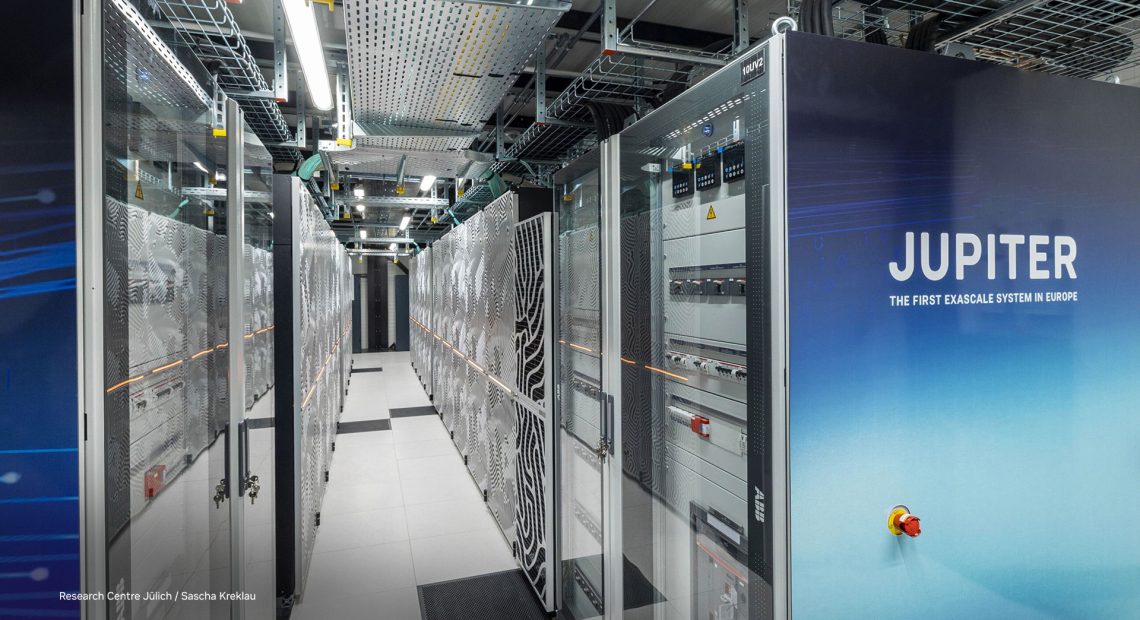
The system’s core architecture includes nearly 24,000 Nvidia GH200 Grace Hopper Superchips and the high-speed Quantum-2 InfiniBand network, enabling more than 90 exaflops of AI performance. With an energy efficiency of 60 gigaflops per watt, it is also the most power-efficient supercomputer in the world at this scale.
The EuroHPC Joint Undertaking owns the system, while France-based Eviden, part of the Atos Group, led its development using the BullSequana XH3000 liquid-cooled infrastructure. Its modular build allowed completion of the data centre in under nine months. The facility is expected to play a key role in addressing some of Europe’s major scientific and industrial challenges.
Early testing with the Linpack benchmark confirmed its capabilities, placing it among the world’s fastest machines.
Jupiter’s computing capacity is intended to support a wide range of research fields, including climate modelling, structural biology, quantum algorithm development, and high-performance simulation.
The machine is also expected to accelerate the development of large-scale AI models. These capabilities are particularly significant at a time when Europe is seeking greater autonomy in science and technology.
Applications include real-time environmental forecasting, digital twin simulations of the Earth for climate research, drug discovery, and advanced manufacturing. It supports hybrid quantum-classical workflows, a feature expected to be crucial as researchers develop quantum algorithms and integrate them with high-performance computing.
The development aligns with Europe’s broader ambitions to enhance its sovereignty in high-tech industries. Officials involved in the project have described it as a strategic step forward for both research and innovation infrastructure on the continent.
While the system is hosted in Germany, access is open to qualified researchers across Europe. Interest in the technology is also growing in regions such as the Middle East, where countries including the United Arab Emirates are investing heavily in advanced computing to support energy modelling, climate resilience, and medical research.
As artificial intelligence becomes increasingly central to scientific discovery and national planning, systems like Jupiter are likely to experience increased global demand. The UAE has previously collaborated with international partners on similar computing initiatives and may look to leverage European exascale computing to boost its own AI development programmes.
Image: Jupiter’s core architecture includes nearly 24,000 Nvidia GH200 Superchips and the high-speed Quantum-2 InfiniBand network. Credit: Nvidia