Kalba’s inaugural Jashe and Sahnah Festival is witnessing broad and diverse participation from leading national fishing supply and processing companies and facilities, alongside a select group of skilled craftspeople, fishermen, and maritime heritage stakeholders.
Organised collaboratively by the Sharjah Chamber of Commerce and Industry (SCCI) and Kalba City Municipality, the four-day festival concludes today, Sunday, in Al Samar neighbourhood in Kalba’s Al Ghail Suburb, drawing thousands of visitors and industry enthusiasts and generating strong heritage and commercial engagement.
As the first event of its kind in the region, the festival has emerged as a landmark cultural and economic celebration that showcases Sharjah’s authentic coastal heritage while reinforcing Kalba’s place in the UAE’s maritime heritage and identity.
The Jashe and Sahnah Festival provides a vital platform for knowledge and expertise exchange among entrepreneurs, productive families, fishing businesses, and stakeholders in fish drying and processing.
Through their displays, leading companies specialising in fishing equipment and fish processing provided local producers with direct exposure to the latest packaging, grading, sorting, and safe fish-drying techniques. This helped them enhance product quality, increase added value, and strengthen their readiness to compete in major distribution channels and access wider consumer markets locally and regionally. These efforts directly contribute to strengthening the sustainable national food security ecosystem built on the effective utilisation of local natural resources.
Khalil Al Mansouri, Chairman of the Jashe and Sahnah Festival’s Organising Committee, said the inaugural edition achieved exceptional success, reflected in the strong visitor turnout and the diversity of its offerings.
He noted that the participation of six national companies and processing facilities, together with more than 85 productive families and leading craftspeople, added a significant investment and industrial dimension to the event. This helped broaden the scope of dried-fish production and distribution from small-scale traditional practices towards high-potential value-added processing industries.
For his part, Ali Mohammed Al Kindi, General Coordinator of Jashe and Sahnah Festival and Director of SCCI branch in Kalba, said the participation of leading fishing supply manufacturers and companies provided fishermen, entrepreneurs, and aspiring young business owners with an opportunity to explore the latest fishing equipment, advanced processing and packaging technologies, and sustainable production solutions.
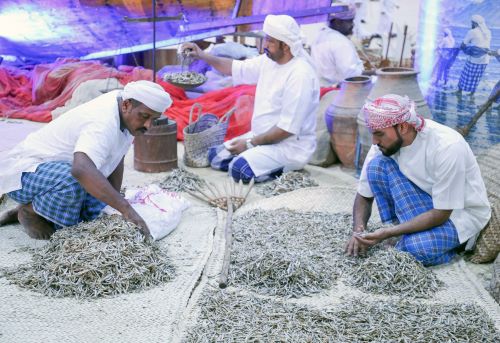
The pavilion of marine craftsman Hashem Juma drew considerable interest from festival visitors, providing a hands-on explanation and a documented account of the traditional Jashe and Sahnah production process.
He explained that the process begins with catching young sardines and anchovies, locally referred to as “Al Barriyah”, using traditional beach fishing nets known as “Al Dhaghwa”. The fresh catch is transported directly from the sea to the sun-drying area, historically called “Al Yirdab”, where it was traditionally spread over smooth pebbles. Modern producers now use drying mats and protective netting to meet stringent health and hygiene standards and protect products from contaminants.
Juma further noted that the fish remain exposed to the sun for three to five days until they are fully dried and acquire the traditional name ‘Jashe’. The dried fish are then sorted and arranged into pyramid-shaped piles known as “Kadas” (plural: Kados), under a traditional cooperative system called “Al Ashr”, whereby the person transporting the harvest is compensated with one Kadas for every ten piles. The product is subsequently packed in jute sacks known as “Al Yawani” and stored in the traditional “Al Bukhār” warehouse before being sold to traders.
He concluded by explaining how Jashe is crushed and pounded in a “Minhaz” (traditional wooden mortar) using a “Madaq” (pestle) to produce Sahnah powder. The powder is traditionally poured hot, together with local ghee and lemon juice, over “Aish” (rice). He emphasised that safeguarding the integrated heritage value chain of “Al Barriyah – Jashe – Sahnah” is a national responsibility, helping preserve ancestral knowledge and skills and pass them on to young people and future generations.
Salem Hammam Mubarak, representing Bahr Al Arab Factory for Animal Feed Meals, highlighted the factory’s over 15 years of expertise in recycling and repurposing marine resources. He noted that the factory is showcasing two key products: “Fishmeal” (fish protein concentrate) and natural organic fertiliser, both manufactured from Jashe raw materials and locally sourced Al Ouma fish.
His participation underscores the festival’s role in highlighting value-added supply chains and circular-economy practices, demonstrating how marine resources can be efficiently repurposed to create products that support the UAE’s agricultural and livestock sectors.
Craftsman Abdulqader Ali captivated festival audiences with finely crafted models showcasing the art of traditional wooden boatbuilding. His handcrafted replicas included historic vessels such as the “Boom”, “Sanbook”, “Shu’i”, and “Jalboot”, complemented by a selection of traditional fishing and pearl-diving tools and equipment.
The displays provided visitors and younger generations with practical insights into traditional boatbuilding techniques and maritime engineering, while highlighting the navigational functions and seafaring roles associated with each vessel throughout the history of the UAE’s coastal heritage.