For historic Moon mission
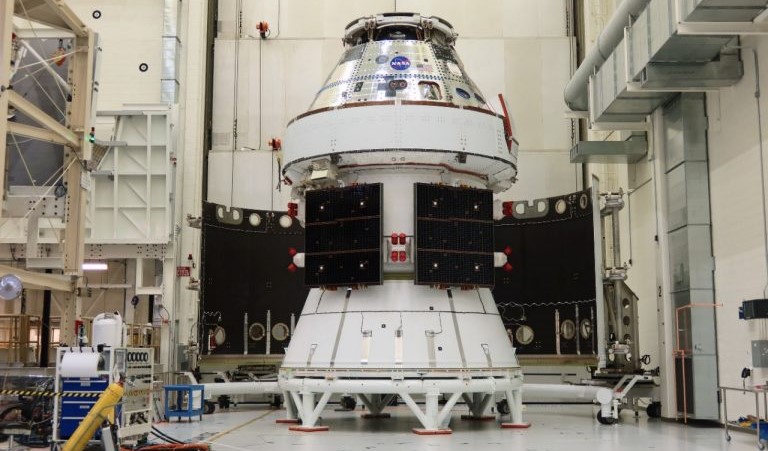
In a landmark achievement for Nasa’s Artemis programme, Lockheed Martin [NYSE: LMT] has completed the assembly and testing of the Orion Artemis II spacecraft, handing the vehicle to Nasa’s Exploration Ground Systems (EGS) team on May 1, 2025.
The key milestone marks the final preparation phase before the spacecraft’s launch in early 2026. The spacecraft will carry four astronauts on a pivotal journey around the Moon.
The handover, which took place at Nasa’s Kennedy Space Center in Florida, signals a crucial transition in the Artemis mission timeline. With the spacecraft now under Nasa’s control, the focus turns to final preparations, including fuelling, integration with the Space Launch System (SLS) rocket, and launch readiness operations.
Orion is the most advanced human-rated spacecraft ever built for deep space missions. Lockheed Martin, Nasa’s prime contractor for Orion, is responsible for designing and producing the crew module, adaptor, and launch abort system.
“This achievement is a testament to our employees and suppliers who have worked tirelessly to get us to this important milestone,” said Kirk Shireman, Lockheed Martin vice president of Human Space Exploration and Orion programme manager.
“The Orion spacecraft completion for Artemis II is a major step forward in our nation’s efforts to develop a long-term lunar presence. It is exciting to think that soon, humans will see the Earth rise over the lunar horizon from our vehicle, while also travelling farther from Earth than ever before.”
The Artemis II mission will be the first time American and Canadian astronauts fly aboard Orion. It builds upon the successes of the uncrewed Artemis I and EFT-1 test flights, which validated many of the spacecraft’s core systems during previous missions.
Unlike its test predecessors, Artemis II’s Orion is outfitted with comprehensive systems designed to sustain life and support astronaut operations during the 10-day mission. These include a robust life support infrastructure, with air, water, thermal regulation and waste management systems.
The crew module now features improved displays, manual and digital controls, a communications suite, an in-flight exercise device and a fully integrated launch abort system. Additionally, Orion carries experimental technology such as a high-speed laser communication system to revolutionise data transmission during deep space travel.
A partial set of docking sensors has been installed to simulate future lunar docking operations. These systems are critical for ensuring precision when astronauts transfer between spacecraft in future missions.
With construction and functional testing now complete, Nasa’s EGS team will guide the spacecraft through the next phase of mission readiness. Orion will be moved from the Neil Armstrong Operations and Checkout Building to several key processing sites across Kennedy Space Center.
Here, engineers will load crucial consumables including water and oxygen, fill the tanks with propellants and install the final elements of the Launch Abort System. Once fully prepared, the spacecraft will be transported to the Vehicle Assembly Building, which will be integrated atop the SLS rocket ahead of its historic flight.
Scheduled for no earlier than early 2026, Artemis II will carry Nasa astronauts Reid Wiseman, Victor Glover, Christina Koch, and Canadian Space Agency astronaut Jeremy Hansen. This will be the first crewed mission to the Moon in over 50 years, and the furthest humans have ever travelled from Earth.
The crew will complete a lunar flyby, reaching approximately 4,600 miles beyond the Moon before returning to Earth. During the mission, they will assess Orion’s flight systems, practice manoeuvres such as rendezvous with the SLS upper stage, and carry out science experiments critical to long-duration spaceflight.
These operations are designed to validate spacecraft performance and astronaut training ahead of Artemis III, the first mission planned to land humans on the Moon since 1972.
Lockheed Martin’s work on Orion does not stop with Artemis II. The company is developing and assembling spacecraft for upcoming Artemis flights. Construction is underway on the Artemis III and IV vehicles, while the pressure vessel for Artemis V is currently being welded at Nasa’s Michoud Assembly Facility in New Orleans.
The long-term goal of the Artemis programme is to establish a sustainable human presence on the Moon, which will act as a proving ground for missions to Mars. Lockheed Martin is under contract to deliver Orion spacecraft through Artemis VIII, with costs decreasing through design optimisations and production efficiencies.
As preparations continue for the next chapter of human spaceflight, the successful delivery of Orion Artemis II marks a significant step forward for lunar exploration and the broader mission to send astronauts to the Red Planet.
Image: The handover of the Orion Artemis II spacecraft took place at Nasa’s Kennedy Space Center in Florida. Credit: Lockheed Martin