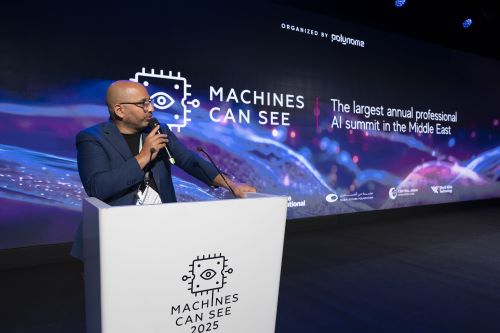
The third edition of Machines Can See (MCS) Summit has concluded at Dubai’s Museum of the Future, marking the largest research‑driven AI gathering ever staged in the Middle East. More than 300 start‑ups pitched to investors from EQT Ventures, Balderton, Lakestar, e& capital and Mubadala. More than 3,500 delegates from 45 countries attended the summit in person, while online engagement reached new heights, with over 3.5 million views on day one and more than 1.2 million views on day two. Real-time updates via the #MCS2025 hashtag are projected to exceed 5 million views across both days.
The summit was hosted by Polynome Group — a UAE‑based deep‑tech ecosystem — under the patronage of H.H. Sheikh Hamdan bin Mohammed bin Rashid Al Maktoum as the main anchor event of the inaugural Dubai AI Week. Strategic backers included Digital Dubai, Dubai Police, Emirates, Amazon Web Services, NVIDIA, IBM, SAP, MBZUAI and other global technology leaders.
“In just three years, MCS has evolved from a specialist meet‑up into a true crossroads for the world’s top minds in science, business and public policy. This week proved that when researchers, entrepreneurs and governments share one stage, we move a step closer to transparent, human‑centred AI that delivers real value for society,” – said Alexander Khanin, Founder & CEO, Polynome Group
Landmark Agreements Announced Live on Stage
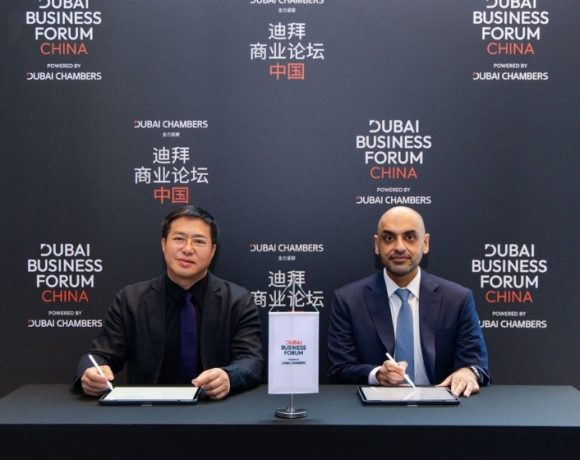
During the two‑day programme, several high‑profile agreements were formally signed in front of the summit audience, including:
- A trilateral Memorandum of Understanding between Astana Hub (Kazakhstan), IT‑Park Uzbekistan and Al‑Farabi Innovation Hub (UAE), creating a Central‑Asia‑to‑MENA soft‑landing platform for high‑growth start‑ups.
- A Google Cloud initiative offering no‑cost “Gen‑AI Leader” learning paths and discounted certification vouchers to accelerate responsible AI adoption across the region.
Additionally, Polynome Group officially launched AI Academy, a strategic educational initiative developed in collaboration with the Abu Dhabi School of Management and supported by NVIDIA’s Deep Learning Institute. The Academy will offer short executive seminars and a specialized four‑month Mini‑MBA in Artificial Intelligence, aimed at equipping leaders and innovators with practical AI knowledge to bridge the gap between technology research and commercial application.
Policy & Talent
Day 1 opened with a ministerial round‑table — “Wanted: AI to Retain and Attract Talent to the Country.” Ministers Omar Sultan Al Olama (UAE), Amr Talaat (Egypt), Gobind Singh Deo (Malaysia), Zhaslan Madiyev (Kazakhstan) and Meutya Hafid (Indonesia) detailed visa‑fast‑track programmes, national GPU clouds and cross‑border sandboxes designed to reverse brain‑drain and accelerate R‑and‑D.
Breakthrough Research
- Prof. Michael Bronstein (University of Oxford / Google DeepMind) demonstrated Geometric Deep Learning applications that shorten drug‑discovery timelines and model subatomic physics.
- Marco Tempest (NASA JPL / MagicLab.nyc) blended GPT‑4o dialogue with mixed‑reality holograms, turning the stage into an interactive mind‑map.
- Prof. Michal Irani (Weizmann Institute) showed perception‑to‑cognition systems capable of reconstructing scenes from a single gaze sequence.
- Andrea Vedaldi (Oxford) premiered a 3‑D generative‑AI pipeline for instant city‑scale digital twins, while Marc Pollefeys (ETH Zurich / Microsoft) demonstrated real‑time spatial mapping at sub‑10 ms latency.
Industry Workshops & Panels
AWS ran a hands‑on clinic — “Building Enterprise Gen‑AI Applications” — covering RAG, agentic orchestration and secure deployment. NVIDIA’s fully booked workshop unveiled its platform approach to production generative‑AI on Hopper‑class GPUs, complementing its newly announced Service Delivery Partnership with Polynome Group’s legal entity, Intelligent Machines Consultancies L.L.C. Dubai Police hosted a closed‑door DFA session on predictive policing, while X and AI workshops explored social‑data pipelines on GPU clusters.
The parallel Machines Can Create forum examined AI’s role in luxury, digital art and media with speakers from HEC Paris, The Sandbox, IBM Research and BBC, culminating in the panel “Pixels and Palettes: The Canvas of Tomorrow.”
Prof. Marc Pollefeys, Director of the Mixed Reality and AI Lab at ETH Zurich and Microsoft, highlighted the role of cutting-edge technology in daily life: “We are at a turning point where technologies like spatial AI and real-time 3D mapping are moving from laboratories into everyday life, transforming cities, workplaces, and even how we interact with the digital world. The Machines Can See Summit underscores how collaboration between researchers, industry, and policymakers accelerates this transition, bringing innovative solutions closer to everyone.”
Ethical & Security Focus
Panels “Good AI: Between Hype and Mediocrity” and “Defending Intelligence: Navigating Adversarial Machine Learning” stressed the need for continuous audits, red‑teaming and transparent supply chains. Dubai Police, TII UAE and IBM urged adoption of ISO‑aligned governance tool‑kits to safeguard public‑sector deployments.
High‑Profile Awards
On Day Two, H.H. Sheikh Hamdan bin Mohammed bin Rashid Al Maktoum personally presented trophies for the Global Prompt Engineering Championship, honouring breakthroughs in multilingual, safety-aligned LLM prompting.