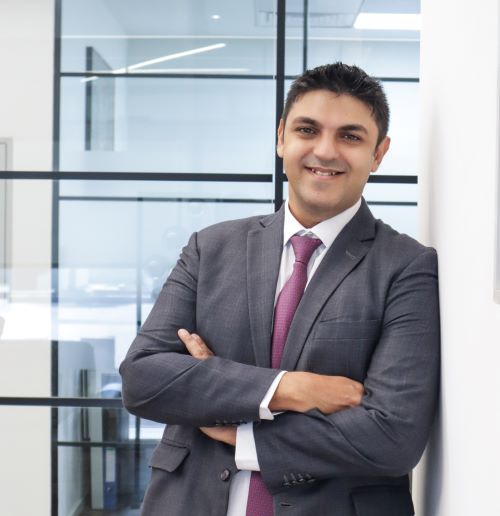
Vijay Valecha, CIO, Century Financial
The Federal Reserve’s decision to hold interest rates steady, while projecting just one quarter-point cut later in 2026 (and another in 2027), means interest rates are likely to remain stable in UAE.
Globally, Investors have scaled back expectations for multiple 2026 reductions, with federal-funds futures still pricing in only one cut by year-end. The Fed’s modest upgrade of 2026 growth to 2.4 % and steady 4.4 % unemployment means multiple rate cuts would be tough to come by this year . Crucially, central bankers continue to view energy-price jumps triggered by regional tensions as temporary, providing no justification for tightening. So rate hikes also are ruled out at this point of time.
Since the UAE dirham is pegged to the US dollar, the Central Bank of the UAE (CBUAE) has historically followed the US Fed policy to preserve currency stability. So the, UAE benchmark rates are expected to remain unchanged in the coming months. This stability should keep mortgage and personal-loan rates steady, which would be a welcome relief for UAE businesses and consumers battling external geopolitical pressures.

Madhur Kakkar, Founder & CEO, Elevate Financial Services
The Fed holding rates feels like a textbook decision in a very non-textbook environment. With the Iran–Israel conflict now into its third week and disruptions in the Strait of Hormuz putting as much as 10 million barrels per day of Gulf supply at risk, inflation risks are clearly being driven by geopolitics, not just domestic data. Powell’s tone reflected that balance — acknowledging energy-driven inflation pressures while maintaining that policy remains “well-positioned.” For investors, this reinforces that we are in unconventional times where policy lags real-world shocks. For investors, this reinforces the need to stay flexible, focus on short-term opportunities, and maintain liquidity — because in this cycle, the ability to move quickly matters more than long-term positioning.

Aliasgar Tambawala, Co-CIO at Klay Group
The Federal Reserve delivered a broadly neutral policy outcome at its March meeting, underscoring a clear “wait-and-watch” stance amid rising geopolitical uncertainties, particularly from the Middle East. The target range for the federal funds rate was left unchanged at 3.5–3.75%, with only one dissent from Governor Stephen Miran, who favoured a 25bp cut. Importantly, the updated Summary of Economic Projections (SEP) continues to signal a shallow easing cycle, with the median expectation of one rate cut each in 2026 and 2027. Seven participants see no cuts in 2026, while the distribution of rate projections has narrowed, suggesting growing convergence around a “higher-for-longer” stance.
Inflation forecasts were revised modestly higher, with both headline and core PCE expected to remain elevated over the next two years. Growth projections were upgraded across the horizon, pointing to continued economic resilience. The labour market outlook remains broadly stable, with unemployment expected to hover near current levels.
Chair Powell struck a balanced tone, highlighting that risks to inflation and employment are now more symmetric. He emphasised that policy remains “mildly restrictive” and appropriate given persistent inflation and potential oil price shocks. Overall, we believe that while near-term risks have risen, particularly from energy markets, the macro backdrop differs materially from 2022, suggesting that limited rate cuts—potentially one to two—remain plausible, albeit likely pushed into the second half of 2026.