
In race for Moon resources
Nasa has confirmed the selection of three new scientific instruments to support its upcoming lunar missions, signalling a renewed focus on mapping, analysing, and understanding the Moon’s surface and subsurface. Two of the instruments will be integrated into a new lunar rover, while the third will orbit above, providing data on the broader lunar environment.
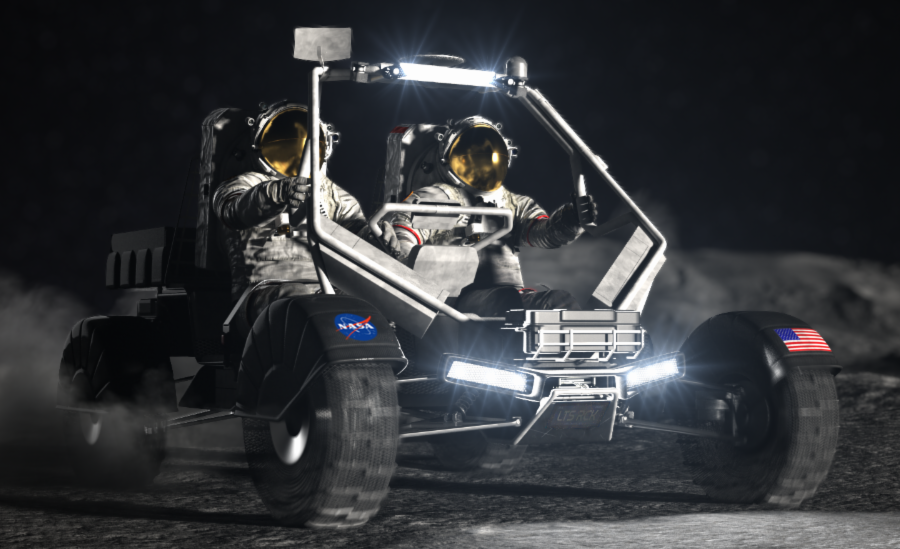
This move is part of Nasa’s Artemis programme, which aims to return humans to the Moon and lay the groundwork for future missions to Mars. The Artemis Lunar Terrain Vehicle, or LTV, is central to this plan. It will be the first crew-driven vehicle to operate on the Moon in over five decades, able to transport two astronauts or function remotely when unoccupied.
The newly selected instruments are intended to unlock insights into lunar geology, water deposits, and other volatiles — substances that vaporise at low temperatures — which are of increasing interest to space agencies and private operators aiming to exploit extraterrestrial resources.
The first of the instruments, the Artemis Infrared Reflectance and Emission Spectrometer (AIRES), will be used to identify and map minerals and volatiles on the Moon’s surface. The device will collect infrared spectral data, helping researchers determine the distribution of materials such as water ice, carbon dioxide, and ammonia in the Moon’s south polar region. This area has drawn global attention due to its permanently shadowed craters that may contain frozen water.
The second tool, known as the Lunar Microwave Active-Passive Spectrometer (L-MAPS), will examine what lies beneath the surface. It features both ground-penetrating radar and a microwave spectrometer, allowing scientists to assess the temperature, density, and structure of subsurface layers up to 40 metres deep. Its primary aim is to identify potential ice deposits and other geological features that could inform both future habitation efforts and scientific exploration.
A third instrument, the Ultra-Compact Imaging Spectrometer for the Moon (UCIS-Moon), will not be mounted on the LTV but will instead be launched on a future orbital mission. UCIS-Moon will observe the Moon from space, offering wide-area imaging of geology, volatiles, and how human activity may be altering these elements. Its high-resolution data will help determine areas suitable for sample collection and give mission planners the broader context required for future landings.
Together, the three instruments are expected to provide a detailed understanding of the Moon’s composition and evolution. Nasa says the data will not only guide astronaut activity but also improve understanding of planetary bodies across the solar system. The research will directly support ongoing discussions about in-situ resource utilisation, which has become a central theme in long-term lunar strategy.
Nasa has worked with three private vendors — Intuitive Machines, Lunar Outpost, and Venturi Astrolab — to review early designs for the LTV. These reviews confirmed that the vehicles meet technical requirements, with clearly defined interface systems and verification protocols. A final decision on which vendor will lead the demonstration mission is expected by the end of 2025.
The LTV will operate in some of the Moon’s most rugged and uncharted terrain. Unlike the Apollo-era rovers, which were limited in range and mobility, the Artemis LTV is expected to explore broader regions autonomously and support longer-duration missions.
The south polar region, in particular, has become a key area of strategic importance for both scientific and practical reasons. The presence of water ice could support life-support systems, fuel production, and other technologies critical to establishing a long-term human presence on the Moon. With rising geopolitical interest in the Moon’s potential, Nasa’s exploration strategy reflects a global push for lunar access.
Nasa’s Artemis programme is not solely about returning astronauts to the Moon. It is designed to address major science questions that can only be answered through direct human and robotic exploration. The data gathered from both surface and orbital instruments will shape future missions, including the first human missions to Mars.
In the Middle East, where space exploration is gaining momentum, the latest Nasa developments are likely to be closely watched. The UAE’s Mohammed bin Rashid Space Centre has already signalled interest in lunar science through its Rashid rover missions. Increased international cooperation on lunar infrastructure and research may open new opportunities for partnerships between Nasa and regional space agencies.
Image: An artist’s rendering of Nasa’s Lunar Terrain Vehicle. Credit: Nasa