Leading rare book dealer Peter Harrington will return to the Abu Dhabi International Book Fair later this month, presenting an extraordinary catalogue of rarities that resonate strongly with Middle Eastern history, heritage, and cultural identity.
Among the standout pieces this year are rare documents that capture Saudi Arabia’s post-war attempt to revive the Hejaz Railway, and fascinating Arabic-English phrasebooks from 19th-century Egypt. The fair list features a compelling mix of Islamic and Western material, reflecting the growing global appetite for spotlighting themes of cross-cultural exchange, and spotlighting formative periods in the region’s history and development.
“These works carry value that goes far beyond their rarity – they speak to identity, memory, and belonging,” says Pom Harrington, Owner of Peter Harrington. “We’ve seen increasing interest around items like early regional cookbooks that document recipes from ordinary households, or a phrasebook designed to help Egyptians learn English during a time of cultural shift. It’s not just collectors in the Middle East, but across the diaspora – people are building collections that reflect their personal histories.”
Highlights from the Abu Dhabi Fair List include:
- A Photographic Archive of the Hejaz Railway (1948) – A never-before-seen visual record of Saudi Arabia’s ambitious post-war project to revive the Hejaz Railway. Over 200 photographs show rare scenes from Medina to Tabuk. £18,500
- Kitab al-Ibriz (1877) (The Book of Pure Gold) – A scarce and fascinating Arabic-English phrasebook that phonetically transliterates English using Arabic script –designed as a tool for Arabic speakers to learn English, rather than the reverse. This rare inversion of the typical colonial language dynamic is all the more remarkable for its Arab authorship, and the fact that no other copy has been traced. £7,500
- The Kentuckian in New-York (1834) – An early American novel that features what may be the first printed Arabic script in U.S. literature, based on the handwriting of an enslaved Fula Muslim character. £7,500
- Two Glorious Years in the History of the Emirate of Abu Dhabi (1968) – A richly illustrated account from the dawn of Sheikh Zayed’s leadership, filled with optimism and national pride. £10,000
- Voyage d’exploration à la Mer Morte et Petra (1874) – A visual and scientific landmark, this work includes some of the earliest published photographs of Petra and the Dead Sea, and helped establish the photobook as a genre. £19,500.
- Kitab al-Aqalim (“The Book of Climes”) The first and only printing of a scarce lithographic facsimile reproducing the earliest surviving dated Arabic maps – a complete reproduction of al-Istakhri’s manuscript. Given the rarity of medieval Islamic maps, facsimiles such as this provide an important window onto a fascinating period in the history of cartography. £45,000
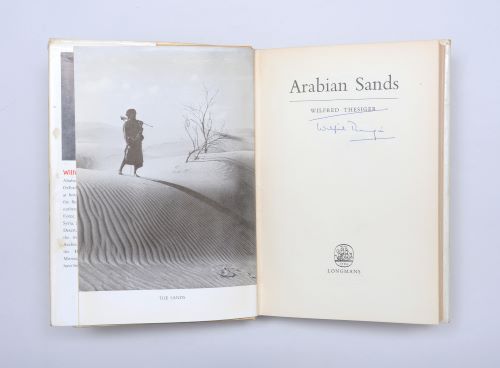
- First edition of Thesiger’s acclaimed debut Arabian Sands, signed by the author and bearing the rare thumbprint signature of Salim bin Ghabaisha, his Bedouin guide and the book’s dedicatee – a powerful testament to their partnership. No other copy bearing bin Ghabaisha’s signature thumbprint can be traced. £12,500
- Original Edmund Dulac Artwork for The Arabian Nights (1907) – Two mesmerising watercolours created for the book that defined Dulac’s career. Steeped in moonlit mystique, they celebrate the enduring allure of Arabic storytelling.
- “She went on to vent her malice upon the city and islands” – £35,000
- “And taking her hand he led her to the apartments of the Queen Pirouze” – £80,000
- Moorish Recipes (1954) – Possibly the first English cookbook focused solely on North African cuisine, printed in a limited run. Compiled by the 4th Marquess of Bute from Moroccan households. £1,850
- Euclid’s Elementa Geometriae (1482) – The first printed edition of Euclid’s seminal work, derived from Arabic translations by medieval scholars. A foundational text in mathematics and scientific thought. £250,000
Young Collector Trends
“There’s been a noticeable shift in the rare book world globally – and this is becoming increasingly evident in the Middle East as well. Younger collectors are not inheriting family libraries; they’re building collections from scratch that reflect their identities, values, and cultural interests. We’ve recently opened our first rare book gallery in New York City and we see this trend in every market we sell to,” adds Ben Houston, Sales Director at Peter Harrington.
In the Middle East, this shift ties into a broader cultural movement to rediscover and reclaim regional heritage — especially in the UAE, Saudi Arabia, and Qatar, where national identity and cultural pride are heavily reflected in the national museums and contemporary cultural spaces. Governments and institutions are heavily investing in cultural initiatives, and this is filtering down into personal interests.
We see curators and young collectors from the region drawn to Arabic calligraphy, Islamic philosophy, and early scientific texts — especially works by Arab or Muslim scholars that shaped the global intellectual tradition. Other trends include an exploration of “diasporic heritage” – books and materials that trace family roots, migration, or cross-cultural exchanges, such as early maps or trade route documentation. Collectors are also often more aesthetic in their approach, placing value on the beauty and craftsmanship of bindings, illuminations, and marginalia. Our thoughtfully curated collection includes examples that speak to several of these collector interests,” adds Houston.
Museums like the House of Wisdom in Sharjah, the upcoming Zayed National Museum, and initiatives by Misk Art Institute in Saudi Arabia are playing a key role in driving awareness and interest in these themes by creating immersive exhibitions that showcase rare manuscripts and antiquarian books in visually stunning and interactive ways, encouraging public engagement with heritage, especially among students and emerging creatives and even hosting workshops and talks that demystify collecting and conservation.
“This growing accessibility is making the rare book world feel more approachable, further fuelling interest from a younger demographic. We are seeing these trends across the world, and certainly in the Middle East,” adds Harrington.