As military space tech interest surges
The United States Space Force is set to launch the eighth mission of its experimental X-37B spacecraft on August 21, 2025. The classified test vehicle will lift off aboard a SpaceX Falcon 9 rocket from Kennedy Space Center in Florida, under mission designation USSF-36.
The uncrewed spacecraft will carry out a range of experiments during its time in orbit, including demonstrations of laser-based inter-satellite communication and new navigation technologies. Among them is what the Space Force described as the most advanced quantum inertial sensor yet deployed in space.
The X-37B Orbital Test Vehicle, developed in secrecy, has previously been used to test several space-related technologies, including power-beaming systems and long-duration orbital endurance. Since its first flight in 2010, the platform has spent a total of 4,208 days in orbit, often for more than a year at a time. Its last mission lasted 908 days and landed in November 2022.
Although many details of the upcoming mission remain classified, past launches have demonstrated capabilities that hint at broader military objectives. These have included changes in orbital path via atmospheric manoeuvring, tests of space domain awareness tools, and exposure of biological samples to space radiation.
The current mission extends this approach with an emphasis on data transmission and inertial navigation—both considered vital for autonomous operations in contested or GPS-denied environments.
Unlike previous missions that used United Launch Alliance’s Atlas V rockets, this launch will mark the second time the X-37B flies on a SpaceX Falcon 9, further solidifying the company’s role in US military space operations. SpaceX has become a key launch partner for both commercial and defence customers, with its reusable systems significantly reducing the cost and turnaround of orbital missions.
Analysts suggest that the quantum navigation system onboard the X-37B could help reduce dependence on satellite-based GPS, which is vulnerable to jamming and spoofing—both of which have been reported in conflict zones across the Middle East and Eastern Europe.
According to the European Space Agency, incidents of GPS interference have increased by over 60% globally in the past five years, many occurring in or near active military theatres.
The launch comes amid growing concerns about the militarisation of low Earth orbit. China, Russia, and India have each demonstrated anti-satellite capabilities in recent years, while Western space agencies are increasingly speaking about the need for “space resilience.”
While the mission objectives of X-37B remain largely undisclosed, the timing is significant. It comes during a period of heightened geopolitical tension and accelerated space activity. In 2024, the global space economy was valued at over $630 billion, according to data from Morgan Stanley, with a projected rise to over $1 trillion by 2030. Military expenditure on space-based assets is expected to account for nearly a quarter of that growth.
The X-37B’s extended orbital missions offer the US a platform for testing technologies that might later be integrated into both commercial and defence applications. As space becomes an increasingly contested domain, the ability to test new tools—particularly in navigation, communications, and power—could prove decisive in future satellite-based operations.
No end date has been announced for Mission 8. The spacecraft is designed for long-duration flight and can remain in orbit for hundreds of days before returning to Earth for analysis and refurbishment.
As global interest in military space technology continues to grow, the X-37B serves as a key example of how the US is advancing its orbital capabilities. The United Arab Emirates, Saudi Arabia, and other Gulf nations have been increasingly investing in space technology, though their programmes remain primarily civilian in focus.
However, observers in the Middle East are closely watching developments in military space programmes due to the potential implications for regional security and surveillance.
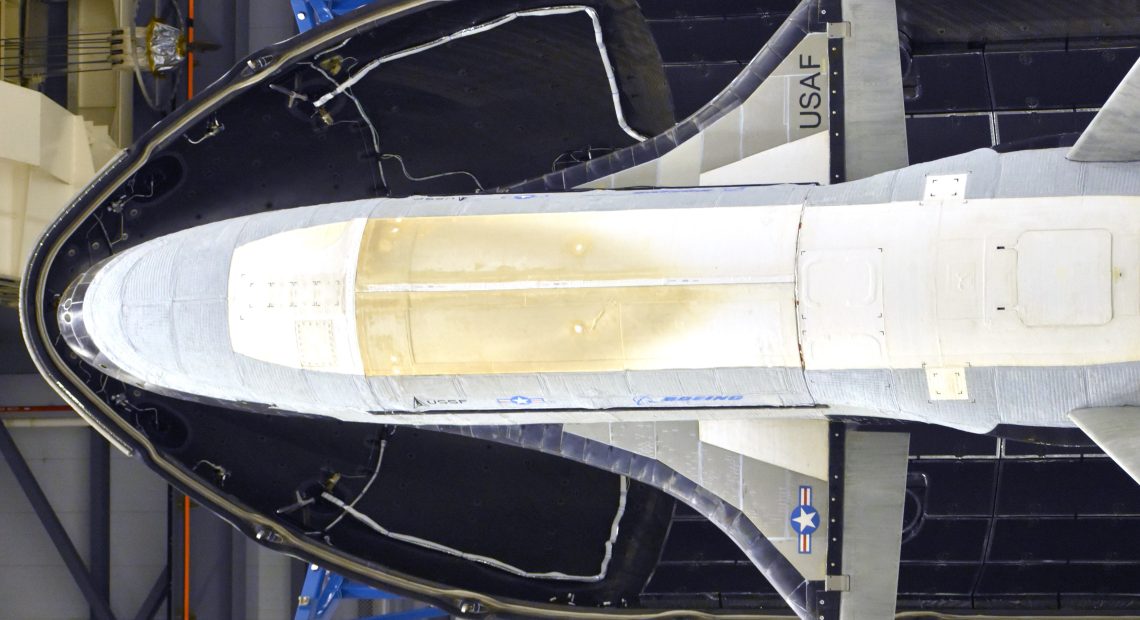
Image: America’s X-37B is a dynamic and responsive spacecraft responsible for conducting a range of tests and experiments that expedite the development of critical next-generation technologies and operational concepts for reusable space capabilities. Credit: US Space Force