Photo Credit: WAM
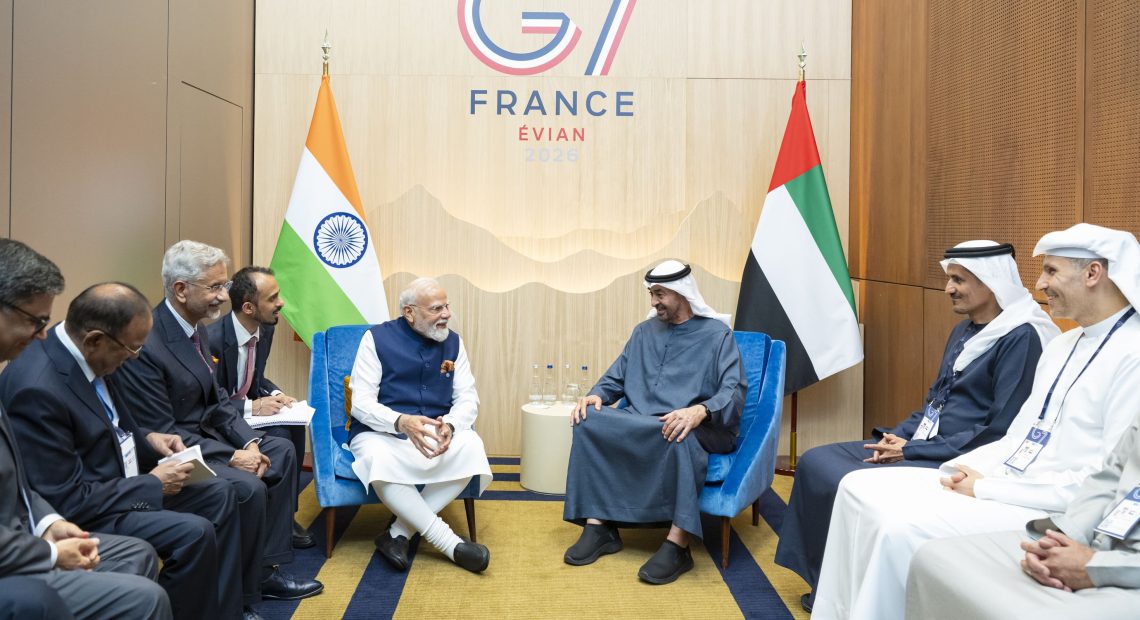
Dubai, UAE — June 2026 — His Highness Sheikh Mohamed bin Zayed Al Nahyan, President of the United Arab Emirates, held a bilateral meeting on June 17 with His Excellency Narendra Modi, Prime Minister of the Republic of India, on the sidelines of the G7 Summit currently underway in the French city of Évian.
According to the Emirates News Agency, the two leaders reviewed the broad spectrum of cooperation between their countries, with particular emphasis on technology and artificial intelligence, areas both nations regard as central engines of tomorrow’s economy.
Discussions reflected the shared ambition of the UAE and India to harness innovation and emerging technologies as drivers of sustainable development and long-term prosperity.
The meeting took place within the framework of the Comprehensive Strategic Partnership and the Comprehensive Economic Partnership Agreement binding the two countries, with both leaders reaffirming their commitment to advancing the bilateral relationship in ways that serve the mutual development interests of their respective peoples.
Sheikh Mohamed and Prime Minister Modi also exchanged assessments on the evolving situation across the Middle East, discussing regional developments and aligning their perspectives on key geopolitical matters.
The two leaders further addressed the issues on the G7 agenda, underlining the summit’s significance as a platform for strengthening international cooperation in confronting shared global challenges and fostering collective prosperity.
The relationship between the UAE and India stands among the most robust bilateral partnerships in the wider Gulf-South Asia corridor. Home to approximately 3.5 million Indian nationals, the largest expatriate community in the Emirates, the UAE has long served as a critical gateway for Indian talent, trade, and capital into the broader Middle East and beyond.
The two countries elevated their ties to a Comprehensive Strategic Partnership in 2017, a framework that has since underpinned growing collaboration across defence, trade, energy, and technology.
A landmark in recent years was the signing of the CEPA in February 2022, which came into force just months later and has driven a significant uptick in bilateral non-oil trade, targeting an ambitious threshold of $100 billion annually.