
Nick Spencer-Skeen, Senior Executive Officer, Lunaro Financial Markets
Friday Closing Prices
- S&P 500 7,501 (+1.08%)
- Nasdaq 26,518 (+1.91%)
- Gold $4,155 (-1.27%)
- Brent Crude Oil $80.37 (+1.41%)
Last week was defined by the collision between central-bank hawkishness and geopolitics.
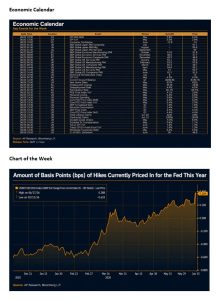
The market rally early in the week on the basis of a US/Iran peace deal was interrupted by Kevin Warsh’s first Fed meeting as Chair, where a hawkish hold shifted the market back toward inflation control. 2-year Treasury yields rose 13bps, the largest one-day jump since April 2025, while money markets moved to fully price a Fed hike by October. The dollar strengthened as leveraged funds bought call options, and USD/JPY pushed higher, raising Japanese intervention risk (more on that below).
The penning of the US-Iran peace deal on Thursday took some pressure out of energy markets, with Brent crude down over 16% over the past two weeks as sentiment has improved.
Moving back to central-bank action, tightening was not limited to the US. The Bank of Japan raised rates 25bps to 1.0%, the highest since 1995, while the Bank of England held at 3.75% in a 7-2 vote, with two members voting for a hike.
In the equity space, the Stoxx Europe 600 was a notable outperformer, hitting a record high, helped by lower oil and rotation into European risk.
Emerging markets also found support from improving earnings, though weak Chinese data, including a 0.6% year-on-year fall in retail sales, remained a drag. The week ended with a US national holiday, causing a pre-mature finish, but providing plenty of time for traders to digest events ahead of another busy week. This week, we expect to see continued geopolitical headline sensitivity, along with US inflation data in the spotlight.
Warsh Rewrites the Fed Script
Part of the move in assets to start the week will reflect the continued digestion of the Fed meeting from last Wedneday.
It certainly marked a hawkish reset under new Chair Kevin Warsh. The FOMC held the funds range at 3.50-3.75%, but the language and projections moved firmly against the cut trade. The statement noted that inflation remained “elevated relative to the committee’s 2% goal.” Warsh’s key line was his pledge that the FOMC was “unambiguous and unanimous” and “will deliver price stability.” US equity markets knee-jerked lower on the news. The median summary of economic projections (SEP) showed inflation at 3.6% this year, unemployment at 4.3%, and the funds rate ending 2026 at 3.8%. Warsh also stripped out forward guidance and provided a very short 130 word statement, as well as announcing a new task force covering communications.
The concern going forward is that should we see inflation gauges move higher, the Fed could be pushed to raise rates earlier than currently factored in by rates markets. Speaking of inflation…
The Next Inflation Gut Check
After the Fed’s hawkish pivot, the major data event comes on Thursday with the May Personal Consumption Expenditures (PCE) inflation print. Given the push from Warsh toward inflation control, the market is now looking to see if the recent energy shock is starting to bleed into the Fed’s preferred measure of price pressure.
The consensus setup is not especially friendly. Headline PCE is expected to rise by 0.5% month-over-month, lifting the annual rate to 4.1%, from 3.8% in April. Core PCE is expected to rise by 0.3% month-over-month, taking the annual rate to 3.4%, up from 3.3% previously. That would keep underlying inflation materially above the Fed’s 2% target and reinforce the message from last week’s meeting that policy is not yet restrictive enough to declare victory.
The CPI report already showed the headline problem clearly. May CPI rose 0.5% month-over-month and 4.2% year-over-year, with energy prices up 3.9% on the month and accounting for more than 60% of the monthly gain. Whether PCE will paint a similar story remains to be seen.
For markets, a firm headline and core print keeps cuts dead and hike risk alive. A softer core number would help risk assets, but it would need to be meaningfully soft to unwind the Fed’s new hawkish bias.
Watching Out on USD/JPY
Intervention risk in USD/JPY looks elevated this week, with the pair now trading back in the zone where Tokyo has already shown a willingness to step in. The yen closed the week at 161.25 per dollar and touched 161.81 on Thursday, putting it within touching distance of the 2024 trough at 161.96. A break above that level would take the yen to its weakest point since 1986, making the political optics increasingly difficult for Japanese officials to ignore.
The issue is not just the level, but the speed and composition of the move. Japan’s Ministry of Finance has already spent ¥11.735tn, roughly $73bn, on intervention between April 28 and May 27, the largest one-month operation on record. Yet USD/JPY has effectively retraced the move, with the yen again pressured by the wide US-Japan yield gap and higher Japanese imported energy prices.