

ServiceNow survey reports
A new survey by ServiceNow, the Santa Clara, California-based AI platform for business transformation, reveals that UAE consumers are increasingly seeking emotionally intelligent AI in customer service interactions. The ServiceNow Consumer Voice Report 2025, conducted in partnership with Opinium, surveyed 17,000 adults across 13 countries in the EMEA region, including 1,000 in the UAE.
The findings underscore a growing demand for AI that not only delivers efficiency but also understands and responds to human emotions.
Between January 10 and 17, 2025, ServiceNow surveyed 17,000 nationally representative adults in the UK, Ireland, France, Spain, Germany, Belgium, Austria, Italy, Saudi Arabia, the UAE, Sweden, Switzerland, and the Netherlands.
Despite the widespread adoption of AI in customer service, UAE consumers express a clear preference for human interaction. At least 68% of respondents prefer to interact with people for customer support, attributing this preference to the perceived lack of emotional intelligence in AI.

Over half (54%) of UAE consumers believe that failing to understand emotional cues is more characteristic of AI than humans. Similarly, 51% feel that agents having a limited understanding of context are more likely to be AI, and an equal number (51%) say that misunderstanding slang, idioms, and informal language is more likely to be AI. Furthermore, nearly two-thirds (64%) of UAE consumers associate repetitive or scripted responses with artificial intelligence (AI).
William O’Neill, Area Vice President for the UAE at ServiceNow, stated: “The key takeaway for business leaders is that AI can no longer be just another customer service tool – it has to be an essential partner to the human agent. The future of customer relationships now lies at the intersection of AI and emotional intelligence (EQ). Consumers no longer want AI that gets the job done; they want AI that understands them.”
The report also highlights a trust gap between consumers and AI, particularly concerning urgent or complex requests. While UAE consumers embrace AI for speed and convenience in low-risk tasks—23% trust an AI chatbot for scheduling a car service appointment and 24% for tracking a lost or delayed package—confidence drops for more sensitive issues.
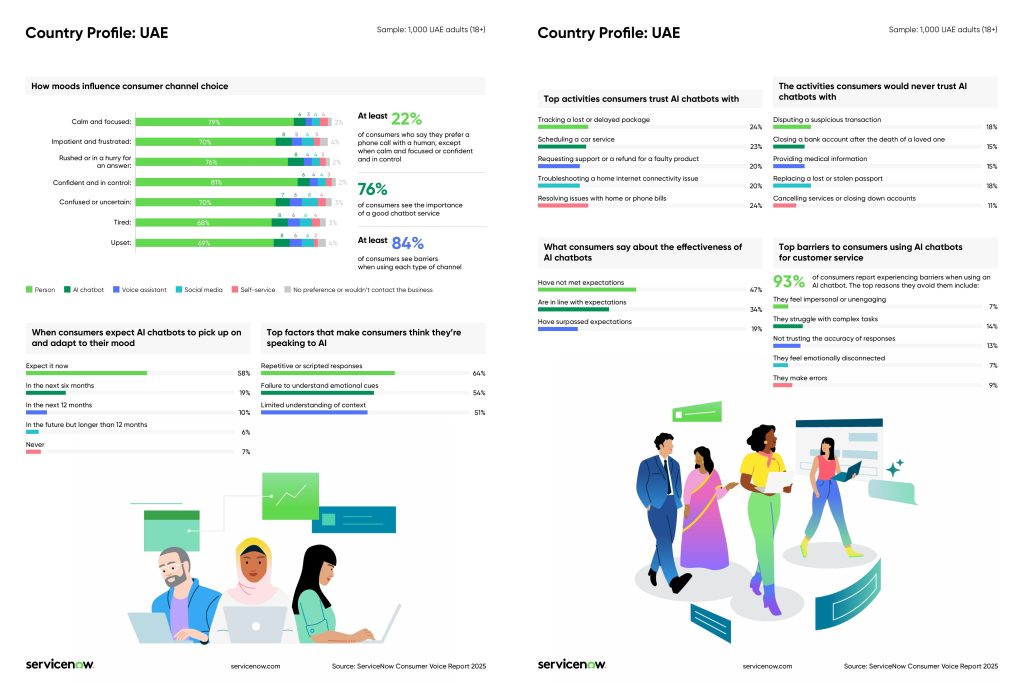
Only 13% would trust AI to dispute a suspicious transaction on their bank account, with 43% preferring to handle this in person. Similarly, when troubleshooting a home internet issue, only 20% are comfortable relying on an AI chatbot, while 50% prefer to speak with someone on the phone.
This trust gap underscores the need for AI systems that not only perform tasks efficiently but also build and maintain consumer trust through empathetic and context-aware interactions.
Despite concerns, UAE consumers acknowledge the importance of AI in delivering exceptional customer experiences. The research indicates that consumers consider AI crucial for organisations aiming to meet their expectations. In addition to seamless service (90%), quick response times (89%), and accurate information (88%), more than three-quarters (76%) expect organisations to provide a good chatbot service.
Moreover, 85% of consumers in the UAE expect the option for self-service problem-solving, indicating a desire for organisations to integrate AI insights and data analysis into service channels to anticipate customer needs before they arise.
O’Neill added: “While AI in customer service is currently falling short of consumer expectations, it is not failing. Rather, it is evolving. There is an opportunity for businesses to refine AI by empowering it with the right information, making it more adaptive, emotionally aware, and seamlessly integrated with human agents to take/recommend the next best action and deliver unparalleled customer relationships.”
The findings of the ServiceNow Consumer Voice Report 2025 suggest that consumers are not rejecting AI but are advocating for its evolution. They desire AI systems that are not only efficient but also emotionally intelligent and capable of understanding context.
This shift in consumer expectations presents a significant opportunity for businesses to enhance their customer service strategies by integrating AI that complements human agents and addresses the emotional nuances of customer interactions.
Hero image: When troubleshooting a home internet issue, only 20% are comfortable relying on an AI chatbot, while 50% prefer to speak with someone on the phone. Credit: Mikhail Nilov