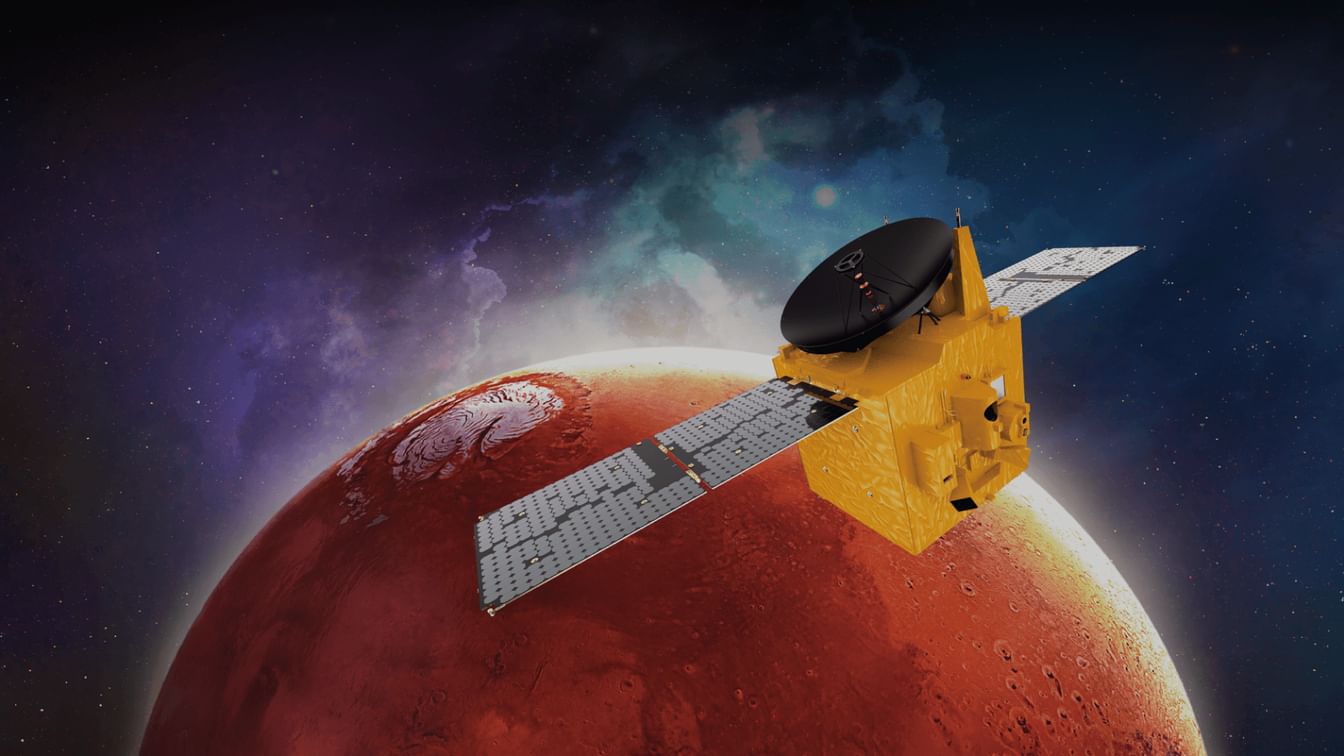
Photo Credit: WAM
Dubai, UAE — February 2026 — The UAE Space Agency has announced a formal extension of the Emirates Mars Mission, the first interplanetary exploration undertaken by an Arab nation, extending operations of the Hope Probe until 2028.
Building on the exceptional performance and durability of the spacecraft, the extension aims to maximize the scientific, operational, and strategic returns of the mission, according to the Emirates News Agency.
Over the next several years, the probe will continue to provide unique data on the Martian atmosphere while serving as a foundational asset for training national talent and supporting future deep space endeavors.
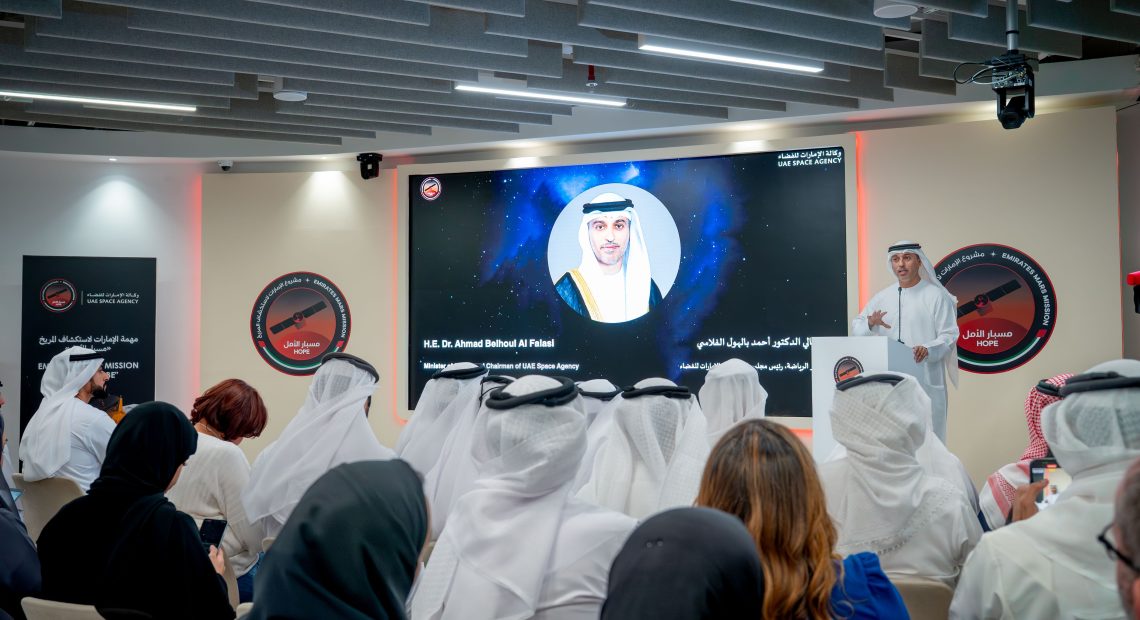
Minister of Sports and Chairman of the Board of Directors of the UAE Space Agency, Ahmad Belhoul Al Falasi, stated that extending the mission reflects the UAE’s commitment to leveraging its space investments for the maximum benefit of both the nation and the global scientific community.
He emphasized that the project underscores the UAE’s dedication to using space science to serve humanity, deepen the understanding of climate dynamics, and build a future rooted in knowledge and innovation.
Al Falasi noted that the Hope Probe represents a long-term strategic choice aligned with the leadership’s vision of the space sector as a pillar of a sustainable knowledge economy.
The extension decision, he explained, demonstrates confidence in the capabilities of national teams and the probe’s technical readiness, reinforcing that the mission is not a temporary milestone but a sustained trajectory that strengthens the UAE’s global standing.
Since entering Mars’ orbit in 2021, the Hope Probe has driven significant progress in scientific output and contributed to the expansion of the national space ecosystem. Between 2020 and 2025, the number of entities operating in the sector has tripled, with notable growth in research and development investment.
The number of UAE universities offering aerospace engineering and space-related degree programs has also approximately doubled, reflecting a rapid expansion of the talent pipeline.
In October 2025, the mission expanded its scientific reach beyond Mars by capturing a series of images of Comet 3I/ATLAS. Using the EXI and EMUS instruments, the spacecraft redirected its focus from the Red Planet to capture the interstellar object in visible and ultraviolet wavelengths.
The comet, only the third ever detected entering our solar system, made its closest approach to Mars on 3 October 2025, passing within 30 million kilometers of the planet.
Originally launched as a two-year mission, the Hope Probe has far exceeded its initial objectives. It has made pioneering discoveries of Martian auroral phenomena and conducted groundbreaking fly-bys of Mars’ moon Deimos, offering new insights into its origins.
While the mission initially aimed to collect one terabyte of atmospheric data, it has already gathered ten terabytes, shared with over 200 academic and research institutions through 16 separate data releases.
Director-General of the UAE Space Agency, Salem Butti Al Qubaisi, described the extension as a testament to the probe’s robust design and its enduring contributions to Mars science and the national sector.
He noted that the mission has generated more than 35 peer-reviewed scientific papers and has been central to transforming the UAE’s education, innovation, and research ecosystems, creating tens of thousands of potential career opportunities.
Director of Space Missions at the agency, Mohsen Al Awadhi, added that the mission has exceeded all expectations, not only in scientific discovery but in reshaping the technological and educational landscape of the UAE.
The operational experience gained from extending the Mars mission is expected to directly benefit the upcoming Emirates Mission to the Asteroid Belt, which aims to conduct an extensive survey of the main asteroid belt.