Dubai, UAE — March 2026 — When the world’s most critical maritime chokepoint becomes a battleground, the consequences ripple far beyond oil markets, reaching factory floors, farmlands, and family budgets across the globe.
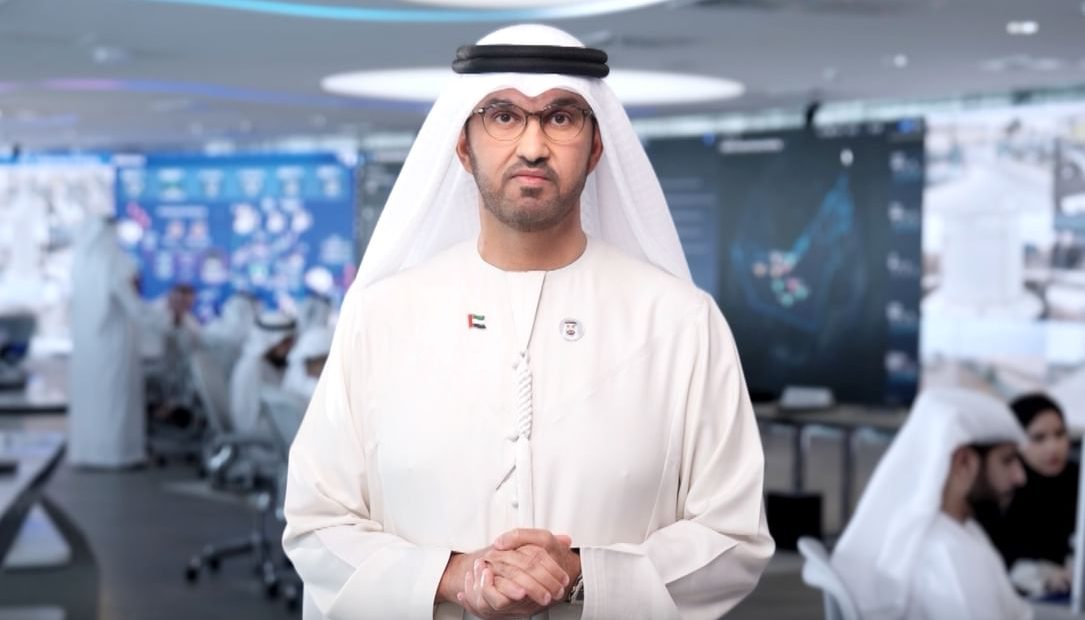
That was the stark warning issued today by Sultan bin Ahmed Al Jaber, the UAE’s minister of industry and advanced technology, who described any attempt to weaponise the Strait of Hormuz as an act of economic terrorism with exponential human cost.
Speaking at CERAWeek in Houston, Texas, Al Jaber, who also serves as managing director and group CEO of ADNOC, chairman of Masdar, and executive chairman of XRG, delivered a forceful address on the fragility of global energy security and the urgent need for collective action.
“Energy security is not just a slogan,” he said. “It’s the difference between lights on and lights off.”
He laid out the numbers with precision: the Strait of Hormuz is just twenty-one miles wide, yet it carries twenty million barrels of oil per day, nearly a fifth of the world’s oil and gas. It also transports more than a third of global fertiliser, almost a quarter of the world’s petrochemicals, and significant quantities of industrial metals.
“In short, much of the oxygen of the global economy runs through a single throat,” Al Jaber stated. “Yet, Iran believes that choking it is an acceptable strategy.”
The consequences of such a strategy are already evident, he said. In just three weeks, the price of oil has surged by 50 percent, driving up the cost of living for the world’s most vulnerable and slowing economic growth across continents.
“When Hormuz is squeezed, the pressure is immediately felt around the world,” he said. “From factories, to farms, to families around the world, the human cost is mounting by the day.”
Al Jaber was unequivocal in his condemnation. “Weaponising the Strait of Hormuz is not an act of aggression against one nation. It is economic terrorism against every nation. And no country should be allowed to hold Hormuz hostage, not now, not ever.”
He stressed that the current crisis is not a supply issue but a security issue, adding that while market-stabilising efforts are appreciated, they cannot resolve the root problem. “We cannot trade our way out of this crisis. The only durable answer is keeping the Strait open.”
Al Jaber said the UAE did not seek conflict and had taken every possible step to prevent it. “But when the moment came, we were ready. Our defenses have been tested. Our resilience has been tested. Our character has been tested. And we withstood.”
He described the toll taken on ADNOC, saying the company endured attacks that no civilian enterprise, least of all one dedicated to powering the world, should ever have to face. “We are deploying extraordinary measures to keep our people safe and to make sure, as much as possible, every customer and every stakeholder gets what they need.”
That resilience, he explained, was no accident. It was forged through years of investment in infrastructure, long-term planning, and strategic partnerships. “For the UAE, partnership is not just something we do. It is who we are. Our commitments are concrete. Our word is our currency. And when it really matters, we step up and show up.”
He pointed to the enduring strength of the UAE’s relationship with the United States, noting that through ADNOC, XRG, and Masdar, the UAE has already invested more than $85 billion in U.S. energy assets, supporting power generation, advanced chemicals, and jobs across nineteen states.
“We are actively exploring opportunities across the whole value chain,” he added, “and we are keen to expand our investments in hard infrastructure from storage to liquefaction to regasification plants.”
Al Jaber framed the current moment as a clash between two opposing visions: one that spreads instability, and another that promotes prosperity. The UAE, he said, made its choice long ago.
“We built ADNOC into one of the most reliable energy companies on Earth not because disruption never reaches our borders, but because when it does, we stay the course.” He cited the company’s diversification of energy production, expanded supply routes, integration of all energy sources at scale, and embedding of technology and artificial intelligence across operations as the force multipliers that will define the next era of energy.
“We have built a global network of partners who believe that energy security is a shared responsibility,” he said.
Closing his address, Al Jaber extended an invitation to energy leaders to attend ADIPEC in Abu Dhabi this November, describing the events of recent weeks as having drawn a clear line in the sand.
“You can choose to be an architect of stability or a spectator to volatility,” he said. “And if you believe that collaboration should prevail over conflict, then your place is with us. Stability does not happen on its own. It must be built deliberately and collectively.”
He urged the global energy community to join the ADIPEC gathering not merely as another conference, but as a working session on the resilience of the global energy system.
CERAWeek runs from March 23 to 27 in Houston, bringing together the energy industry’s foremost thought leaders. ADIPEC will take place from November 2 to 5, 2026, at the ADNEC Centre in Abu Dhabi.