With new launch platforms
UK-based advanced VTOL & UAV launch and logistics infrastructure firm Urban-Air Port (UAP) has entered into a strategic agreement with drone developer Axis Aerospace to develop launch and logistics systems for uncrewed aerial vehicles, ahead of the DSEi 2025 defence exhibition in London.
The partnership focuses on enhancing the operational use of drones in high-threat environments, particularly through two systems, the DBx-A1 and DBx-MP1. These platforms are designed to enable rapid UAV deployment and support a wide range of missions, including reconnaissance and precision strikes.
The collaboration reflects the increasing global demand for unmanned systems in both military and civilian applications. Market analysts project the defence UAV sector to grow to $24.2 billion by 2030, driven by technological advances and a shift toward uncrewed operations across airspace and logistics infrastructure.
The DBx-A1 platform is designed to be compatible with standard palletised load systems used by military logistics units. It enables multiple drones to be launched from a single mobile base, allowing for fast deployment and reducing operational delays. The DBx-MP1 complements this by streamlining logistical support, a key concern for forces operating in contested or remote areas.
Axis Aerospace founder Angus Benson-Blair, a former British Army officer with experience in drone operations, said the joint effort addresses the need for secure and scalable UAV infrastructure. His firm, which has delivered custom-built drones for both defence and commercial use, contributes airframe design and integration capabilities to the initiative.
Urban-Air Port has previously focused on ground infrastructure for vertical take-off and landing (VTOL) aircraft, particularly for urban air mobility. Its expansion into the defence sector signals a strategic pivot aimed at capitalising on the growing relevance of unmanned systems in national security planning.
The DBx suite supports various drone types, including both reusable and single-use models. It is intended for use in battlefield scenarios that require rapid intelligence gathering, targeted strikes, or emergency resupply. Developers say the modular nature of the systems also allows for dual-use deployments in civilian roles such as disaster response and infrastructure inspection.
Both platforms will be showcased at the DSEi 2025 event in London, scheduled for September 9-12. The exhibition is expected to attract defence ministries and commercial buyers from across Europe, the Middle East and Asia. UAV systems have been a focal point at recent defence forums, reflecting concerns over asymmetric warfare, border surveillance, and the integration of autonomous systems.
Gulf states, including the United Arab Emirates and Saudi Arabia, have significantly increased investments in UAV systems in recent years. The UAE has used drones for both security and humanitarian operations, and continues to develop its domestic capabilities. Modular and scalable platforms such as DBx may appeal to regional defence planners seeking interoperable and export-compliant systems.
Urban-Air Port CEO Andrea Wu said the DBx systems were developed based on experience from various operational theatres. She stated the systems are intended to provide a practical and scalable solution to support fast-moving and complex operations.
Axis Aerospace’s involvement includes integrating bespoke UAVs into the DBx launch architecture. The company is among the earliest commercial drone operators in the UK to receive advanced safety clearance from aviation authorities. Its work in aerial cinematography and industrial inspection has since expanded into defence-oriented platforms.
The DBx systems feature real-time intelligence, surveillance, and reconnaissance (ISR) capabilities, which developers say could improve coordination and situational awareness in field operations. A reduced deployment footprint and the use of software-defined controls are expected to enhance stealth and adaptability.
While no financial details of the agreement have been disclosed, both companies suggest the memorandum of understanding is aimed at attracting government contracts and private investment. They cite growing interest from NATO members and partner states in distributed drone systems capable of operating across various theatres.
A senior officer from the British Army’s Future Force Development directorate noted that UAP’s approach aligns with emerging military requirements for integrating unmanned systems. The officer said such platforms could prove valuable in both defence and civil operations, particularly given their dual-use capability.
With the rise in geopolitical tensions and reliance on remote systems for intelligence and engagement, countries in the Middle East have also signalled their intention to procure flexible UAV technologies. Regional defence experts have pointed to the increasing role of drones in coastal surveillance, counter-terrorism and border monitoring.
The DBx-A1 and DBx-MP1 may provide armed forces with a cost-effective method to expand UAV fleets without building new ground infrastructure. Their plug-and-play nature could simplify procurement and support multilateral operations among allied forces.
The agreement between Urban-Air Port and Axis Aerospace highlights a broader trend in defence procurement where modularity, speed of deployment, and dual-use viability are becoming key evaluation criteria. The companies are positioning themselves to serve not only military clients but also civil agencies and industrial operators with UAV needs.
As the sector continues to grow, the ability to deliver secure, autonomous, and easily deployable drone launch infrastructure is likely to become a decisive factor in defence planning. As regional militaries in the Middle East increasingly integrate drone systems into their force structures, collaborations like this are expected to play a larger role in the global UAV market.
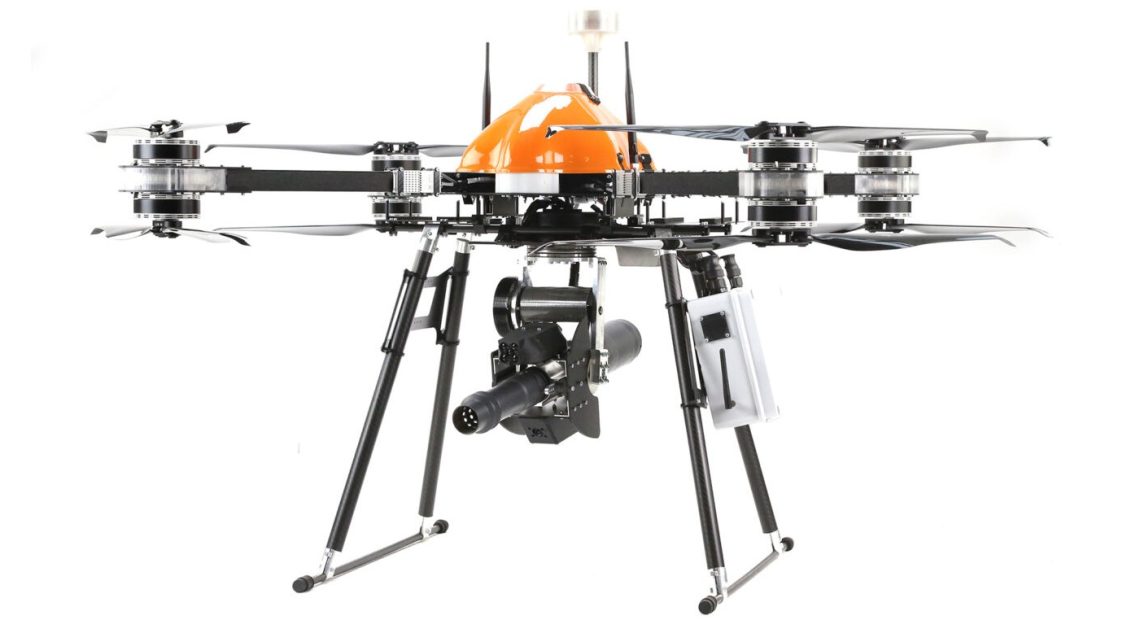
Hero image: File image of a military anti-mine & IED disruptor drone manufactured by Axis Aerospace. Credit: Axis Aerospace