As investment models shift
A three-day global summit in Vienna concluded recently with the signing of the Vienna Conference Consensus, a new international agreement aimed at closing the gap in artificial intelligence (AI) development between wealthy nations and the Global South.
The consensus, endorsed by representatives from over 80 countries, outlines investment principles and governance frameworks to foster AI growth in developing economies.
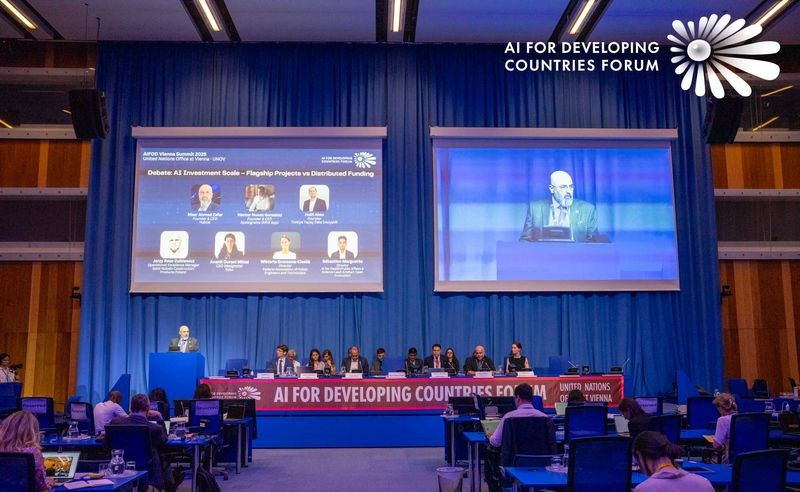
Held at the United Nations Office in Vienna, Austria, the AI for Developing Countries Forum (AIFOD) Summit brought together senior officials, investors, and policy experts to examine how countries with limited digital infrastructure can benefit from AI technologies without ceding control to foreign entities or exacerbating existing inequalities.
Funding disparities
Opening the summit, AIFOD Founder Tianze Zhang highlighted a stark funding imbalance in global AI investment. “While the United States invested $470.9 billion in AI development in 2025, developing countries received less than 1% of global AI funding,” Zhang said.
He argued that future market growth lies in the Global South, not in saturated North American or European markets.
Zhang cited data showing rapid annual AI market growth in Brazil (28.6%), India (34.4%), and Indonesia (28.7%), compared to under 20% in the United States and Canada. He said these trends indicate untapped scalability, particularly in sectors like agriculture and digital finance.
Globally, 570 million smallholder farms and over one billion unbanked individuals represent significant entry points for AI deployment, according to the World Bank and the UN Food and Agriculture Organisation.
Middle East and African delegates echoed concerns over the region’s exclusion from key investment flows. The International Telecommunication Union reports that around 43% of people in Sub-Saharan Africa remain offline, with digital divides growing between urban and rural communities.
Strategic debates
Throughout the summit, discussions centred on whether developing countries should focus limited resources on digital infrastructure or invest in application-level technologies using existing networks. Advocates of infrastructure expansion argued that “without robust digital infrastructure, AI applications are castles in the air,” while others maintained that immediate gains were possible through adaptable, low-connectivity solutions.
Sessions explored the trade-offs between local innovation and foreign technology transfer. Some argued that building homegrown capacity ensured long-term sovereignty, while others pushed for adopting proven systems that could be scaled quickly. In one debate, panellists discussed whether to prioritise flagship national AI centres or fund distributed, grassroots-level initiatives.
Speakers from Nigeria, Vietnam, and Colombia shared examples of successful blended finance strategies, in which public capital was used to reduce risk for private investors. Nigeria’s $350 million public grant programme for off-grid solar projects was cited as a model that could be adapted for digital infrastructure and AI.
Public-private frameworks
Case studies such as the Philippines’ AI public-private partnership model were presented as practical roadmaps. Congressman Brian Poe Llamanzares explained how his country balanced private-sector participation with state control of sensitive infrastructure, offering a potential template for nations in Africa and the Middle East.
In another session, Slovakia’s flexible governance approach was praised for allowing small states to lead in AI policy design. Tajikistan, representing landlocked developing countries, emphasised the importance of regional cooperation to reduce reliance on external digital pathways.
Andrea A. Jacobs of Antigua and Barbuda addressed AI investment challenges facing small island states. She explained that geographic isolation made open-source AI frameworks more appealing than proprietary systems due to their lower costs and greater accessibility.
Policy tools
The AIFOD summit introduced several tools to help developing nations begin implementing the principles outlined in the Vienna Consensus. These included new evaluation metrics for patient capital — investment strategies with longer horizons and impact-based returns — and the AIFOD FAIR Standards, designed to ensure ethical deployment and data governance.
Specialised tracks focused on sectors such as justice, education, and employment. In Papua New Guinea, the national ombudsman shared how AI was being tested to manage services across 10 million people and thousands of islands. In Ethiopia and Ghana, UNIDO presented industrial use cases where AI was supporting leather and rice producers, respectively.
Evening sessions explored workforce development, with calls for AI-powered skills mapping in partnership with local governments. Delegates also examined how to strengthen national AI ecosystems through policies, talent development, and interoperability standards.
Regional sovereignty
A recurring theme was digital sovereignty. Panellists warned that adopting AI technologies must not come at the cost of ceding data or decision-making authority. The final day’s session, “Building Digital Sovereignty Through Cooperation,” outlined how regional collaboration can offer countries more negotiating power with global tech firms while still maintaining national autonomy.
Legal experts have proposed regulatory frameworks that sit between heavy-handed restrictions and open-ended deregulation, aiming to strike a balance between innovation and public interest.
Speakers from India and several African nations described how international partnerships could enable locally controlled AI solutions. Open-source development models were positioned as a viable alternative to proprietary technologies, particularly in resource-constrained settings.
Next steps
The Vienna Conference Consensus now serves as a starting point for implementation. It includes guidance on structuring investment partnerships, evaluating AI’s long-term impact beyond short-term profit, and aligning private capital with public goals. The consensus also encourages regional coalitions to pool technical and policy resources.
The forum concluded with the announcement that the 2026 AIFOD summit will build upon the Vienna framework, focusing on cross-border AI infrastructure and South-South cooperation.
Middle East and African countries are expected to play a larger role in next year’s summit. The UAE, Egypt, Kenya, and Saudi Arabia are among the nations developing national AI strategies to achieve sustainable development goals.
Hero image: The AIFOD Summit explored how countries with limited digital infrastructure can leverage AI technologies without compromising control or exacerbating existing inequalities. Credit: AIFOD