
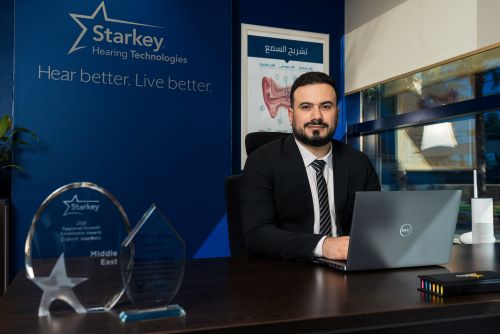
Starkey, a global leader in hearing technology, is urging parents, schools and healthcare providers across the UAE to treat a hearing check as a standard part of the back-to-school health routine, alongside vision and dental checks. The call comes as UAE schools prepare to reopen for the 2026-2027 academic year on 31 August.
In March 2026, the World Health Organization devoted World Hearing Day to childhood hearing under the theme “From communities to classrooms: hearing care for all children”. WHO urged governments and partners across the health and education sectors to promote good ear and hearing practices within school health programmes, to integrate ear and hearing screening into school and community health programmes with clear referral pathways, and to equip teachers, parents and health workers with accurate information and practical tools.
The scale WHO described is significant. More than 95 million children and adolescents aged 5 to 19 worldwide live with unaddressed hearing loss and without access to the services they need. WHO estimates that close to 60 per cent of ear and hearing problems could be prevented or treated at local health clinics with trained staff and the right equipment, medicines and devices — yet more than 80 per cent of people who need ear and hearing care do not receive it.
The UAE begins from a position of strength. Newborn hearing screening is a mandated element of the national newborn screening programme, delivered through a unified network of government and private hospitals under the Ministry of Health and Prevention and governed by the UAE Cabinet Resolution on newborn medical screening, which sets standard protocols for hearing screening. MoHAP further strengthened the programme during 2025 to align it with approved national standards under federal health legislation.
“Every baby born in this country has their hearing screened, and the UAE deserves real credit for that,” said Moayad Zalloom, Audiologist and Commercial Sales Manager, Starkey MEA. “But a newborn screening is a snapshot of the first days of life. Glue ear, repeated middle ear infections, noise exposure and late-onset hearing loss all arrive long after the maternity ward. The World Health Organization spent World Hearing Day this year asking countries to bring hearing screening into schools. The UAE already has the clinical infrastructure to do it.”
WHO’s own guidance identifies pre-school and school-age children among the groups requiring systematic screening for hearing loss, and the organisation now publishes a dedicated implementation handbook on vision and hearing screening for school-age children. WHO has also announced WHOears, a free mobile application intended to let trained individuals carry out hearing screening for children in schools and community settings, extending reach beyond clinics.
Starkey MEA said the case for a school-age checkpoint is reinforced by how childhood hearing loss presents. Children with mild or single-sided hearing loss rarely report a hearing problem – they compensate, and the difficulty surfaces instead as inattentiveness, reluctance to participate, fatigue by mid-morning, weaker performance in languages, or behaviour that is read as disruptive. In the UAE’s multilingual classrooms, those signals are easily misattributed. WHO notes that untreated hearing loss can delay speech and language development, hinder cognitive growth and limit social interaction, leading to poorer educational outcomes and reduced employment prospects later in life.
“We see children referred to us after two or three years of being labelled distracted or slow, and the finding is a straightforward, treatable hearing issue,” added Moayad. “That is years of lost ground for the sake of a test that takes minutes. Parents do not need to wait for a policy to change. They can ask for the test themselves, this month.”
Starkey is encouraging families and schools across the UAE to adopt four practical steps at the start of the academic year: include a hearing check in the annual school medical rather than waiting for a concern to be raised; ask specifically for a hearing test rather than relying on a question on an intake form; arrange a follow-up check after any episode of ear infection or fluid in the ear; and take seriously the everyday signs – a child turning up the volume, asking for things to be repeated, struggling in noisy settings, or mishearing similar-sounding words.
Starkey Middle East and Africa will continue working with audiologists, clinics, schools and health partners across the UAE to raise awareness of paediatric hearing health and to support earlier identification, so that fewer children begin the school year at a disadvantage that could have been found in a few minutes.