Photo Credit : WAM
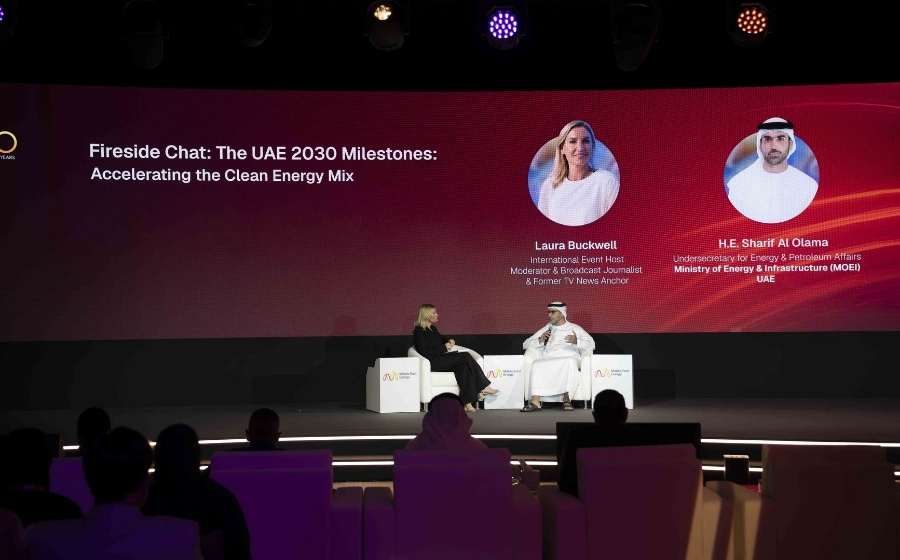
The UAE is continuing to build a cleaner, smarter and more resilient energy system while maintaining a balanced focus on energy security, affordability and economic growth, according to Eng. Sharif Al Olama, Undersecretary for Energy and Petroleum Affairs at the Ministry of Energy and Infrastructure.
Speaking at the 50th Middle East Energy during a session titled “The UAE 2030 Milestones: Accelerating the Clean Energy Mix,” Al Olama outlined the country’s progress toward its clean energy ambitions and highlighted the importance of combining climate action with reliable and affordable energy supplies.
He said the UAE’s energy strategy goes beyond increasing generation capacity and is focused on developing an energy system that is more efficient, resilient and capable of supporting long-term economic expansion.
Energy, he noted, plays a central role in supporting industry, technology, mobility and national competitiveness. Rising electricity demand, rapid technological development and the expanding use of artificial intelligence are also creating new requirements for energy infrastructure.
Al Olama said future energy systems must be able to support the growth of data centres, electrification, advanced mobility solutions and industrial development.
The UAE has expanded its clean energy portfolio through major investments in solar power, the Barakah Nuclear Energy Plant, battery storage, electricity grid infrastructure and emerging energy technologies.
He also highlighted the UAE’s round-the-clock renewable energy project, which combines solar generation with large-scale battery storage to provide continuous clean electricity.
Energy efficiency remains another major priority for the country, Al Olama said, pointing to its ability to reduce operating costs, enhance energy security, ease pressure on electricity networks and improve industrial productivity.
Greater efficiency can also help meet rising energy demand while limiting the need for unnecessary investment in additional generation capacity.
During the discussion, Al Olama highlighted the Global Energy Efficiency Alliance, launched by the UAE to help turn global energy-efficiency commitments into practical projects and measurable results.
The initiative brings together governments, technology companies, industry stakeholders and financial institutions to connect energy-efficiency opportunities with the expertise, technology and financing required to make projects commercially viable and scalable.
Al Olama said many of the technologies and funding sources needed to improve energy efficiency are already available, but stronger coordination between stakeholders remains necessary.
“The technology exists. The capital exists. The demand exists. What is often missing is the bridge between them,” he said.
He also called for deeper cooperation across the energy sector, noting that governments have a key role in developing supportive policies and regulations, while the private sector can drive technology and innovation and financial institutions can provide the capital needed to expand successful solutions.
“The next phase of the global energy transition will not be judged only by targets announced. It will be judged by projects delivered, systems modernised, demand reduced and investment mobilised,” Al Olama said.
He reaffirmed the UAE’s commitment to investing in clean energy, improving energy efficiency, modernising infrastructure and advancing innovation through international partnerships.
“The future of energy will not be shaped by those who wait for change. It will be shaped by those who have the courage to lead it,” he concluded.