

Amid soaring demand
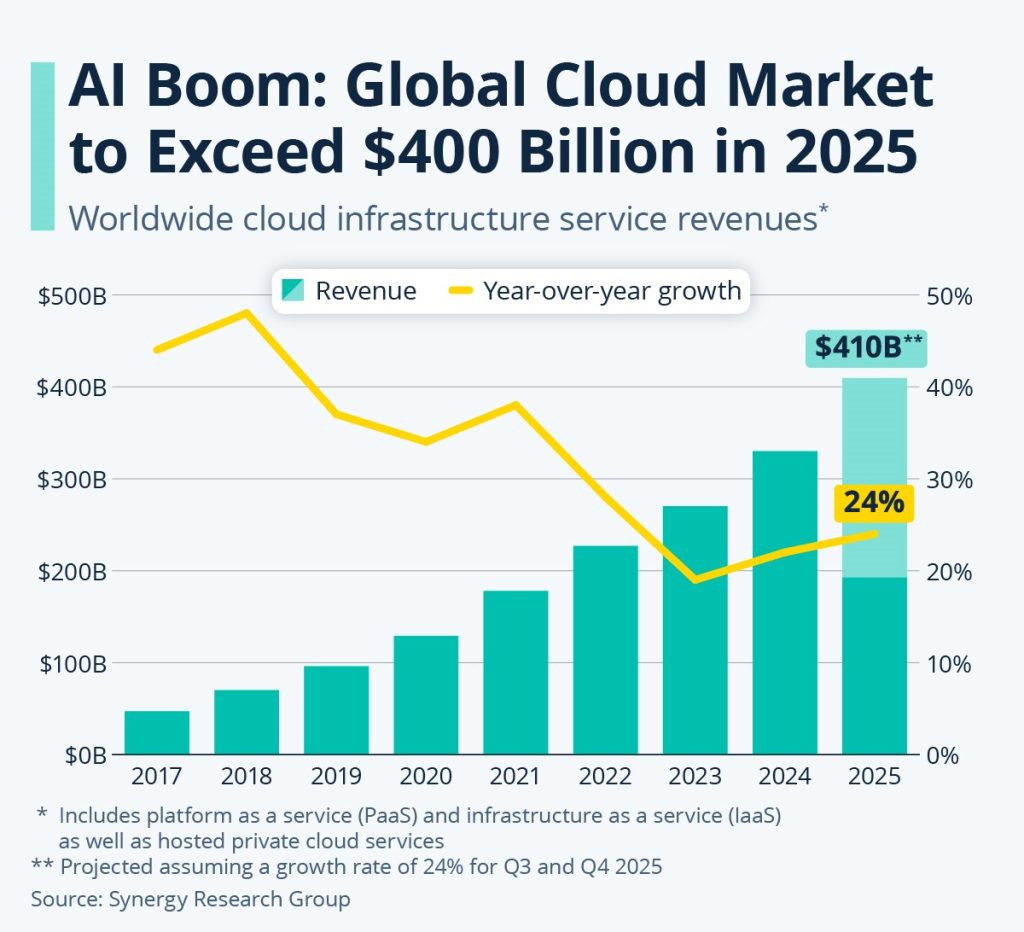
The global cloud infrastructure market is on track to exceed $400 billion in revenue by the end of 2025, driven by surging demand for generative artificial intelligence services and broader enterprise digital transformation. The sharp rise marks a notable acceleration in one of the world’s most lucrative technology sectors.
New data from Synergy Research Group shows cloud infrastructure service revenues climbed to $330 billion in 2024, rising from less than $50 billion in 2017.
Market growth had started to slow in recent years, falling below 20 per cent in 2023. But the explosion in AI-driven computing requirements, especially around generative AI models, has reignited expansion.
In the first six months of 2025, global cloud revenue grew nearly 25 per cent year-on-year. That pace sets the stage for the market to comfortably surpass the $400 billion milestone this year—positioning cloud as a cornerstone of the global digital economy.
John Dinsdale, Chief Analyst at Synergy Research Group, said GenAI has transformed what was already a large and high-growth market.
“Despite being on the verge of becoming a hundred-billion-dollar-per-quarter market, cloud revenues are still growing by around 25 per cent per year, and we are forecasting that average annual growth over the next five years will remain above 20 per cent,” Dinsdale said.
Regional Impact
In the oil-rich and affluent Arabian Gulf, where nations like the United Arab Emirates and Saudi Arabia are investing heavily in AI and smart city infrastructure, the cloud market’s momentum is expected to have a significant regional impact.
The UAE’s ambition to become a hub for AI and emerging technologies is likely to fuel demand for scalable cloud services in both the public and private sectors.
According to a report from International Data Corporation (IDC), cloud spending in the Middle East and Africa region is projected to exceed $7.5 billion in 2025, a 20 per cent increase over the previous year.
The UAE alone is expected to contribute a sizeable portion, as local governments push for digital transformation aligned with national visions such as UAE Vision 2031.
Despite continued efforts by regional players to grow their share, the global cloud landscape remains dominated by the three largest providers: Amazon Web Services (AWS), Microsoft Azure, and Google Cloud. These Big Three’ firms accounted for more than 60 per cent of global cloud infrastructure revenues in the second quarter of 2025.
AWS retained the top position with a 30 per cent global market share, translating to over $100 billion in revenue annually. Microsoft Azure followed with 20 per cent, while Google Cloud held 13 per cent. The remaining providers collectively struggle to break into double-digit territory.
High margins
The profitability of cloud services remains a key factor for investors. In 2024, AWS generated $40 billion in operating profit—around 60 per cent of Amazon’s total operating earnings—highlighting the high-margin nature of the cloud business.

This level of profitability continues to attract investment and competition, even as barriers to entry remain high due to the capital-intensive infrastructure required.
Synergy Research noted that global spending on cloud infrastructure services reached $99 billion in Q2 2025, marking a $20 billion increase from the same period a year earlier. The quarterly growth reflects rising enterprise workloads, demand for large-scale AI training and inference models, and expansion of edge computing.
Dinsdale noted a significant spike in spending on GenAI-specific cloud services during the quarter. “In Q2, we saw growth of 140–180 per cent in GenAI-specific cloud services, and AI is also contributing to enhancements and added growth across the broader portfolio of cloud services.”
Market outlook
Despite its scale, the cloud sector remains one of the fastest-growing segments in global tech, underpinned by structural demand for remote computing, data storage, and AI integration. As enterprises in Europe, Asia, Africa, and the Middle East adapt to AI requirements, cloud infrastructure will continue to serve as the backbone of their digital ecosystems.
In the UAE and across the Gulf Cooperation Council region, national cloud strategies and sovereign data regulations are expected to shape the local market. Government partnerships with leading global cloud providers may also expand, particularly in sectors such as health, education, and energy.
With AI usage accelerating and cloud-native solutions increasingly embedded in digital services, analysts expect continued growth well into the next decade, reaffirming the cloud sector’s critical role in the global technology supply chain.
Hero image: In the first six months of 2025, global cloud revenue grew nearly 25 per cent year-on-year. Credit: Nvidia