Regent Craft unveils defence line
Regent Craft, a US-based aerospace firm, has launched a military-focused division called Regent Defense to manufacture high-speed, low-signature maritime vessels aimed at strengthening American defence operations in the Indo-Pacific region. The announcement was made at the Reindustrialize Summit in Detroit.
The company’s Seaglider vessels, initially designed for commercial transport, will now include a defence line tailored for military missions such as logistics, surveillance, and rescue.
Production will take place at Regent’s facility in Rhode Island to support US and allied efforts to deter China’s increasing maritime presence in contested waters.
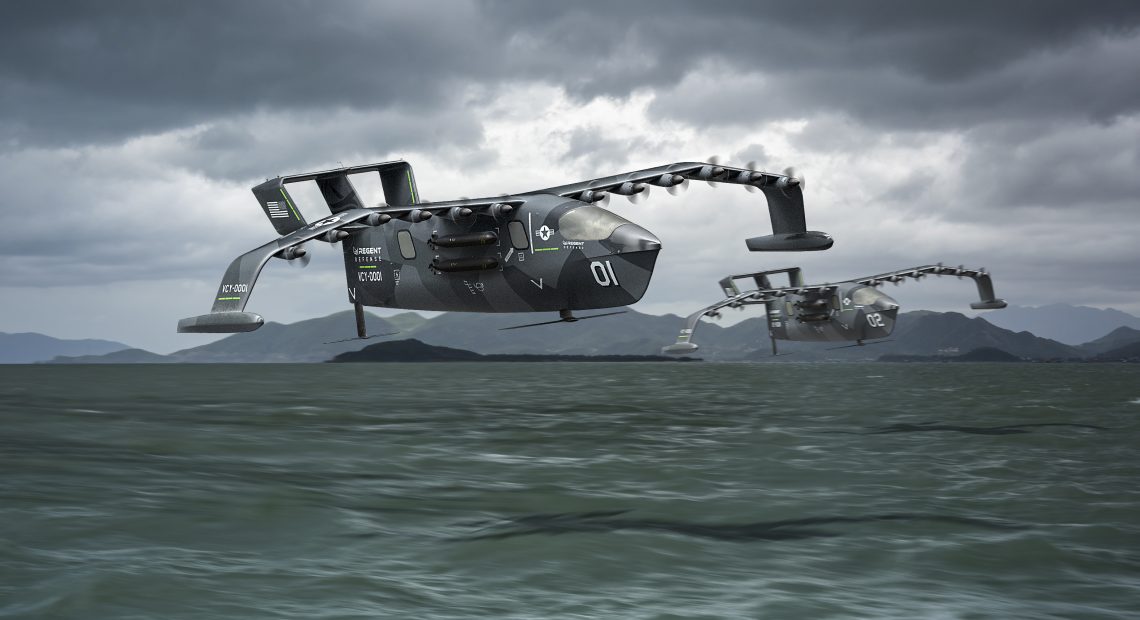
Regent’s Seaglider is a wing-in-ground effect craft, designed to fly just above the water’s surface using aerodynamic lift. The design allows it to avoid radar detection and sonar tracking, making it suitable for operations in littoral zones — coastal waters where conventional military logistics are often hindered by distance and terrain.
Billy Thalheimer, CEO of Regent Craft, said Regent intends to deliver “an urgently needed mobility solution that gives the US and our allies a strategic edge”.
Regent reports that its Seaglider design provides a cost-effective alternative to legacy transport platforms, offering greater speed and operational range. The vessels, built with hydrofoiling technology, are designed to stay within a few metres of the water’s surface, allowing them to remain below radar while cruising at speeds up to 160 knots (around 296 km/h).
The Viceroy model, now developed in both electric and hybrid versions, is capable of carrying up to 1,590 kg over distances of 1,400 nautical miles in the hybrid variant. A smaller, autonomous version known as the Squire can carry 22 kg and reach speeds of 70 knots for more than 100 nautical miles.
Multiple missions
Regent has stated that the new defence-focused vessels are intended for multiple missions, including troop and supply transport, medical evacuations, surveillance, and the deployment of uncrewed systems. Tom Huntley, General Manager of Regent Defense, said the platform offers a low-cost and scalable approach to supporting military readiness.
The announcement follows growing interest from US military branches. Earlier this year, Regent expanded a contract with the US Marine Corps Warfighting Lab, securing $10 million to explore how the vessels could support distributed maritime operations. The US Marine Corps is shifting towards more agile strategies to meet the challenges posed by long-range operations in regions such as the South China Sea.
Regent is also working with US Special Operations Command and the US Coast Guard Research and Development Center to explore new applications of the technology.
The US military’s interest in Seaglider platforms comes amid ongoing tensions in the Indo-Pacific. The US and regional allies, including Japan and Australia, have increased defence cooperation in response to China’s rapid naval expansion and assertive actions in the South and East China Seas.
According to the Stockholm International Peace Research Institute, China has nearly doubled its naval ship numbers over the past decade and continues to outpace the US in shipbuilding capacity.
For Gulf states and regional navies in the Middle East, the Seaglider platform could offer insights into future maritime mobility. Countries like the UAE and Saudi Arabia have increasingly focused on developing naval capabilities, particularly for littoral security and uncrewed operations.
Regent’s hybrid and autonomous designs could prove relevant as regional navies seek modern solutions for defending economic waters, safeguarding maritime trade routes, and responding to asymmetric threats in the Red Sea and Arabian Gulf.
Regent says it holds a $10 billion commercial backlog and has raised over $100 million from global investors, including Japan Airlines and Lockheed Martin. Though the firm is currently focused on US defence applications, wider international interest could follow as militaries seek cost-effective, flexible options to enhance maritime domain awareness and response capacity.
As global navies shift toward distributed and technologically advanced operations, the introduction of new vessel classes such as the Seaglider highlights the growing importance of speed, stealth, and automation in shaping future maritime strategy.
Image: Regent Craft’s new defence-focused vessels are intended for multiple missions, including troop and supply transport, medical evacuations, surveillance, and the deployment of uncrewed systems. Credit: Regent Craft