

Bid to localise supply chains
Apple has announced a significant expansion of its operations in the United States, pledging an additional $100 billion, which brings its total US investment commitment to $600 billion over four years.
The initiative is part of a broader strategy to localise supply chains, boost advanced manufacturing, and strengthen America’s position in the global semiconductor and artificial intelligence sectors.
Apple CEO Tim Cook revealed the announcement in the Oval Office at the White House, alongside US President Donald Trump, on August 6, 2025.
The centrepiece of Apple’s expansion programme is the new American Manufacturing Program (AMP), which aims to boost domestic production of critical components used in Apple devices. The programme is expected to deepen the company’s involvement with major suppliers across the US and create a stronger, end-to-end technology supply chain rooted in American soil.
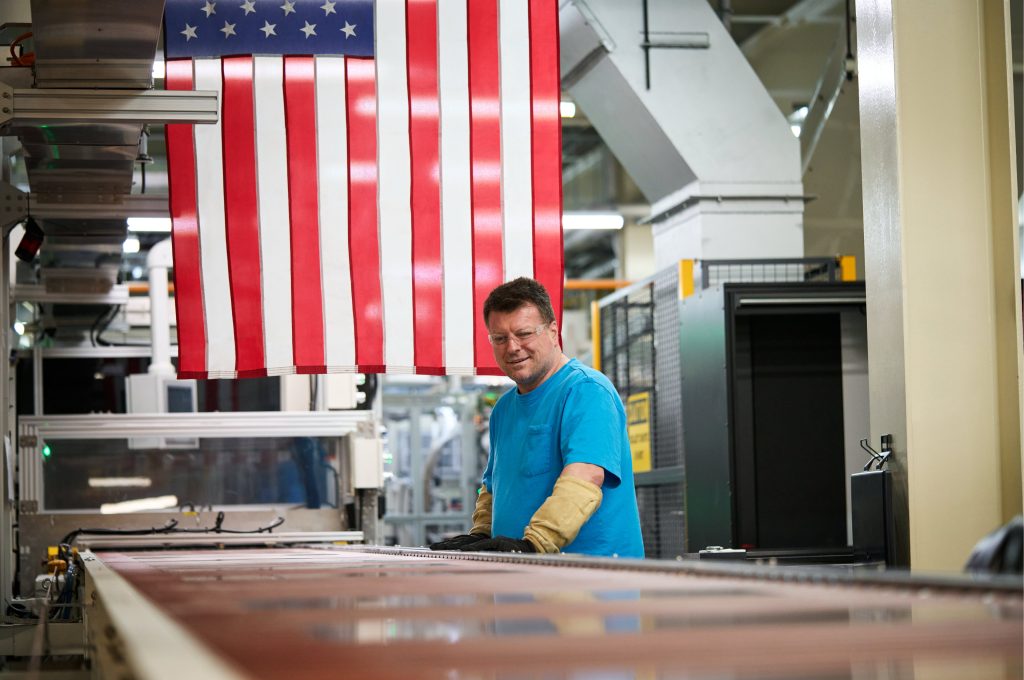
The decision comes amid intensifying competition between the US and China in high-tech industries, particularly around semiconductors, artificial intelligence, and critical minerals. Apple’s announcement follows Washington’s recent push to reduce reliance on foreign supply chains and invest more heavily in domestic chip manufacturing under the CHIPS and Science Act.
The AMP will involve new or expanded collaborations with firms such as Corning, Coherent, GlobalWafers America, Applied Materials, Texas Instruments, Samsung, GlobalFoundries, Amkor, Broadcom, and MP Materials.
Partnerships’ benefits
In a statement, Apple said these partnerships would contribute to key components used in the iPhone, iPad, and Apple Watch, and would support its efforts in AI computing and cloud infrastructure.
Apple’s suppliers currently operate in all 50 US states and support over 450,000 jobs, according to the company. It also plans to hire 20,000 new workers over the next four years, with roles focused on research and development, silicon engineering, AI, and machine learning.

The company’s strategy also has implications beyond the United States. Roughly two-thirds of Apple’s US-manufactured components are exported, underlining the international relevance of the new programme.
For Middle Eastern economies increasingly focused on advanced manufacturing and digital transformation, Apple’s reshoring strategy could prompt similar moves in strategic sectors such as chip fabrication, server infrastructure, and AI deployment.
In Kentucky, Apple and long-time partner Corning will expand operations at the Harrodsburg facility, home to the world’s largest smartphone glass production line. This facility will supply cover glass for all iPhones and Apple Watches globally. An innovation centre in the state will also support research and development.
Texas is emerging as a critical hub. At Coherent’s facility in Sherman, Apple is extending its sourcing of VCSEL lasers used in Face ID technology. Meanwhile, MP Materials, the only vertically integrated rare earth producer in the US, is expanding operations at its Independence site in Fort Worth. A new recycling line will also be developed in California to process rare earth materials, which are essential for electronic components and defence applications.
US focus
Apple is also accelerating plans to establish a complete US-based silicon supply chain. The initiative involves close work with chipmakers, equipment suppliers, and testing facilities.
In Arizona, the Taiwan Semiconductor Manufacturing Company (TSMC) is producing chips for Apple using advanced process nodes. TSMC’s Phoenix site, built with significant subsidies from the US government, is considered a flagship project in the Biden administration’s semiconductor policy. Apple is TSMC’s first and largest customer in the United States.


In Texas, GlobalWafers America will supply 300mm silicon wafers for use in domestic chip fabs. These wafers are produced from US-sourced silicon, including from Hemlock Semiconductor. Apple is also collaborating with Applied Materials in Austin to increase the domestic production of semiconductor manufacturing tools.
Texas Instruments is expanding two facilities—in Lehi, Utah, and Sherman, Texas—to handle more of Apple’s chip production needs. These fabs will use GlobalWafers’ silicon and tools built by Applied Materials to manufacture essential semiconductors.
Samsung is contributing to the AMP by developing a new chipmaking technology at its Austin site. Apple will be the primary customer for this technology, which has not yet been deployed commercially elsewhere.
Chips’ production
Apple and GlobalFoundries are working together to boost US production of chips related to wireless connectivity and power management. The collaboration is expected to bring new technical capabilities to the GlobalFoundries facility in Malta, New York.
In Arizona, Apple is funding a new Amkor facility for advanced chip packaging and testing. The site will process Apple silicon manufactured at the nearby TSMC fab and prepare it for global distribution.

Apple is also expanding its work with Broadcom to develop cellular components in the US, particularly for 5G technology—a key priority in emerging markets and a focus area for Gulf states investing in next-generation infrastructure.
The company’s server infrastructure is also shifting. A new 250,000-square-foot facility in Houston recently completed its first test unit. The site will begin mass production in 2026 and will produce servers supporting Apple Intelligence, the company’s private cloud-based AI system. This marks a shift away from overseas manufacturing of critical backend technologies.
In Detroit, Apple is launching the Apple Manufacturing Academy to provide training and resources to small and mid-sized manufacturers. The academy is scheduled to open on 19 August.
Meanwhile, in North Carolina, Apple is expanding its data centre in Maiden. The site, already powered by 100% renewable energy, supports iCloud, Apple Music, iMessage, and other services. Additional facilities are under construction in Iowa, Nevada, and Oregon.

The company said the expansions would strengthen the capacity of Apple Intelligence, its new AI platform that will power a wide range of applications and services. The broader shift in manufacturing may also have implications for global supply chains, particularly in Asia, which has traditionally been the heart of Apple’s production network.
Global demand for semiconductors is projected to exceed $1.1 trillion by 2030, according to estimates from McKinsey & Company.
In the Middle East, countries such as the UAE and Saudi Arabia have outlined ambitions to become regional semiconductor and AI hubs. Apple’s reorientation may create gaps in global supply networks that regional players could seek to fill through partnerships or new investments.
Apple’s renewed focus on US manufacturing comes amid broader scrutiny of technology supply chains and a global push for greater economic resilience. With chip shortages, geopolitical tensions, and the rise of AI reshaping industrial policy worldwide, Apple’s latest move highlights the growing strategic importance of domestic production.
Hero image: Apple CEO Tim Cook looks on as US President Donald Trump speaks in the Oval Office at the White House on August 6, 2025. Credit: White House