
Citing national security concerns
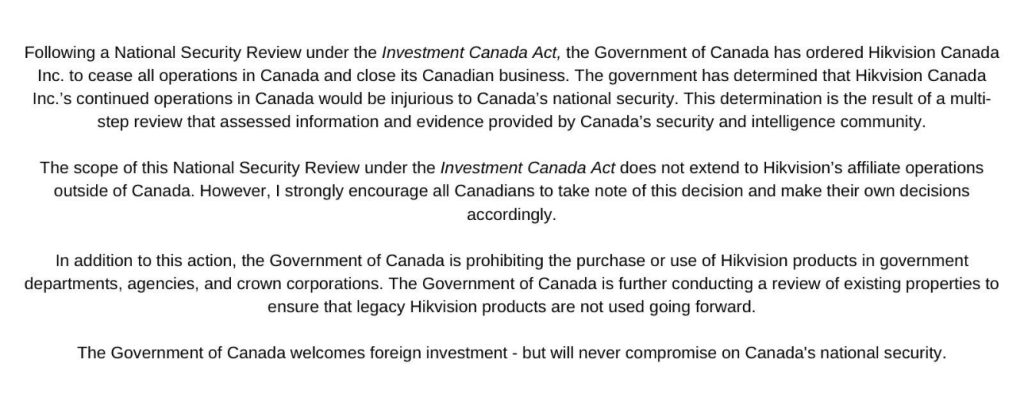
The Canadian government has directed Chinese surveillance camera maker Hikvision to cease all operations in Canada, citing national security concerns, according to Canada’s Industry Minister Mélanie Joly.
Joly, in a post on X late last week, stated that the order followed a “multi-step review” under the Investment Canada Act, which examined material from the security and intelligence community.
It concluded that allowing Hikvision Canada to continue would be “injurious to Canada’s national security”. Joly said the decision does not affect the company’s activities elsewhere, but urged Canadians to consider the implications when using its products.
Hikvision is a Chinese state-affiliated technology firm and one of the world’s largest manufacturers of video surveillance equipment. Founded in 2001, the company provides security solutions powered by AI and IoT for civilian, industrial, and military uses. The company supplies surveillance systems to various state-owned entities across China.
Hikvision, formerly Hangzhou Hikvision Digital Technology Co, said it “strongly disagrees” with the Canadian government’s decision. A company spokesperson criticised the ban as lacking a factual basis and transparency, attributing it to “broader geopolitical tensions and an unjustified bias against Chinese companies”.
The firm stated that it has fully cooperated, providing documentation in response to the review. It criticised the decision for disregarding the cybersecurity merits of its technology.
Critics argue that Ottawa has not detailed the precise threats. Hikvision and the Chinese embassy claim that Ottawa has overextended its state security measures and failed to provide evidence supporting the decision.
Earlier this month, Ottawa also banned the purchase of Hikvision equipment by federal departments. It has begun reviewing federal installations to identify and remove legacy products.
Hikvision has faced sustained scrutiny abroad, including from the United States, Europe, the United Kingdom and Australia. The firm has been accused of supplying surveillance systems used to monitor Uyghur Muslims in China’s Xinjiang region, prompting sanctions by Western governments.
Rights groups have documented the use of Hikvision cameras in Xinjiang detention camps and at mosques. Canadian intelligence had previously flagged the risk of espionage through such equipment.
The Chinese embassy in Ottawa criticised Canada’s move, saying it “seriously damages the legitimate rights and interests of Chinese enterprises and disrupts normal economic and trade cooperation,” according to the Globe Times. It urged Canada to avoid politicising economic issues and promised China would “take all necessary measures to safeguard” the rights of its companies resolutely.
From a Middle East perspective, Canada’s decision reflects broader global efforts to restrict Chinese technology amid strategic competition. Governments in the Gulf have become increasingly cautious about foreign surveillance systems, citing concerns over data protection and security.
In Canada, the announcement follows a Quebec provincial ban announced late last year targeting Hikvision and other Chinese suppliers. Provincial security concerns have resurfaced in light of national reviews. Analysts note that this deepens the divide between national policy and local procurement practices, which are often rooted in cost and convenience.
The tech industry sees potential for North American and European surveillance firms to expand their operations in these regions. Ottawa’s move may accelerate procurement shifts toward “trusted tech” companies that meet rigorous cybersecurity standards.
The Canadian government has signalled openness to alternatives, framing them as safer for critical infrastructure.
Image: Ottawa also banned the purchase of Hikvision equipment by federal departments earlier this month. Credit: Maicon Vinicius