

Law enforcement capacity lags
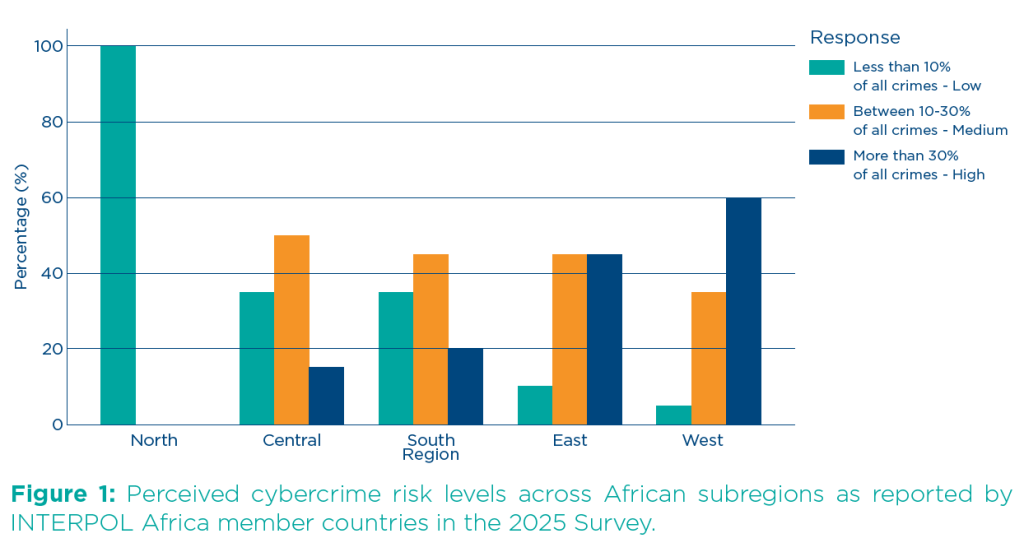
Cybercrime has emerged as one of the most prevalent forms of criminal activity in parts of Africa, accounting for over 30 per cent of all reported crimes in Western and Eastern regions, according to Interpol’s latest Africa Cyberthreat Assessment.
The 2025 report, based on surveys and operational data from Interpol member states, indicates that two-thirds of African countries view cybercrime as a medium to high share of their overall criminal caseload. Online scams, ransomware, business email compromise (BEC) and digital sextortion are the most reported threats.
Phishing-related scams were the most frequent, while ransomware infections surged across several states. South Africa and Egypt recorded the highest detections in 2024, followed by Nigeria and Kenya.
The attacks have included breaches of government bodies such as Kenya’s Urban Roads Authority and Nigeria’s National Bureau of Statistics.
BEC schemes continue to generate significant financial losses. Eleven countries were identified as the primary sources of BEC attacks, with criminal syndicates in West Africa operating complex, transnational fraud operations. One such group, Black Axe, has been linked to multimillion-dollar scams targeting individuals and companies worldwide.
Blackmail attempts
Cases of digital sextortion are also rising. Sixty per cent of countries reported increases in blackmail attempts involving sexually explicit images, which may be real or artificially generated. These are often shared voluntarily or obtained through deception, coercion or hacking.
Interpol’s report reveals that law enforcement capacity is lagging behind the rise in cybercrime.

Seventy-five per cent of countries say their legal and prosecutorial frameworks are insufficient. A further 95 per cent report limited access to resources, inadequate training and a lack of specialised tools to investigate and prosecute cyber offences.
Basic digital crime-fighting infrastructure is still absent in most parts of the continent. Only 30 per cent of countries have formal incident reporting systems. Less than one-third have repositories for digital evidence or cyberthreat intelligence databases.
Cross-border cooperation remains a significant gap. Eighty-six per cent of African member states cite weak international coordination due to slow legal processes and a lack of access to operational platforms or data hosted outside their jurisdictions.
Despite the transnational nature of many cyber offences, countries report difficulty in tracking and prosecuting suspects across borders.
The private sector is viewed as an essential partner in addressing cyber threats. However, most African countries report low levels of collaboration with technology companies and cybersecurity firms.
Nearly nine in ten respondents said their partnerships with private entities require significant or some improvement due to unclear procedures, limited institutional readiness and fragmented engagement.
Despite the challenges, Interpol reports progress. Several countries have revised their legislation to meet international cybersecurity standards. Some have established dedicated cybercrime units and invested in digital forensics capabilities.
Recent law enforcement operations demonstrate these gains. Operation Serengeti and Operation Red Card, both coordinated by Interpol, resulted in more than 1,000 arrests and the takedown of hundreds of thousands of malicious networks across multiple jurisdictions.
To build further resilience, the report outlines six strategic recommendations. These include increasing regional and international collaboration, raising public awareness and adopting emerging technologies to detect and disrupt cyber threats more effectively.
The Africa Cyberthreat Assessment forms part of Interpol’s Africa Joint Operation against Cybercrime (AFJOC) initiative, which is supported by the UK’s Foreign, Commonwealth and Development Office. The project aims to enhance the capacity of African law enforcement to combat cyber threats through training, partnerships and intelligence sharing.
The report draws on inputs from Interpol’s African member countries and industry partners, including Kaspersky, Trend Micro, Group-IB and Bi. Zone.
While the focus is on Africa, the cyber trends outlined in the report are likely to have regional implications for the Middle East, including the Gulf, where digital and financial links with African states continue to grow.
Image: Online scams, ransomware, business email compromise (BEC), and digital sextortion are the most reported threats. Credit: FotoRichter