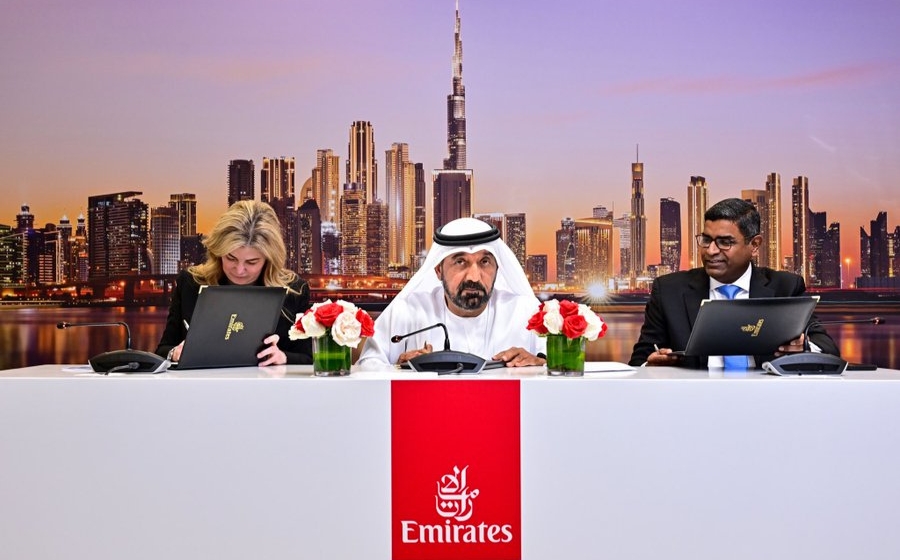
Emirates and ENOC Group have taken a major step toward expanding the use of Sustainable Aviation Fuel in the UAE, signing a Memorandum of Understanding to explore how SAF can be supplied at scale for Emirates flights operating out of Dubai.
The agreement, announced during the Dubai Airshow, brings together the UAE’s largest airline and its primary fuel provider at a time when global carriers are racing to cut emissions and secure access to cleaner fuel sources.
Building a long-term SAF supply chain
Under the MoU, both sides will conduct feasibility studies to determine what is needed to create a consistent, large-scale SAF supply chain in Dubai. The assessment will cover infrastructure requirements, the potential for local production, blending processes, and the commercial framework needed to make long-term supply viable.
A joint steering committee will oversee the project, highlighting the strategic collaboration between two key players in the country’s aviation ecosystem.
Fuel that works with today’s aircraft
Sustainable Aviation Fuel is a certified drop-in alternative that can be used with existing aircraft and airport systems. When unblended, it can cut lifecycle carbon emissions by up to 80 percent. When blended, it can be mixed with conventional jet fuel at ratios of up to 50 percent, making it one of the most practical options available for near-term aviation decarbonisation.
Emirates has been closely involved in national-level SAF initiatives, contributing to the UAE’s General Policy for Sustainable Aviation Fuel, which aims to make the country a regional hub for alternative fuels and targets the production of 700 million litres of SAF by 2030.
Demonstration flights and global procurement
The airline has already completed several milestone flights using SAF. In January 2023, Emirates operated a Boeing 777 test flight with 100 percent SAF in one engine, followed by an A380 demonstration flight using the same configuration in November 2023.
In the same month, Emirates used more than 315,000 gallons of blended SAF on flights departing Dubai International Airport, with the fuel integrated directly into the airport’s supply system.
During the 2024–25 financial year, the airline sourced 7,519 tonnes of SAF across key international hubs including Amsterdam, London Heathrow, Oslo, Singapore, Paris, Lyon and Nice.
The new partnership with ENOC shifts momentum back to Dubai, focusing on the infrastructure and commercial conditions needed to make a domestic SAF supply chain both practical and scalable.