

In high-stakes decision-making
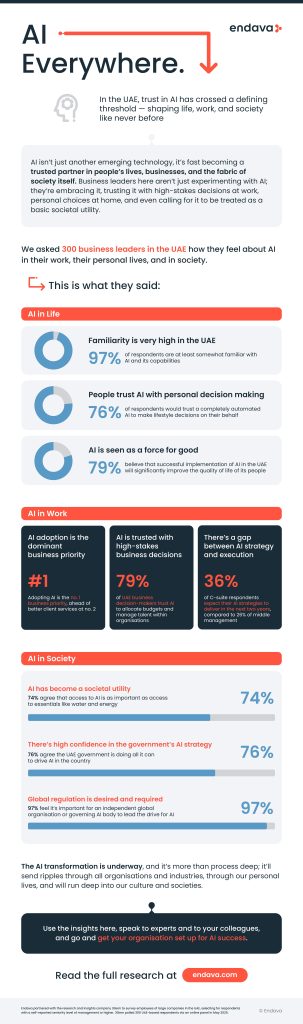
Business leaders in the United Arab Emirates (UAE) are displaying an unprecedented level of trust in artificial intelligence (AI), with the majority confident that AI systems can make crucial decisions that impact their professional lives, according to a new study.
The report also reveals that employees are increasingly willing to let AI take on roles traditionally reserved for human judgment, including salary determinations, hiring recommendations, and health and safety management.
The survey, conducted by London, UK-based technology services provider Endava, found that 79% of the UAE’s business decision-makers trust AI to manage organisational budgets, including those influencing individual compensation.
The same percentage expressed trust in AI for managing talent—covering hiring, performance management, and career progression—while 80% felt comfortable with AI overseeing essential health and safety tasks within their organisations.
This trust in AI extends beyond the professional realm. Notably, 80% of respondents indicated that they would trust fully automated AI systems to make personal decisions, ranging from career advice to financial management. This includes essential choices about salary progression, career shifts, investments, and retirement planning.
The Endava study, conducted in partnership with 3Gem Research & Insights, surveyed 300 business decision-makers from the UAE across various industries. It also highlights the public’s increasing willingness to entrust intelligent systems with significant life decisions, indicating a change in society’s perception of AI’s role beyond the workplace.
The results come as the UAE accelerates its ambitions to become a global frontrunner in AI, with billions of dollars earmarked for AI infrastructure and innovation. The UAE government’s focus on AI adoption seems to resonate with the public, as nearly half (46%) of respondents believe the UAE is ahead of the global curve in AI adoption.
When asked to rank global leaders in AI, the Middle East came in third, trailing only the United States and China.
The findings reveal a broad belief in AI as a driving force for business efficiency and profitability. Among those surveyed, 71% said AI had already had a direct, positive impact on their company’s profits.
The notion that AI could eliminate jobs was also largely dismissed, with nearly three-quarters of decision-makers suggesting that their organisations are either already creating or planning to establish AI-focused roles. Furthermore, 75% believe that effective AI implementation will boost job satisfaction within their teams.

For many organisations, the push towards AI adoption is no longer a matter of debate but a strategic imperative. Over half of those surveyed stated that if their company does not make significant progress in AI deployment, it risks losing market share within the next two years.
In response to this pressure, around 30% of businesses are planning to increase their AI investment in 2025, with many recognising the need to enhance their infrastructure to accommodate the demands of AI-driven operations. However, only a quarter of respondents felt that their current data management systems were fully prepared for enterprise-level AI deployment.
David Boast, Managing Director for the Middle East and North Africa (MENA) at Endava, highlighted the role of trust in facilitating AI adoption. “Trust is the critical enabler of any AI strategy,” Boast said. “The UAE’s youthful, tech-savvy population and digital-first mindset create an environment where businesses can confidently innovate with AI. While other regions remain cautious, the UAE’s workforce is not only ready for AI but actively embracing it.”
Despite the enthusiasm, Boast also emphasised the need for careful implementation of AI. “It’s crucial that organisations focus not only on AI investment but also on responsible implementation. This involves modernising core systems, integrating AI in a way that complements human potential, and prioritising solutions that create measurable outcomes,” Boast added.
“The UAE’s strategy must be focused on extracting impactful AI use cases rather than just following the trend.”
The rise of AI presents both opportunities and challenges. While its potential to drive profitability is clear, the infrastructure readiness and thoughtful integration of AI into organisational processes remain significant hurdles.
Nevertheless, the research suggests a broader transformation in how AI is perceived, not just as a tool for automating tasks, but as an essential partner in decision-making processes that impact both business performance and personal lives.
Hero image: For many organisations, the push towards AI adoption is no longer a matter of debate but a strategic imperative. Credit: The Coach Space