
With Ax-4 mission to ISS
Astronauts from India, Poland and Hungary are set to join the International Space Station (ISS) for the first time in a historic joint mission launching next week, marking each country’s return to human spaceflight after more than four decades.
Axiom Mission 4 (Ax-4), a privately funded flight operated by Axiom Space in partnership with SpaceX, will lift off from NASA’s Kennedy Space Center in Florida on June 10 at 8:22 a.m. local time. It is the fourth private astronaut mission organised by the Houston-based company and the second to include government-sponsored astronauts.
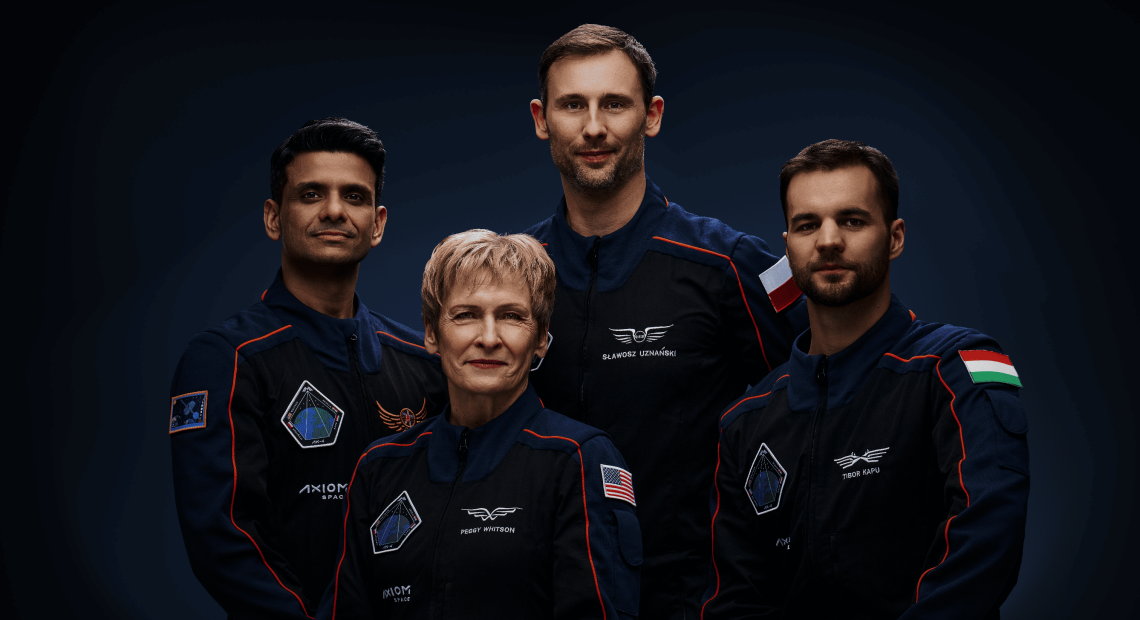
Commanded by former Nasa astronaut Peggy Whitson, the four-person crew includes Shubhanshu Shukla of India, Sławosz Uznański-Wiśniewski of Poland and Tibor Kapu of Hungary. Once launched aboard a SpaceX Falcon 9 rocket, they will travel to the ISS on the Dragon spacecraft and are scheduled to dock with the orbiting laboratory late on June 10.
The mission is a significant milestone for the participating nations. It will be the first time astronauts from India, Poland and Hungary have visited the ISS. All three countries are sending government-sponsored astronauts into space for only the second time in their respective histories, and for the first time since the late Cold War.
Shukla becomes India’s second astronaut after Rakesh Sharma flew in 1984. Uznański-Wiśniewski follows Mirosław Hermaszewski, who represented Poland in 1978, while Kapu is the second Hungarian in orbit since Bertalan Farkas in 1980. The trio’s mission is being closely watched by their national space agencies, which view Ax-4 as a stepping stone for deeper involvement in low-Earth orbit missions.
The Ax-4 crew will spend up to 14 days aboard the ISS, conducting research and outreach activities. According to Axiom Space, the mission includes 60 scientific studies involving 31 countries. It is the most research-intensive flight the company has launched to date. Key experiments will focus on human physiology, Earth observation, biological sciences and materials testing.
Watch the video here:
The scientific programme is led by the United States, India, Hungary and Poland, with additional participation from the United Arab Emirates, Saudi Arabia, Brazil and Nigeria, alongside European nations.
Many of the experiments are backed by national institutions, including the Indian Space Research Organisation (Isro), the Hungarian to Orbit (Hunor) programme and the European Space Agency, which is supporting Uznański-Wiśniewski as a project astronaut.
Speaking during a virtual press briefing from the crew’s quarantine location in Florida, Whitson said the mission goes beyond science.
“With a culturally diverse crew, we’re not only advancing scientific knowledge but also strengthening international cooperation in space,” she said. “We’re expanding access to low-Earth orbit and opening new possibilities for nations that have been absent from human spaceflight for decades.”
Whitson, who holds the US record for cumulative time spent in space at 665 days, will be flying her fourth mission and second as the commander of a commercial spaceflight. She flew three long-duration missions to the ISS with Nasa between 2002 and 2017.
The Ax-4 team will also engage with schools, research centres and the public in their home countries throughout the mission, promoting space science and technology. A key part of their outreach is the introduction of a zero-gravity indicator named “Joy” — a plush baby swan that will float inside the capsule once it reaches orbit.
The crew selected the swan for its cultural symbolism and unity. In India, the swan is associated with wisdom and purity. In Poland, it represents loyalty and resilience. In Hungary, it is a symbol of grace and the beauty of nature. The toy, which will be visible during the live broadcast of the launch, reflects the shared ambitions of three nations returning to space in the same capsule.
“Joy is more than a mascot. It represents our shared journey and aspirations as we rise together into orbit,” said Kapu.
The Ax-4 mission comes as commercial providers like Axiom Space and SpaceX increasingly enable access to space for countries that do not operate their launch vehicles or human-rated spacecraft. With government funding and growing private partnerships, emerging space nations are seeking a foothold in microgravity research and future commercial space stations.
For Axiom, Ax-4 builds on previous missions aimed at establishing a commercial presence in low-Earth orbit. The company plans to attach the first segment of its private space station to the ISS by 2026, to operate an independent orbital platform once the ISS is decommissioned.
Until then, missions like Ax-4 are serving as testbeds for the company’s hardware, training regimes and international collaboration models. As commercial access to orbit expands, analysts say such missions may reshape how space exploration is shared across borders and economies.
With a few days to go before launch, final preparations are underway. The Dragon spacecraft has passed its checks, and the crew will soon enter final quarantine before donning their suits for the mission.
If successful, Ax-4 will represent a turning point not just for India, Poland and Hungary, but for the growing ecosystem of international partners turning to private companies for access to space.
Image: Official portrait of the Ax-4 mission crew (L-R) Shubhanshu Shukla of India, Peggy Whitson of the United States, Sławosz Uznański-Wiśniewski of Poland and Tibor Kapu of Hungary. Credit: Axiom Space